Close Menu
  • Home
  • UNSUBSCRIBE
  • News
  • Lifestyle
  • Tech
  • Entertainment
  • Sports
  • Travel
Facebook X (Twitter) WhatsApp
Trending
  • New robotic heart mimics common, mysterious condition to help researchers study it
  • Canon EOS R6 III review: A wildlife wonder
  • Medieval babies and adults buried together in Sweden were not related, archaeologists discover — raising big questions about early Christian burial practices
  • NASA is creating a fifth state of matter on the ISS, thanks to an upgrade to a mini-fridge-sized quantum lab
  • New sodium metal battery design charges in just 4 minutes and retains its capacity for years
  • Quantum computing wielded to create extremely rare material critical to nuclear fusion
  • Scientists build tiny ‘diving suit’ for cockroaches, turning them into search-and-rescue cyborgs
  • Physicists develop the first working model of quantum mechanics using only ‘real’ numbers
Facebook X (Twitter) WhatsApp
Baynard Media
  • Home
  • UNSUBSCRIBE
  • News
  • Lifestyle
  • Tech
  • Entertainment
  • Sports
  • Travel
Baynard Media
Home»Lifestyle»Physicists create electron ‘catapult’ that moves particles through solar cells at record speed
Lifestyle

Physicists create electron ‘catapult’ that moves particles through solar cells at record speed

EditorBy EditorMarch 21, 2026No Comments3 Mins Read
Share Facebook Twitter Pinterest LinkedIn Tumblr Reddit Telegram Email
Share
Facebook Twitter LinkedIn Pinterest Email

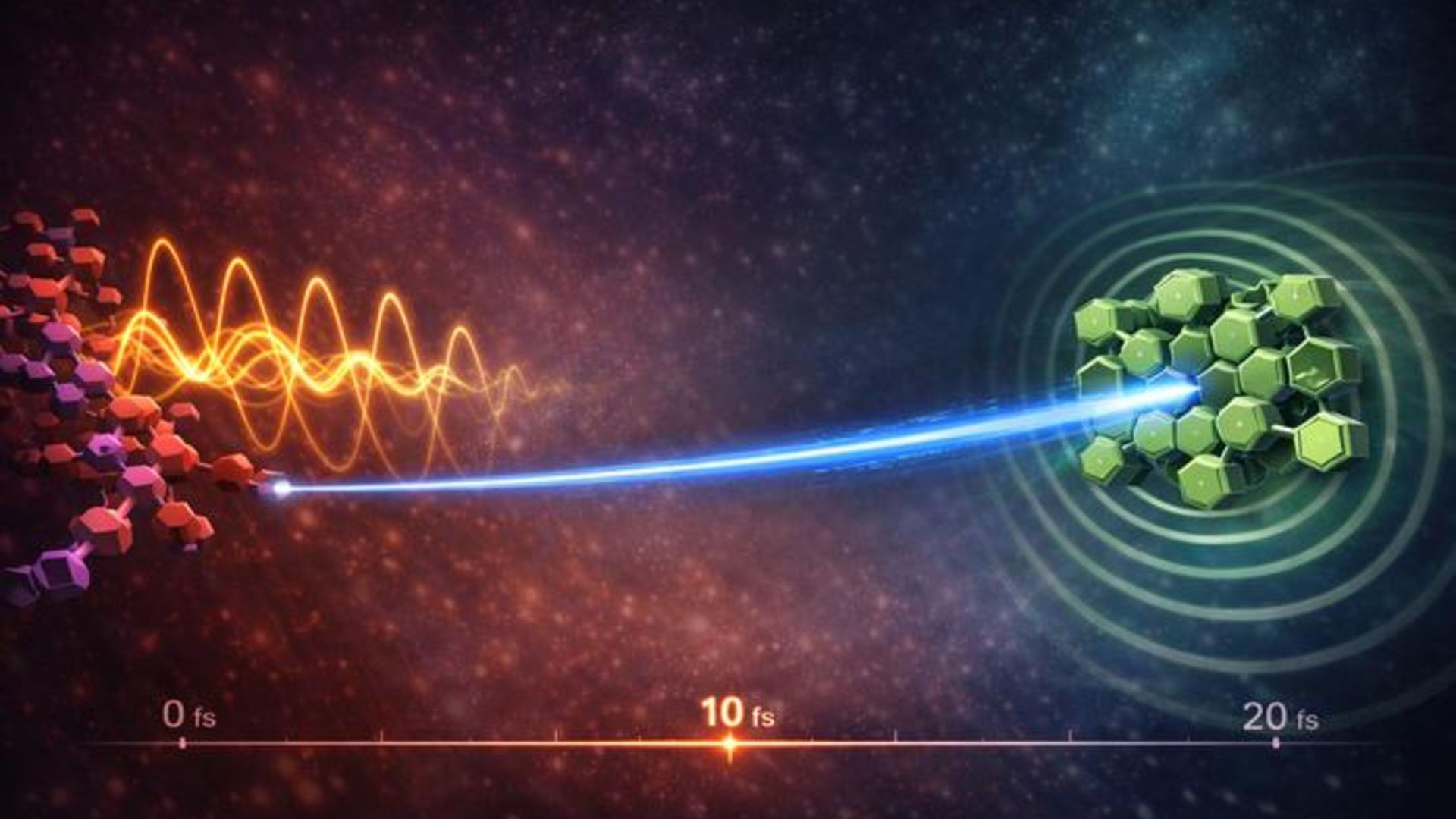
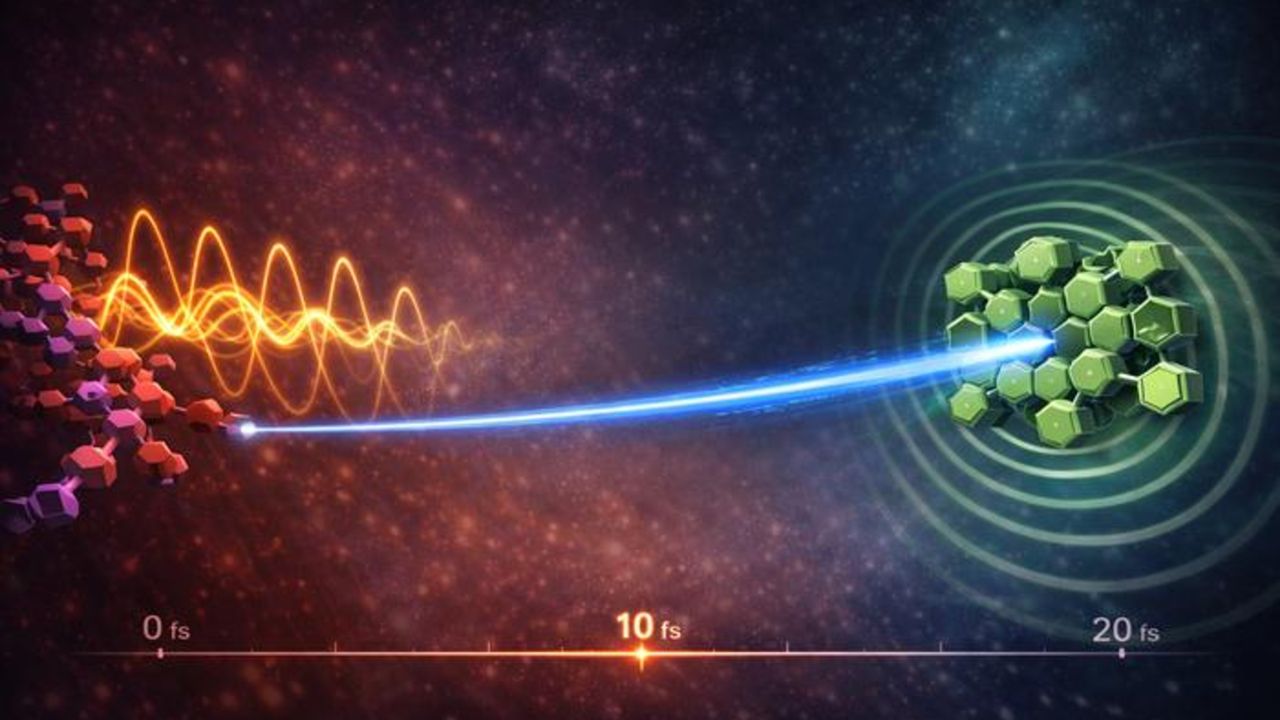
Molecular vibrations can “catapult” electrons across solar materials in quadrillionths of a second‬ ‪— much faster than previously thought, a new study shows.

The findings could help scientists find more efficient ways to convert solar energy into electricity, according to the study, which was published March 5 in the journal Nature Communications.

“We’re effectively watching electrons migrate on the same clock as the atoms themselves,” study co-author Pratyush Ghosh, a researcher who studies ultrafast spectroscopy at the University of Cambridge, said in a statement.

Article continues below


You may like

Organic molecules go solar

Organic solar cells use carbon-based molecules, rather than silicon, to convert sunlight into electricity. In theory, organic solar cells could provide that electricity at lower cost than conventional solar cells, but they are much less efficient.

In a typical organic solar cell, an electron donor and an electron acceptor are sandwiched between two conductive electrodes. When light hits the cell, it generates an “exciton,” an electron-hole pair. Excitons split at the interface between the donor and the acceptor, generating electricity.

Seeing it happen on this timescale within a single molecular vibration is extraordinary

Pratyush Ghosh, University of Cambridge researcher

To achieve fast charge transfer at the interface and limit energy loss, the donor and acceptor molecules usually have strong electronic coupling, or overlap between their electronic states, which allows charges to move easily between molecules. They also often have a large energy difference between them, but that limits the voltage available from the device.

In the new study, researchers observed ultrafast charge transfer at a junction between the electron donor and electron acceptor in an organic solar cell, without needing to conform to either of these constraints. The team used a short laser pulse to excite the electron donor, a polymer called TS-P3, and then used a different laser to measure how the system changed during charge transfer.

Get the world’s most fascinating discoveries delivered straight to your inbox.

That charge transfer happened in 18 femtoseconds ‪—‬ about as fast as an individual molecule vibrates. A few other systems without strong driving forces exhibit charge transfer over 100 to 200 femtoseconds, but most take ten to a thousand times that long.

“Seeing it happen on this timescale within a single molecular vibration is extraordinary,” Ghosh said in the statement.

A ‘molecular catapult’

That similar timescale wasn’t a coincidence. In a second set of laser experiments, the team found that vibrations in the polymer donor molecule launched an electron across the junction to an acceptor molecule. When the electron arrived, it triggered overlapping vibrations in the acceptor molecule. This overlap allowed charge transfer to happen much more quickly than expected, and without the need for strong coupling or a large energy difference.

“Instead of drifting randomly, the electron is launched in one coherent burst,” Ghosh said in the statement. “The vibration acts like a molecular catapult. The vibrations don’t just accompany the process, they actively drive it.”

The findings help to explain the processes that control the speed of charge transfer and establish new strategies for designing more efficient organic solar cells and materials, the researchers wrote in the study.

“Instead of trying to suppress molecular motion, we can now design materials that use it ‪—‬ turning vibrations from a limitation into a tool,” study co-author Akshay Rao, a physicist at Cambridge, said in the statement.

Ghosh, P., Royakkers, J., Londi, G., Giannini, S., Arul, R., Gillett, A. J., Keene, S. T., Zelewski, S. J., Beljonne, D., Bronstein, H., & Rao, A. (2026). Vibronically assisted sub-cycle charge transfer at a non-fullerene acceptor heterojunction. Nature Communications, 17(1). https://doi.org/10.1038/s41467-026-70292-8

Source link

Share. Facebook Twitter Pinterest LinkedIn Tumblr Email
Previous ArticleMarch Madness: Florida’s Olivier Rioux towers over opponent in viral moment
Next Article Debunking the defamation of Minnesota: Immigrants
Editor
  • Website

Related Posts

Lifestyle

New robotic heart mimics common, mysterious condition to help researchers study it

July 11, 2026
Lifestyle

Canon EOS R6 III review: A wildlife wonder

July 10, 2026
Lifestyle

Medieval babies and adults buried together in Sweden were not related, archaeologists discover — raising big questions about early Christian burial practices

July 10, 2026
Add A Comment

Comments are closed.

Categories
  • Entertainment
  • Lifestyle
  • News
  • Sports
  • Tech
  • Travel
Recent Posts
  • New robotic heart mimics common, mysterious condition to help researchers study it
  • Canon EOS R6 III review: A wildlife wonder
  • Medieval babies and adults buried together in Sweden were not related, archaeologists discover — raising big questions about early Christian burial practices
  • NASA is creating a fifth state of matter on the ISS, thanks to an upgrade to a mini-fridge-sized quantum lab
  • New sodium metal battery design charges in just 4 minutes and retains its capacity for years
calendar
July 2026
M T W T F S S
 12345
6789101112
13141516171819
20212223242526
2728293031  
« Jun    
Recent Posts
  • New robotic heart mimics common, mysterious condition to help researchers study it
  • Canon EOS R6 III review: A wildlife wonder
  • Medieval babies and adults buried together in Sweden were not related, archaeologists discover — raising big questions about early Christian burial practices
About

Welcome to Baynard Media, your trusted source for a diverse range of news and insights. We are committed to delivering timely, reliable, and thought-provoking content that keeps you informed
and inspired

Categories
  • Entertainment
  • Lifestyle
  • News
  • Sports
  • Tech
  • Travel
Facebook X (Twitter) Pinterest WhatsApp
  • Contact Us
  • About Us
  • Privacy Policy
  • Disclaimer
  • UNSUBSCRIBE
© 2026 copyrights reserved

Type above and press Enter to search. Press Esc to cancel.