
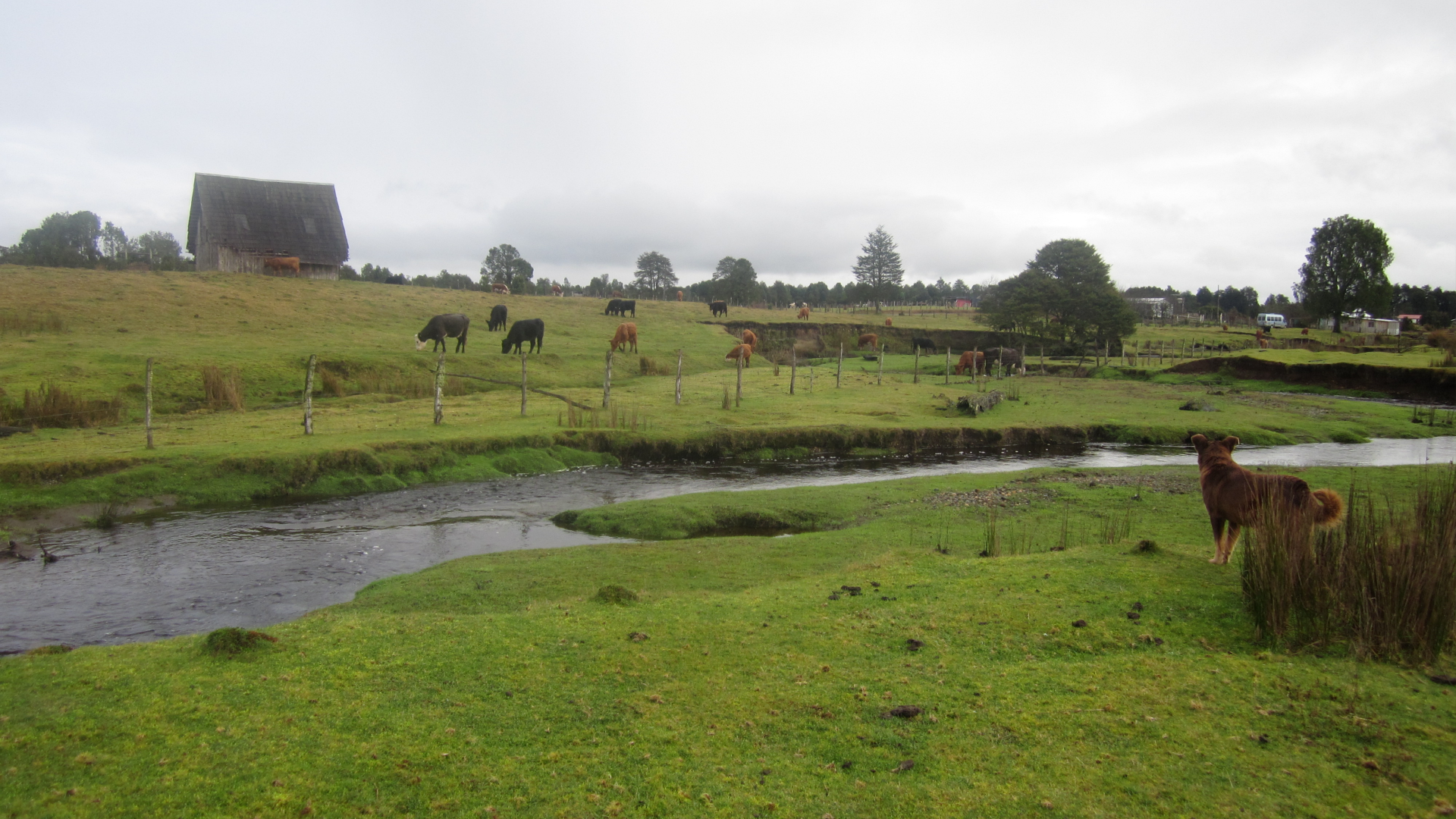
A team of archaeologists is questioning the 14,500-year-old date of Monte Verde in Chile, one of the oldest human occupations in the Americas, and proposing a much younger age for the key Paleo-Indian site. The researchers suggest their new date challenges the current narrative of how early the Americas were settled, but other experts are not convinced and call it “egregiously poor geological work.”
The Monte Verde archaeological site is located in the mountains of southern Chile. Discovered in 1976, the site yielded stone tools, preserved wood, bones and skin of extinct animals, a human footprint, edible plant remains, hearths and natural rope. Radiocarbon dates placed the site’s occupation level, called Monte Verde II or MV-II, at about 14,500 years ago.
Article continues below
Since the discovery of Monte Verde, archaeologists have identified many other sites that predate the Clovis migration by more than a thousand years, including Paisley Caves in Oregon, White Sands in New Mexico, the Friedkin and Gault sites in Texas, and Page-Ladson in Florida. But MV-II is still unusual because it is the only securely dated Late Pleistocene archaeological site in South America.
In a study published Thursday (March 19) in the journal Science, an international group of researchers led by Todd Surovell, an archaeologist at the University of Wyoming, reevaluated the age and formation of MV-II. They concluded that Monte Verde was most likely occupied in the Middle Holocene, around 4,200 to 8,200 years ago.
“The so-called 14,500-year-old archaeological component that was supposed to forever change our understanding of the colonization of the Americas actually comes from a landform that’s at best 8,000 years old,” Surovell told Live Science. “In other words, it’s not an ice age site.”
Surovell and study co-author Claudio Latorre, a paleoecologist at the Pontifical Catholic University of Chile, visited Monte Verde in 2023 and collected samples of soil and organic matter from areas near the MV-II occupational site, which was destroyed more than three decades ago by logging activities and flooding. The researchers’ radiocarbon dating of new samples of charcoal and wood from the Monte Verde area produced dates ranging from 13,400 years to 16,500 years ago, in line with previous studies. But because the site is located on the banks of a creek with complex geology, Surovell and colleagues suggested that these older dated materials were actually redeposited onto a much younger site, making MV-II seem older than it is.
The key to the redating, Surovell said, is a layer of ash known as the Lepué Tephra, which blanketed the area after a volcanic eruption 11,000 years ago. The researchers discovered this tephra — ejected volcanic material — in several geological sections along the creek and concluded that, at some point, erosion cut a channel through the site. So while MV-II is lower in the ground than the surrounding terraces, it was actually settled on top of the tephra layer, making it younger than 11,000 years.

Archaeologists question the geological analysis
But Tom Dillehay, an archaeologist at Vanderbilt University who has spent 50 years studying Monte Verde, disagrees with the researchers’ conclusions.
“There is no 11,000-year-old ash layer underneath the Monte Verde II site,” Dillehay told Live Science in an email. “They are studying a different context in the area and are projecting that into the site from elsewhere.”
The volcanic tephra layer is interesting new information, Michael Waters, a geoarchaeologist at Texas A&M University who was not part of the study, told Live Science. But the study includes “egregiously poor geological work,” he said. For example, the authors say one of the site terraces formed partly from erosion and partly from deposition, but Waters said this is geologically impossible.
“There’s so many things that should be done if you’re evaluating an archaeological site,” including micromorphology, wood identification, chemical analysis of bones, and examination of paleosols (ancient soil layers) and cryptotephras (invisible layers of volcanic ash), Waters said. “They didn’t bother to do that. This study falls really short in demonstrating that Monte Verde II is Middle Holocene.”
“Even if the authors are correct — and I am extremely skeptical — that won’t change the overall narrative of the peopling of the Americas.”
David Meltzer, archaeologist at Southern Methodist University
Monte Verde entered archaeology textbooks as a clear example of a pre-Clovis site in the late 1990s, after archaeologists who were previously skeptical of the early date visited the site and concluded there was no reason to question the integrity of the dating.
David Meltzer, an archaeologist at Southern Methodist University in Dallas who led that expedition in 1997, said that, while he appreciates alternative perspectives on archaeological sites, there are several problems with the new study.
“Their work was not actually at the site, but instead in small sections that are tens to hundreds of meters distant,” Meltzer told Live Science in an email. If the creek is active and complicated, as the researchers suggest, “then the other sections they sampled may have little bearing on what was at the site itself.”
Don’t rewrite textbooks just yet
In addition to the methodological errors in the study, archaeologists have taken issue with Surovell’s statement that “with colonization of the Americas no longer anchored by Monte Verde, our revised chronology supports a more recent date of human arrival to the Americas.”
“It’s a sign of a good, healthy discipline when something that’s settled science is questioned,” Kenneth Feder, an archaeologist and author of “Native America: The Story of the First Peoples” (Princeton University Press, 2025), told Live Science. But regardless of the date of Monte Verde, “that really doesn’t in any way negate the probable scenario that people had to come in along the coast first in order to get them into North America before the ice-free corridor ever opened up.”
Meltzer agreed and pointed out that archaeological sites elsewhere support the interpretation of Monte Verde as a very early human occupation site.
“Monte Verde is hardly the sole site in the Americas that pre-dates Clovis,” Meltzer said. “Even if the authors are correct — and I am extremely skeptical — that won’t change the overall narrative of the peopling of the Americas.”
Surovell is not so sure. In a 2022 study published in the journal PLOS One, he and his co-authors argued that pre-Clovis sites like Friedkin, Gault and Coopers Ferry (in Idaho) are marked by “downdrift” of artifacts and organic material from upper layers, potentially making those sites appear older than they actually are.
“It speaks to the need for more of this kind of replication [of dating] to be done,” Surovell told Live Science, “particularly at these sites that appear to be outliers, like White Sands 22,000 years ago. It’s a very strange thing. Where did these people come from? One possible explanation is that that site has been misinterpreted.”
But Dillehay said Surovell and co-authors have a clear agenda: to bring back the “Clovis First theory,” which states that the first Americans arrived through an ice-free corridor around 13,000 years ago.
“The scientific team behind the Monte Verde Project is currently preparing a detailed scientific response that will systematically address the methodological, empirical and contextual errors present in the study,” Dillehay said.
“We came up with a different conclusion,” Surovell said. “Not to say ours was right. I absolutely welcome somebody to try to replicate what we’ve done.”
Surovell, T.A., Méndez, C., García, J.-L., Lüthgens, C., Thompson, J.M., Latorre, C. (2026). A mid-Holocene age for Monte Verde challenges the timeline of human colonization of South America. Science. https://dx.doi.org/10.1126/science.adw9217
