
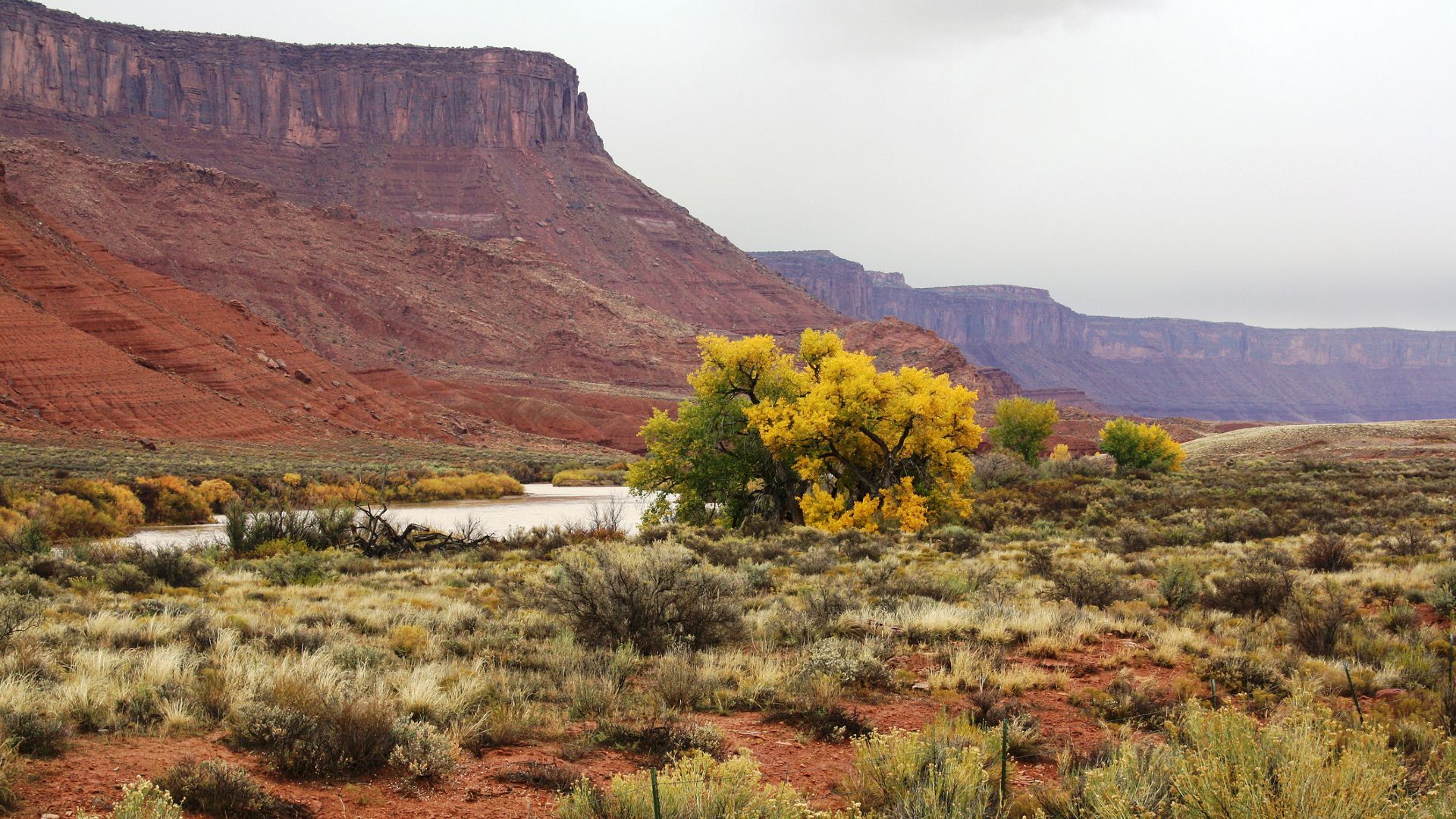
Thirsty plants are sucking up water that would otherwise end up in the Colorado River, according to a new study. The findings could have important implications for water management in regions that rely heavily on snowmelt for their water, including Arizona and California.
More than 1.4 billion people around the world rely on water from snowmelt-driven mountain rivers. In the United States, more than 10% of the population gets the majority of their water from the Colorado River alone.
Article continues below
Most water in mountain ecosystems is lost through a combination of evaporation from the soil and a process called plant transpiration, in which plants release water vapor from their leaves. This combined process is known as evapotranspiration. Scientists had thought plants mostly drew on shallow soil moisture from recent rain or snow, which would mean hot, dry conditions should reduce evapotranspiration while leaving river flows relatively constant.
But recent studies have uncovered a “drought paradox”: Plants actually maintain, or even increase, transpiration during dry periods.
To untangle this paradox, Reed Maxwell and Harry Stone, environmental engineers at Princeton University’s High Meadows Environmental Institute, installed an array of sensors across a 200-acre (81 hectares) area of the East River watershed in Colorado, which feeds into the Colorado River. The sensors measured water movement through the snowmelt-to-streamflow pathway over two years: 2023, which had a high snowpack but a hot, dry summer; and 2024, which had a moderate snowpack followed by a cool, wet summer.
They found that even during hot, dry periods — when soil moisture was at record lows — evapotranspiration remained high. This suggests that plants were tapping into groundwater reserves when soil moisture was low, using water that would otherwise end up in the river.

“Dry summer, wet summer; they’re getting their water,” Maxwell told Live Science. “But they’re finding it from other sources. They’re taking it from shallow groundwater.”
Historical temperature and streamflow data also showed that summer temperatures affected the streamflow regardless of how much snow had fallen the previous winter. Snowmelt efficiency, the ability for a given amount of snowmelt to produce a certain amount of runoff, has declined over the past century, so the same storm produces less water in the reservoirs as time goes on. It’s unclear exactly what is driving this shift, but climate change is a part of it.
“We see that across the Upper Colorado River Basin; a warm summer will actually take a big snowmelt and make it like an average snowmelt because of the additional water demands from plants,” Maxwell said. “Plants are still meeting their needs; they’re just using other water sources, and those sources are taking away from the water that would end up in our reservoirs.”
We could see a 40% decline by mid-century
Brad Udall, senior water and climate research scientist at Colorado State University
The work was published as a preprint article, meaning it has not yet undergone peer review or been published in a scientific journal.
Brad Udall, a senior water and climate research scientist at Colorado State University who was not involved in the research, said a major strength of the work was that the researchers directly measured changes in evapotranspiration on an hourly basis, rather than relying solely on computer models.
The findings support a hypothesis that Udall and others are actively investigating: that increased evapotranspiration brought on by higher temperatures is contributing to reduced river flows, he said.
Over the past century, temperatures in the Colorado River Basin have risen by 2.5 degrees Fahrenheit (1.4 degrees Celsius), according to the study. Over the past seven years, water flow in the basin has dropped by 35%, Udall said. He and others have hypothesized that there will be “increased reductions in flow due to these higher temperatures going forward,” Udall told Live Science.
That could have major impacts on how much water is available for the people who depend on the Colorado River in the future. “It means there will be a lot less water, and we’re already seeing it,” Udall said. “We could see a 40% decline by mid-century.”
New management rules for how water is shared between the upper and lower basin are supposed to go into effect next year. But so far, there is no agreement on what these rules should look like, Udall said. Rising temperatures, declining river flows, and decreases in precipitation will only complicate those negotiations.
While this study is just one piece of how the water cycle in the Upper Colorado River Basin works, it could have important impacts on decisions about water use in the future, Maxwell said. As summers get drier and warmer, we will have to recalibrate our understanding of how much water might be available in the Colorado River, even in years with big snowfalls.
“A better water budget that takes into account increases in summer transpiration is a really important factor when figuring out how much water there is in the basin, before we start to divide it up,” he said.
