
Two new theatrical works in the Twin Cities – one showing now at the Children’s Theatre Company and one opening March 7 at the Guthrie – put “play” into plays and ask audiences to consider what that means.
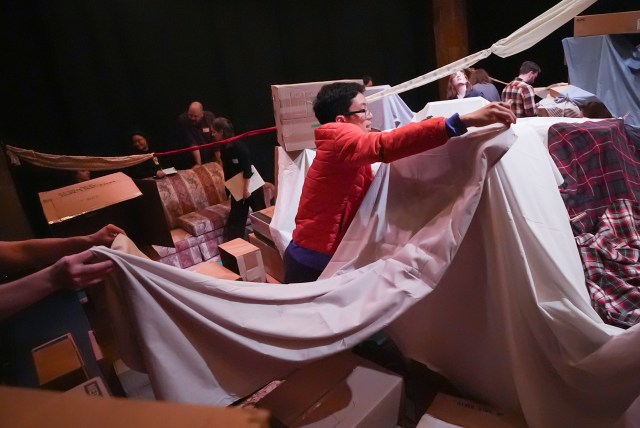
The Children’s Theatre Company’s “Forts: Build Your Own Adventure” isn’t a play in a traditional sense, but a participatory, collective sort of improv performance – and wonderfully playful.
The “performance” I attended transpired much like my own memories of fort-making. First, the audience – children and grown-ups alike – was invited to imagine forts and draw them on scratch pieces of cardboard. Soon, we were ushered into a giant room filled with couches and cardboard box towers. After quickly toppling the towers, the children and their grown collaborators set out to rebuild forts of their own invention.
Related: Art is playful and play is art at kid-friendly Walker exhibition
At timed intervals, new elements were introduced, like colorful tent structures, bedsheets, and changes to the sound and lighting design, like the introduction of flashlights.
“Forts” creator and director, Julie Ritchey, wanted to tap into the magic of fort-making as a creative performance. She asked, “What would it be like to get an amazing team of designers to theatrically design children’s creative play – the verb – with the same rigor that we would theatrically design a play – the noun?”
To create the show, Ritchey drew on her own fort-making experiences as a kid and a college student at Northwestern University, where she and her housemates made a giant fort in their living room.
She thought about the structures necessary for the audience to take over construction. Key to the concept, she said, was the relationship between autonomy and structure – a balancing act familiar to anyone who has played with kids. She asked, “How can we kind of manage that relationship back and forth?”

For anyone who has constructed a fort with couch cushions and blankets, “Forts” provides a similar experience at a larger scale. Ritchey hopes it offers a rare opportunity for children to claim autonomy – to create a space perfectly scaled to their own needs and imagination.
Ultimately, “Forts” is a work of theater as much about playing in the “having fun” sense as it is a “play” in the Aristotelian sense.
Opening March 7 at the Guthrie, “Sleuth,” by British playwright Anthony Shaffer, is a more traditional performance, but inspired by play – specifically a series of murder mystery games designed and hosted by legendary composer and lyricist Stephen Sondheim.
Sondheim, renown for dozens of musicals including “West Side Story,” “Gypsy” and “Into the Woods,” was also hugely into mysteries and games, according to Barry Joseph, author of “Matching Minds with Sondheim: The Puzzles and Games of the Broadway Legend,” and host of a delightful podcast of the same name.
According to Joseph, Sondheim designed elaborate treasure hunts and murder mystery parties for his friends, created cryptic-style crosswords as the founding puzzle editor at New York Magazine, was an early adopter of games like “Myst” and once created a board game in honor of Leonard Bernstein’s 50th birthday.
In the 1960s, Sondheim moved into a townhouse in Midtown Manhattan “decorated with antique board games and beautifully designed puzzles,” Joseph said. “And he would invite his friends over, who were often from the theater world, to have dinner, have some drinks, and play games together.”
In 1965, Sondheim hosted an evening of “The Murder Game,” an updated parlor game. One of the attendees, British playwright Peter Shaffer, told his brother, Anthony, about it. Anthony later convinced Sondheim to replicate it on a visit to London. The experience inspired Anthony Shaffer to write “Sleuth,” which would go on to win the 1971 Tony Award for best play.
On its face, “Sleuth” is a thriller set in the English countryside about two men – one of whom can be seen as inspired by the real-life Sondheim – and a staged jewelry heist.
The play brings to life an experience designed by Sondheim “meant for being done in a parlor, being done in a home, being done in a small group of intimates,” Joseph said.
“It was able to reflect that side of Stephen Sondheim that most people didn’t know – that side that was able to create these very intimate, brilliant, dynamic and challenging experiences that would lead someone creative, like Anthony Shaffer, to say, ‘How can I use this as the material to create something that’d be compelling for an audience to watch?’”
Related: Want to support democracy? Visit your local Twin Cities art gallery.
Both forms of play – the games and puzzles form and the theatrical performances – are “about creating moments where you, the player, or you, the audience, can emotionally experience something that’s going to help you feel something in a new way,” Joseph said.
“We might have higher expectations for what we might experience at a theater than, say, playing a game of Monopoly, but I’ve seen games of Monopoly get more heated than anything I’ve ever seen in a Broadway theater.”
The ability to play is part of what distinguishes us as humans. AI is notoriously terrible at games: ChatGPT can’t figure out chess, and Claude can’t get the hang of Pokémon Red. Maybe it’s something about the imagination that makes playing something distinctively human, or perhaps it’s our capacity for joy.
These two shows, though different in style and aimed at different audiences, tap into both and ask us to play – and to think about plays – from a new perspective.
More information:
“Forts: Build Your Own Adventure” runs through April 5 at Children’s Theatre Company, 2400 3rd Ave S, Minneapolis ($30). More information here.
“Sleuth” plays March 7 – May 10 at the Guthrie Theater, 818 South 2nd St., Minneapolis ($16-$94). More information here.
Kimberly Senior, director of the Guthrie’s production of “Sleuth,” will do a book signing for her book “What Would a Person Do?: Thoughts on Directing and Living,” on Sunday, March 8, 5–6:30 p.m. at the Dowling Studio at the Guthrie (free). More information here.
Correction: This article has been updated with Stephen Sondheim’s correct magazine affiliation. He was the founding puzzle editor at New York Magazine.
