
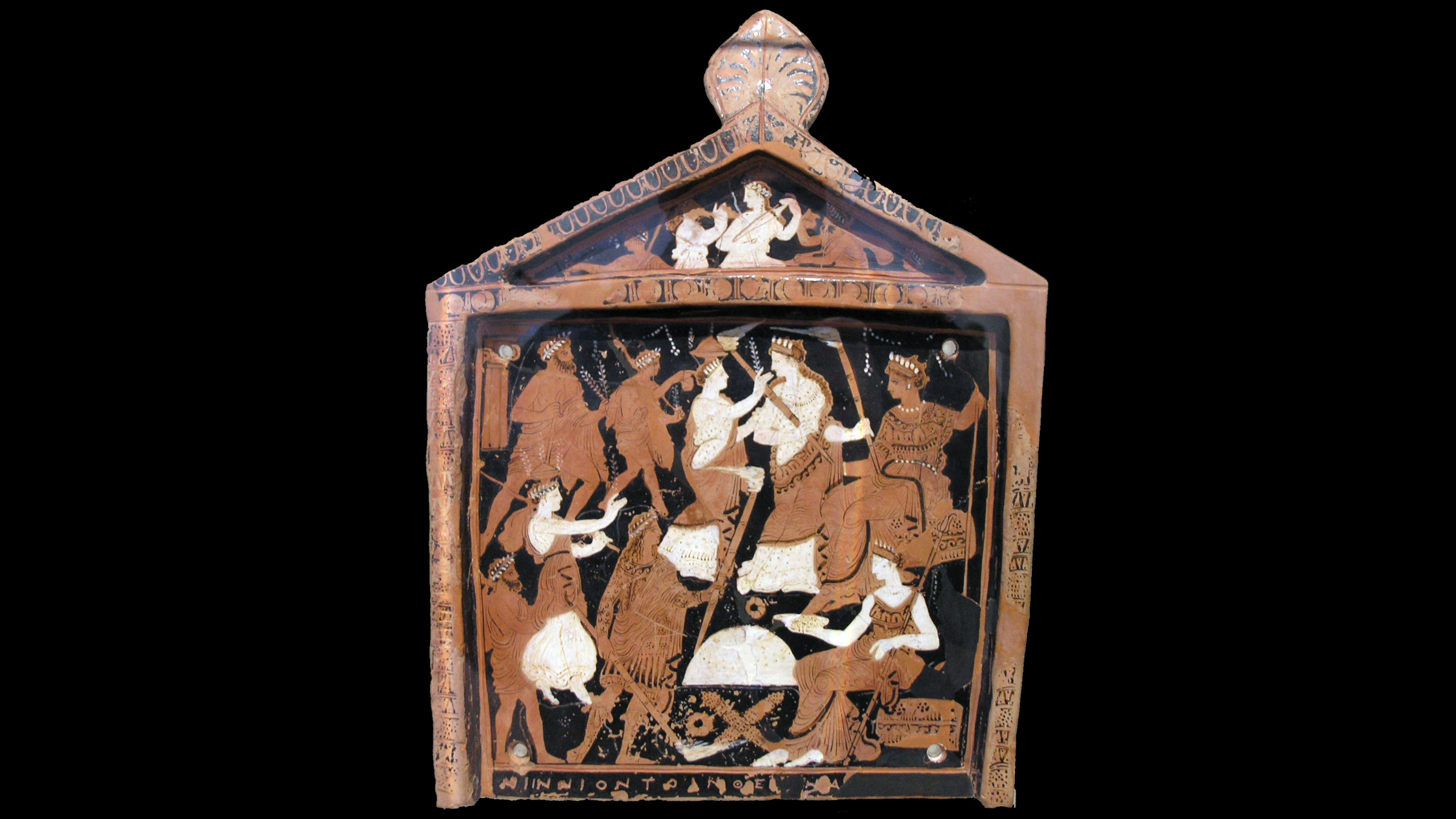
Priestesses of a mysterious cult in ancient Greece and Rome may have used a highly toxic fungus to create psychedelic hallucinations during their rituals, a new study suggests. However, some experts say that, although the study shows that is plausible, it’s not historical proof that this occurred.
The study, published Feb. 13 in the journal Scientific Reports, reports the results of laboratory experiments to make the ergot fungus non-toxic while keeping its hallucinogenic properties. A key feature of the study is that it used only the simple technology known in ancient Greece, where what’s now known as the Eleusinian Mystery cult originated about 3,000 years ago.
The idea that the Eleusinian Mysteries were based on hallucinogenic substances from ergot — the “Psychedelic Eleusis” theory — has been popular since the 1970s. But the researchers are the first to show experimental evidence, Evangelos Dadiotis, a pharmaceutical scientist at the University of Athens, told Live Science in an email.
“The central question was whether toxic ergot could realistically have been processed into something psychoactive but not lethal using methods available in antiquity,” he said. “We used a simple lye [sodium hydroxide] preparation made from water and ash, a technology well known in the ancient world,” he said.
Wood ash produced an alkaline solution, which over time broke down the toxic proteins in the ergot (Claviceps purpurea) while leaving non-toxic byproducts, including the hallucinogenic chemical lysergic acid amide (LSA). LSA is chemically similar to lysergic acid diethylamide — better known as LSD — and it can be a precursor to the drug, but it is much less powerful.
The study suggests the ancient Greeks could have treated ergot with lye to make a non-toxic psychedelic drink for the Eleusinian Mysteries. But whether they did or not is questioned by other experts.

Mystery cult
The Eleusinian Mysteries were the most revered secret religious initiations in ancient Greece and a classic “mystery cult.” They centered on the worship of the fertility goddess Demeter and her daughter Persephone, the personification of spring. According to ancient myths, the underworld god Hades abducted Persephone to be his wife and Demeter made the world barren in her grief, but the chief god Zeus made a deal so Persephone could come back each year. The cult originated in the ancient Greek town of Eleusis, hence its name. But it became popular throughout the later Roman Empire, in part because of the syncretism of Roman and Greek religious beliefs. The details of the cult are obscure — that was the point — but its initiates gathered at Eleusis each year to honor Demeter and Persephone (also called Kore) and the “mysteries” they shared, which were related to agriculture. Therefore, the mysteries were thought to have divine origins, and even Roman emperors such as Augustus became initiates, known as “mystai” in Greek.
The idea that priestesses of the Eleusinian Mysteries administered hallucinogens to initiates was proposed in the “The Road to Eleusis: Unveiling the Secret of the Mysteries” (Harcourt Brace Jovanovich, 1978) by author Gordon Wasson, classicist Carl Ruck (a co-author of the new study) and chemist Albert Hofmann, who had used an ergot derivative to make LSD in 1938 and experienced a dose himself in 1943.
But “the key objection was always toxicity — ergot causes ergotism, meaning convulsions, gangrene, [and] mass poisoning,” Dadiotis said. Nobody had shown before that ergot could be made safe by treating it with lye, which destroyed the toxic chemicals while preserving its psychoactive properties: “Our study fills that gap … that experimental bridge is what was missing.”

Strange rituals
The annual rites of the Eleusinian Mysteries were held at two times each year: the “lesser mysteries” in the spring and the “greater mysteries” in the fall. They often involved sacred processions to cult sites, ritual bathing in the sea, animal sacrifices, and fasting for several days, followed by the drinking of a mysterious elixir called kykeon, which was made with barley and flavored with herbs.
Dadiotis and his colleagues think the treated ergot extracts were added to the kykeon, and they note that in 2002 scientists said they had found traces of the psychoactive chemicals in a ceremonial vase from an Eleusinian site in Spain, and in the hardened dental plaque of an individual buried there.
The herbs added to the kykeon included a pungent type of mint, now called pennyroyal, (Mentha pulegium), and Dadiotis thinks this may have helped mask the bitter taste of the ergot extracts.
“The new study is an interesting and technically careful piece of analytical chemistry,” Sharday Mosurinjohn, a religious studies scholar at Queens University in Ontario, told Live Science in an email. Mosurinjohn was not involved in the new study but has questioned the idea of the use of psychedelics in the Eleusinian Mysteries.
“What it demonstrates is chemical feasibility within a plausible ancient technological context,” but “chemical feasibility is not historical proof,” Mosurinjohn said. The study neither demonstrated that this type of processing was used in ancient times, nor that initiates had consumed the psychoactive doses during the Eleusinian Mystery rituals, she said.
Antonopoulos, R. K., Dadiotis, E., Ioannidis, K., Cheilari, A., Mitsis, V., Garcia-Campaña, A. M., Gámiz-Gracia, L., Hernández-Mesa, M., Narváez, A., Hoffman, M. A., Ruck, C. a. P., Gonou-Zagou, Z., Aligiannis, N., & Magiatis, P. (2026). Investigating the psychedelic hypothesis of kykeon, the sacred elixir of the Eleusinian Mysteries. Scientific Reports. https://doi.org/10.1038/s41598-026-39568-3
