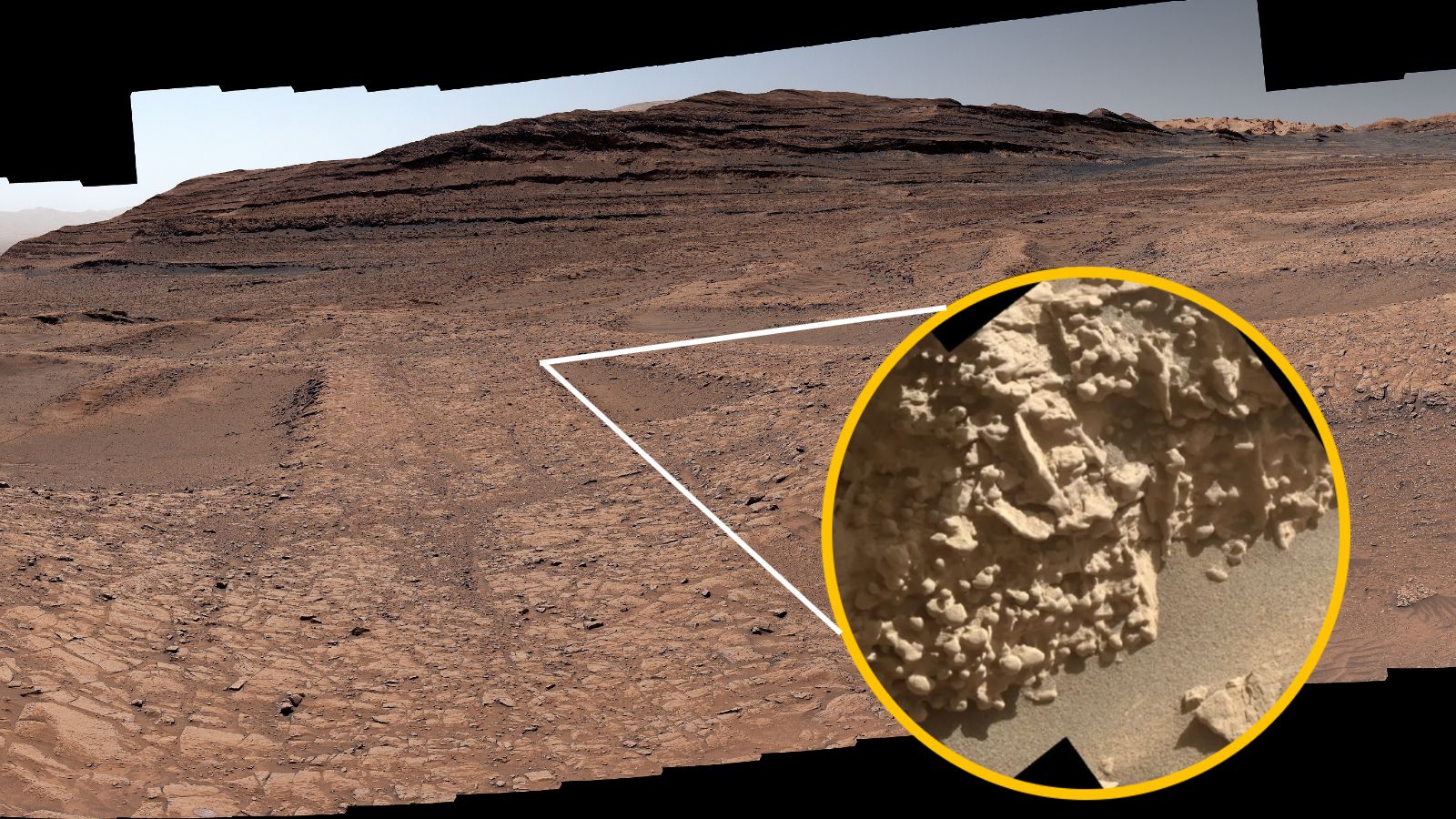
NASA’s Curiosity rover has snapped stunning new photos of giant “spiderwebs” zig-zagging across the surface of Mars. One of these images has revealed never-before-seen, egg-like spheroids covering the sprawling structures — and scientists are struggling to explain them.
Over the last 8 months, Curiosity has been closely examining a series of interconnected rocky ridges, dubbed “boxwork,” on the slopes of Mount Sharp, in the Gale Crater. These ridges, which cover an area up to 12 miles (20 kilometers) across, were created billions of yars ago as ancient Martian groundwater seeped beneath the planet’s surface. They were first spotted by orbital spacecraft in 2006, but they have remained largely unexplored until now.
The web-like structures should not be confused with the infamous “spiders on Mars” — a series of geological features that are created when carbon dioxide ice sublimates beneath the Red Planet’s surface and look like swarming arachnids when viewed from above. (These faux spiders were also recently recreated on Earth, while a similar “wall demon” was also spotted on Jupiter’s moon Europa.)
NASA released Curiosity’s first boxwork photos in June 2025, shortly after reaching the rocky ridges. But on Monday (Feb. 23), the agency released two more snaps, which showed the structures in much greater detail.
One of these photos, captured Sept. 26 last year, shows off a ground-level view of the ridges, which stand 3 to 6 feet (1 to 2 meters) above Mars’ surface. But a second close-up image, snapped on Aug. 21, revealed that some of these ridges are covered in tiny irregular-shaped lumps, or nodules, that have not been seen until now.

These nodules bear a striking resemblance to mini spheroids on the surface of a mysterious “spider egg” rock, which was discovered in the Jezero Crater by NASA’s Perseverance rover last year and has an unknown origin. And researchers are also having a hard time explaining exactly how the tiny boxwork “eggs” formed.
“We can’t quite explain yet why the nodules appear where they do,” Tina Seeger, a planetary scientist at Rice University in Houston who is leading Curiosity’s boxwork investigations, said in a statement. “Maybe the ridges were cemented by minerals first, and later episodes of groundwater left nodules around them,” Seeger said. But more work is needed to confirm if this is the case.
However, while the nodules and boxwork have an eerily biological appearance, there is no suggestion that they have any direct ties to extraterrestrial life.
Martian spiderwebs
Boxwork is made up of criss-crossing ridges of mineral-rich rocks that litter the surface of Mars. Similar yet smaller structures are found on Earth, predominantly within caves, and form when calcite-rich water flows between rocks that are eventually eroded, much like how stalagmites and stalactites form, according to the National Speleological Society.

However, on Mars, the boxwork was shaped by the fierce winds that scour the planet’s surface: “The bedrock below these ridges likely formed when groundwater trickling through the rock left behind minerals that accumulated in those cracks and fissures, hardening and becoming cementlike,” NASA representatives previously wrote. “Eons of sandblasting by Martian wind wore away the rock but not the minerals, revealing networks of resistant ridges within.”
The team is particularly interested in the patch of boxwork on Mount Sharp because it formed in isolation and is surprisingly high up the mountain’s slopes, which has implications for the planet’s puzzling watery past.
“Seeing boxwork this far up the mountain suggests the groundwater table had to be pretty high,” Seeger said. This hints that the water in this area may have “lasted much longer than we thought,” she added.
Researchers hope that further investigation will also shed light on the specific conditions that formed these structures and whether they might have been favorable to any potential ancient Martian microbes.

“These ridges will include minerals that crystallized underground, where it would have been warmer, with salty liquid water flowing through,” Kirsten Siebach, a Curiosity mission scientist at Rice University who has also studied the area, previously said. “Early Earth microbes could have survived in a similar environment. That makes this an exciting place to explore.”
Uneven terrain
While the latest stage of Curiosity’s mission is yielding fascinating results, it is also proving to be one of the hardest to navigate.
The boxwork is arguably the hardest terrain that the car-sized robot has had to traverse since it landed in the Gale Crater in 2012. The rover must balance along the ridges “like a highway” and avoid slipping “down into the hollows” between them, Ashley Stroupe, a systems engineer at NASA’s Jet Propulsion Laboratory in Southern California, said in the statement.
The task of controlling the rover has also become increasingly challenging due to a gaping hole in one of the robot’s wheels, which was first spotted in late 2024.
“There’s always a solution,” Stroupe said. “It just takes trying different paths.”