
Some of the best star and night sky projectors are those that are genuinely useful STEM (Science, Technology, Engineering and Maths) teaching and learning tools. In a classroom or even a home-learning setup, they can help visualise big ideas, enable children to practice observation skills and spark enquiry-led activities that go beyond the realm of space and into how we deal with scientific problems more generally.
When it comes to buying one of the best star projectors on the market, if you’re buying for younger children, the sweet spot is often a projector that’s robust, easy to operate and paired with prompts that can turn visually impressive starscapes into learning opportunities. For teens and adults, look for sharper optics, better coverage, quieter operation and more flexibility. Things like timers, accurate rotation and fine focus allow greater control, so the projector can double as a calm, distraction-free tool for independent study or planetarium-style demos.
In this article, we’ll dive into a collection of some of the best star projectors for a learning environment, detailing the pros, cons and what to look for with each product.
The quick list

Best overall
With a large catalog of available slides, this star projector is the best option to help kids learn about space. The projections are excellent, too.

National Geographic Astro Planetarium
Best for current night sky
With its time and date feature, kids can see what’s above them in real time — ideal for seeing what’s there when the skies are grey.

Govee Star Light Projector
Best for classrooms
This larger star projector is ideal for demonstrations in larger rooms — perfect for astronomy lessons.

Brainstorm Deep Space Home Planetarium
Best on a budget
Great for kids taking an initial interest in space to get them curious about the night sky without breaking the bank.

Clementoni Science Lab Star Projector
Best interactive
Kids can learn more about space with the accompanying app and AR capabilities, take part in interactive quizzes and listen to the history of the universe.
The best STEM star projectors we recommend in 2026
Why you can trust Live Science
Our expert reviewers spend hours testing and comparing products and services so you can choose the best ones for you. Find out more about how we test.
Best overall
Image 1 of 4


Buy it if
✅ You want a realistic feel with crisp deep-space visuals
Don’t buy it if:
❌ You want voice control, app scheduling or extra lighting options
The bottom line
🔎 POCOCO Galaxy Projector: A strong STEM option for older kids and adults. Simple, sharp and content-led. ★★★★
POCOCO’s Galaxy Projector is a streamlined projector that focuses on projection quality and a straightforward, classroom-friendly control layout. In our previous four-star POCOCO Galaxy star projector review, we noted the simple three-button operation (power, rotation, sleep timer) and the absence of extra gimmicks, which is beneficial when trying to keep attention on the learning qualities of a projector rather than what else it can offer.
The biggest draw is the high-quality photographic look that comes from the included dicks. POCOCO markets an optical setup with multiple lenses and high-resolution discs, and in practice, the better discs can look impressively crisp for the money. We think that the result is a projection that feels closer to a mini exhibition than a novelty toy. In a STEM learning environment, this makes it ideal for small-group discussions, as the images are clear
If you want a smart-home experience, voice control or built-in soundscapes, this isn’t for you, and because the content is disc-driven, expanding the curriculum often means buying more discs. But in return, you get a device that’s easy to set up, predictable to run and genuinely effective for inquiry-led STEM activities with high-quality, realistic images.
|
Attributes |
Notes |
|---|---|
|
Design |
Simple, discreet design. |
|
Performance |
Excellent quality projections, even in the daytime. |
|
Functionality |
Rechargeable with simple operation. |
Best for current night sky
Image 1 of 1

Buy it if
✅ You want a classroom-friendly, planetarium-like unit with simple controls.
Don’t buy it if:
❌ You want app control, true HD photo discs, or a modern smart-light feature set.
The bottom line
🔎 National Geographic Astro Planetarium: A strong teaching planetarium, and better suited to demonstrations than many cheaper novelty projectors. ★★★★
The National Geographic Astro Planetarium has clearly been designed with education in mind, so some of its features get our tick from the word go. The planetarium approach is excellent — the device is designed to project stars/constellations in a way that supports discussion of what’s visible on a given day and time, rather than simply bathing the room in a decorative nebula. In practice, that makes it much easier to build activities around prediction and observation.
With a projection area of around 5.25 x 7.4 feet (1.6 x 2.2 meters) at 6.5 feet (2 m) distance and 190-lumen output, it’s more capable than many toy-grade units, but we found that, like most slide/disc systems, the experience depends heavily on the disc quality and your room conditions. It does need quite a darkened, blacked-out space to get the best out of it.
It’s nice to see some quality-of-life features, which will help when you’re using it for calm-down corners or sensory-friendly learning time. You can also connect it up to music and it comes with its own FM radio, which is a nice touch for home bedroom users. For educators, the overall package is easy to justify. It’s not the most premium projection you can buy, but it’s well-suited to be ready for the classroom straight out of the box.
|
Attributes |
Notes |
|---|---|
|
Design |
Easy to use with a fun design |
|
Performance |
Needs a dark room to get the most out of it. |
|
Functionality |
Music and radio connectivity |
Best for classrooms
Image 1 of 1

Buy it if
✅ You want smart control for a larger space, good coverage, impressive effects and flexible ambience
Don’t buy it if:
❌ Your priority is astronomical accuracy over lighting effects.
The bottom line
🔎 Govee Galaxy Star Light Projector: A powerful, modern environment-maker. Lots of control and connectivity make it an impressive piece of kit, and excellent for STEM spaces that also care about wellbeing and atmosphere. ★★★★
Govee’s Galaxy Star Light Projector is best understood as a smart room tool rather than a traditional planetarium, but that can be a big advantage in STEM environments that need flexibility. Control options are a highlight — this includes app and voice control and Wi-Fi and Bluetooth connectivity. It’s non-scientific in the sense that it’s more about the effects than a true replication of the night sky, but you can set up scenes for different contexts — a calm ‘night sky’ for a space story session, for example, or a brighter dynamic aurora with RGB and effect controls in the app.
There are built-in sound setups, including preset white noise options and Bluetooth speaker functionality, which can support sensory-friendly environments or winding-down routines after active learning in an educational context. The speaker won’t rival other audio-first devices, but from a practical perspective, the level of sound and visual control helps educators manage attention and sessions remotely and with ease.
You won’t be buying this to teach constellations with precision, but it’s an immersive piece of kit. If we were to have one criticism, it’s that the motors are quite noisy. It’s best enjoyed in a larger environment, rather than your bedroom or living room.
|
Attributes |
Notes |
|---|---|
|
Design |
A large but smart-looking unit. |
|
Performance |
Bright colors, but noisy motor. |
|
Functionality |
Good BlueTooth speaker. |
Best on a budget
Image 1 of 2

Buy it if
✅ You want a STEM-friendly projector for all ages, with strong visual hooks and easy operation.
Don’t buy it if:
❌ You need a high-fidelity star map for more advanced astronomy teaching.
The bottom line
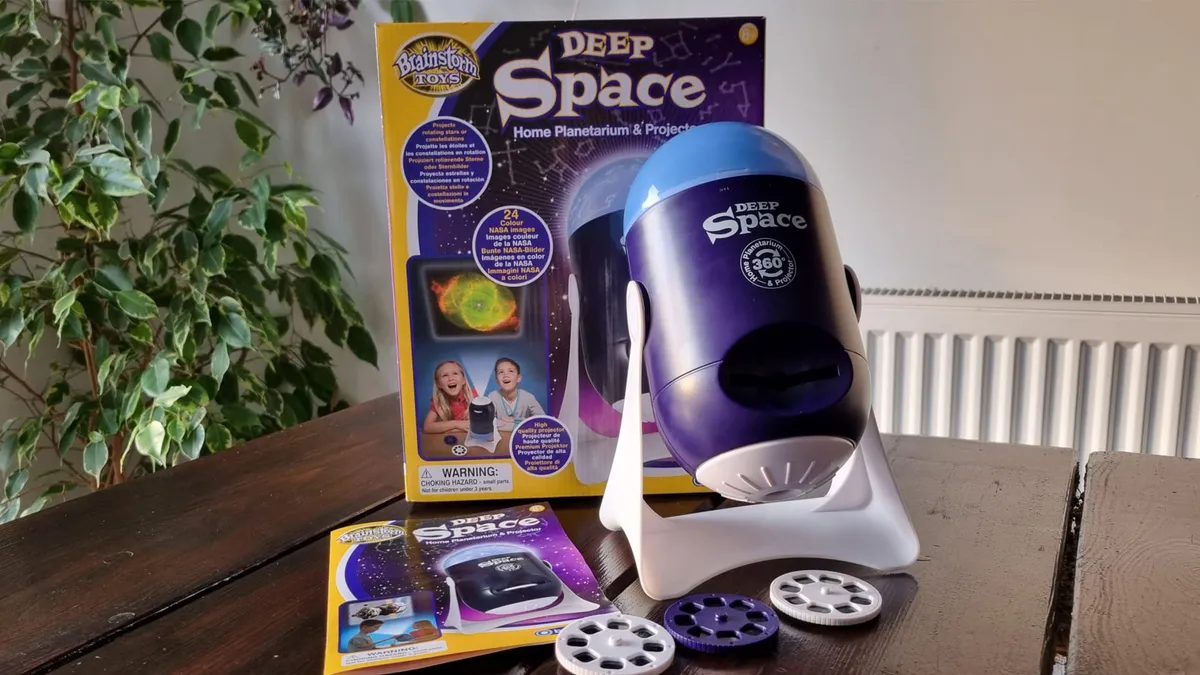
🔎 Brainstorm Deep Space Home Planetarium: A great visual lesson-starter for younger learners. Simple, engaging and built around general space imagery that can lead to further enquiry. ★★★★
The Brainstorm Deep Space Home Planetarium & Projector’s headline feature is its set of NASA image slides. In the box, you get three discs containing 24 colour images in total, which are projected up to roughly 3 feet (1 m) wide in a dark room. There’s also information about each colour image accessible online with a “secret code” you can enter — especially useful for classroom or learning environments. We enjoyed the hands-on learning experience during our full Brainstorm Deep Space Home Planetarium review.
Alongside the image slides, it can project rotating star or constellation patterns, which makes it flexible — you can run a short “mini planetarium” moment, then switch to imagery for deeper explanation. Add the night light dome, and the device also turns into a cool night light, so it’s also useful for kids’ bedrooms.
What’s quite nice about the Deep Space Home Planetarium & Projector is that it’s not trying to be a precision astronomy instrument. It’s geared much more towards use as a STEM engagement toolkit than an accurate star chart, so it deserves a place in this list. It’s less ideal for older students who want fidelity, but for primary school settings, clubs or family learning, it’s robust, intuitive and built around content that encourages curiosity instead of just ambience.
|
Attributes |
Notes |
|---|---|
|
Design |
Child-friendly operation. |
|
Performance |
Projection could be more refined. |
|
Functionality |
Motor isn’t particularly quiet. |
Best interactive
Image 1 of 1

Buy it if
✅ You want a projector that naturally connects to structured STEM activities via an app/AR layer.
Don’t buy it if:
❌ You need a purely offline tool with no screens required.
The bottom line
🔎 Clementoni Science Lab Star Projector: One of the most education-forward options here and especially useful if you want projection and guided activities in one package. ★★★★
As you can imagine from the name, Clementoni’s Science Lab Star Projector is aimed squarely at learning rather than mood lighting or atmosphere enhancement, which makes it easy to justify in STEM environments. It’s positioned for ages 8+ and uses a high-resolution, ultra-bright LED projection. With an accompanying free app and augmented-reality star maps, there are features here that can turn passive viewing into structured learning.
The STEM value is in the bridge between what’s on the ceiling and what learners can do next. A guided layer is especially useful when it comes to identifying objects and building vocabulary around key features in space. The AR/maps are particularly helpful for older kids who want to validate what they’re seeing and connect it to real sky knowledge.
If you’re thinking about a classroom environment, you’ll need to consider your school’s device policy — if students can’t use phones or tablets, you may not get the full benefit. But even without the app, it can still function as a stimulus tool for observation and discussion, especially when paired with printed supporting materials. One word of note is that power is typically via AA batteries, and we found they don’t last too long, so it’s worth budgeting for rechargeables.
|
Attributes |
Notes |
|---|---|
|
Design |
Fun, planet-like design. |
|
Performance |
Educational over atmospheric. |
|
Functionality |
App and AR functionality. |
Best sleep aid
Image 1 of 1

Buy it if
✅ You want an affordable, versatile, disc-based projector that supports guided STEM lessons for children and mixed-age groups.
Don’t buy it if:
❌ You need precise accuracy, app-driven learning or AR overlays
The bottom line
🔎 Mexllex 13-in-1 Planetarium Star Projector: One of the best-value disc planetariums for STEM environments, provided it’s used with teacher-led context and discussion. ★★★★
This is one of the most flexible disc-based projectors available for STEM learning for the money, and its strength lies in content variety. With 13 interchangeable projection films covering planets, galaxies, nebulas and constellation-style star fields, it provides an excellent ready-made visual library that can support multiple points of learning.
In practice, each disc can become the focus of a short activity. The inclusion of a manual focus ring is particularly valuable in STEM contexts, as it encourages learners to actively adjust the image and think about optics, sharpness and projection distance rather than passively watching. The projector includes 360-degree rotation and built-in timers, allowing learning to be tightly structured. USB-C power is another practical plus, making it easy to run from power banks or charging hubs without worrying about disposable batteries.
As with most disc projectors at this price point, some images are more illustrative than accurate and there’s no app or AR layer to guide interpretation. For primary to early secondary STEM learning, the Mexllex strikes an excellent balance between affordability, usability and educational flexibility.
|
Attributes |
Notes |
|---|---|
|
Design |
Manual focus ring allows for accurate focusing. |
|
Performance |
Easy to use. |
|
Functionality |
Includes 13 film discs. |
Best for young kids (3+)
Image 1 of 1

Buy it if
✅ You want an affordable, easy-to-run projector for young audiences
Don’t buy it if:
❌ You’re prioritising sharpness and realism for older learners.
The bottom line
🔎 Discovery Planetarium Projector: A solid entry-level teaching aid, but there are better options out there for projection quality and realism. ★★★
Discovery’s planetarium-style projectors are often sold as a 2-in-1 experience — stars and planets — with a simple slide-disc system that’s easy for younger learners to operate with minimal supervision. In STEM settings, that simplicity is a feature and it’s nice to see good functionality without complicated extra tech or the need to connect to any further devices.
The set includes three discs with 24 slides in total, which gives you enough variety to run multiple short sessions without repeating the same content every time. It does feel a little cheap in terms of build quality, however, and like many affordable projectors, it won’t deliver the crisp, photographic realism of higher-end disc systems.
An older or more educated audience may notice this quickly. But if you have, teach or look after younger children and your priority is engagement and accessibility, it can do the job well. As a budget-friendly “first planetarium,” it’s best used as a guided teaching prop rather than a precision astronomy tool.
|
Attributes |
Notes |
|---|---|
|
Design |
Fun rotating design, easy to use. |
|
Performance |
Disc projections are small but sharp. |
|
Functionality |
Battery powered only. |
Best STEM star projectors: comparison
|
Product |
Projection area |
Brightness |
Media |
Sleep timer |
Power |
Weight |
|
Pococo Galaxy Projector |
130 square feet / 12 square m |
Not stated |
Projection slides |
Yes |
Rechargeable |
1.7 lbs / 771 g |
|
National Geographic Astro Planetarium |
5.25 x 7.4 feet (1.6 x 2.2 m) |
190 lumens (at 2m ceiling height) |
Two slide discs (stars/constellations) |
30/60 mins |
AA batteries |
1.71 lbs / 775 g |
|
Govee Galaxy Star Light Projector |
650 square ft / 60 square m |
Not stated |
16 million color choices |
Yes |
USB-C |
2.8lbs / 1.3 kg |
|
Brainstorm Deep Space Home Planetarium |
Up to 3 feet (1 m) wide |
Not stated |
Three slide discs / 24 NASA images |
No |
3 x AAA batteries |
1.13 lbs / 513 g |
|
Clementoni Science Lab Star Projector |
Not stated |
Not stated |
3 slides |
Not stated |
3 x AA batteries |
1.37 lbs / 623 g |
|
Mexllex 13-in-1 Planetarium Star Projector |
Up to ~12 ft (3.6 m) |
500 lumen |
Interchangeable film discs |
1 / 2 hours plus continuous mode |
USB-C |
1.19 lbs / 540 g |
|
Discovery Planetarium Space Projector |
Not stated |
Not stated |
Three discs / 24 slides |
Yes |
3 x AA batteries |
1 lb / 453 g |
Best STEM Star Projectors: Frequently Asked Questions
What age is a star projector good for?
Most projectors work for kids aged 3 and up, but models with small parts and complex controls are better for 6+. Make sure you check the age limit for the specific model you’re purchasing.
Can kids learn astronomy with a star projector?
Yes! They can explore constellations, planets and stars, making astronomy fun and interactive at home.
What’s the difference between a star projector and a planetarium?
A star projector bring stars and patterns into your room for relaxing light, while a planetarium is more focused on learning, and is usually a big dome for group astronomy experienced.
Are star projectors safe for kids’ eyes?
Yes, most are low-light LED or laser-safe, but always follow the manufacturer’s guidance and avoid direct eye contact.
Can a star projector help kids fall asleep?
Many projectors double as a gentle night light, creating a calm environment that can help kids relax and fall asleep.
Latest updates
Future updates to this guide will be detailed here.
How we tested the best STEM star projectors
We test each star projector the way families would at home. That means checking how easy it is for kids to set up and operate, how clearly it displays stars, constellations and planets, and whether it’s fun, relaxing and educational.
We also assess its brightness, colors, timers and extra features. With these observations, we can recommend models that are both engaging for learning about the night sky and enjoyable for a relaxing bedtime.
