Close Menu
  • Home
  • UNSUBSCRIBE
  • News
  • Lifestyle
  • Tech
  • Entertainment
  • Sports
  • Travel
Facebook X (Twitter) WhatsApp
Trending
  • An ancient piece of the moon found in Africa hints at a long-ago collision that turned the lunar surface molten
  • Do you really have to wash rice before you cook it?
  • Neuroscientists are searching for the ‘cellular substrate of loneliness’
  • Bow-Wow, Ding-Dong, Pooh-Pooh: Expert explains early theories of how human language evolved — and their silly names
  • Famous child mummies in Andes may belong to kids who were sacrificed to ‘ritually anchor’ the Inca’s presence as their empire expanded
  • Artemis II crew captures rare double auroras on the dark side of Earth as they zoom toward the moon — Space photo of the week
  • Has all the water on Earth been peed before?
  • ‘This might be the point of no return’: Experts on the current measles outbreak and where we go from here
Facebook X (Twitter) WhatsApp
Baynard Media
  • Home
  • UNSUBSCRIBE
  • News
  • Lifestyle
  • Tech
  • Entertainment
  • Sports
  • Travel
Baynard Media
Home»Lifestyle»New image of ‘other comet ATLAS’ (C/2025 K1) reveals it’s breaking apart ahead of close approach to Earth
Lifestyle

New image of ‘other comet ATLAS’ (C/2025 K1) reveals it’s breaking apart ahead of close approach to Earth

EditorBy EditorNovember 13, 2025No Comments3 Mins Read
Share Facebook Twitter Pinterest LinkedIn Tumblr Reddit Telegram Email
Share
Facebook Twitter LinkedIn Pinterest Email

The “other” Comet ATLAS has fragmented, transforming into a cloud of debris that’s streaming into space, new observations have revealed.

The comet, called C/2025 K1 (ATLAS), was discovered in May by astronomers at the Asteroid Terrestrial-impact Last Alert System (ATLAS) and passed perihelion, or closest point to the sun, on Oct. 8. It has no relation to the famous interstellar comet 3I/ATLAS, other than having been discovered by the same telescope network around the same time.

Initial observations appeared to suggest that Comet K1 survived its passage around our star at a minimum distance of 31 million miles (50 million kilometers), or roughly four times closer than Comet 3I/ATLAS got.


You may like

However, new observations taken by astronomer Gianluca Masi in Manciano, Italy, show that the gravitational strain of R1’s voyage around the sun was too much for the comet, causing it to fragment into several pieces, or clouds.

“Several parts (sub-nuclei or clouds of debris) are visible, also a plume just below the leading (the first from the left) fragment,” Masi, an astronomer at the Astronomical Observatory of Campo Catino and the founder of The Virtual Telescope Project, wrote in an update.

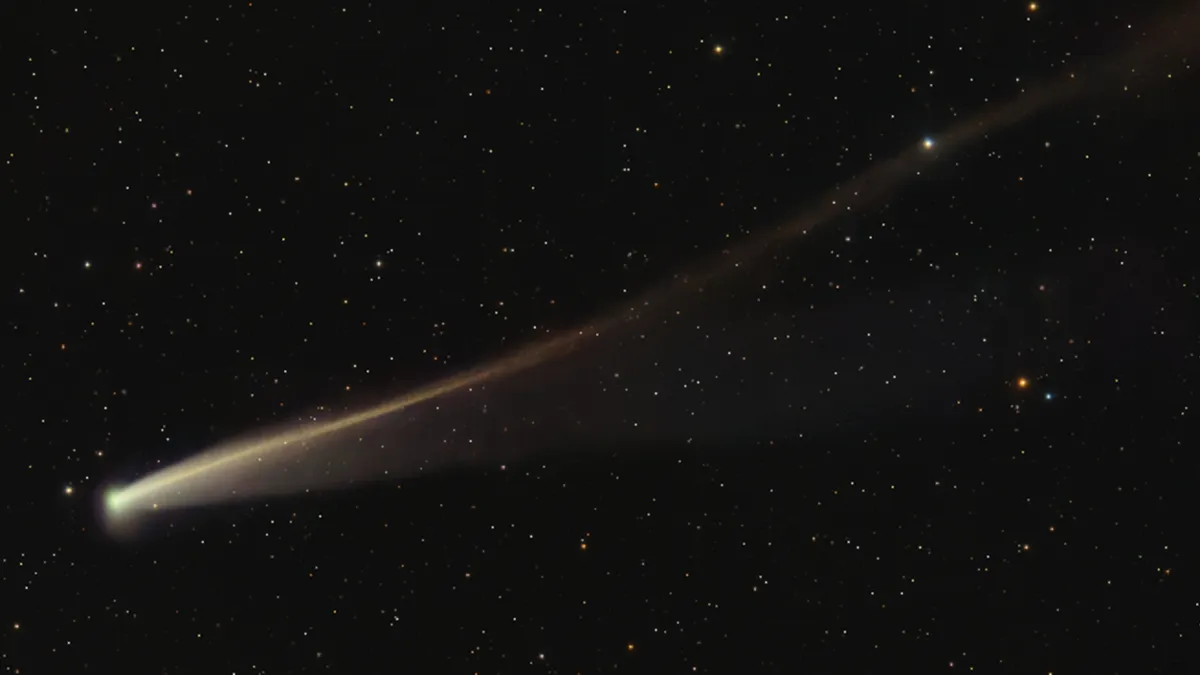
C/2025 K1’s disintegration was portended by a sudden brightening event around perihelion, which saw the comet transform from the greenish hue seen in many comets that fly close to our sun (caused by the presence of diatomic carbon fluorescing in sunlight) into a streaking ribbon of gold.

The cause of this transformation is unclear; some scientists speculate that the change in color had something to do with a relative lack of carbon-bearing molecules in the comet’s coma (the cloud of ice, gas and dust around the comet’s body).
Get the world’s most fascinating discoveries delivered straight to your inbox.

A photo of a gold-colored comet with a long rippling tail in the night sky

A recent photo of C/2025 K1 (ATLAS) shows that it developed a golden glow after passing its closest point to the sun. (Image credit: Dan Bartlett)

If you want to see the exploded comet for yourself, look in the constellation Leo, where it’s shining at magnitude 9.9, according to The Sky Live. (In astronomy, a lower magnitude corresponds to a brighter object; Regulus, the brightest star in Leo, has an apparent magnitude of about 1.35, for example.) Although the comet is still too dim to be seen with the naked eye, it can be spotted with a good telescope or a pair of stargazing binoculars.

Whatever survives of the comet is set to pass closest to Earth on Nov. 25. It will come within about 37 million miles (60 million km), or just under half the average distance between Earth and the sun.

Source link

Share. Facebook Twitter Pinterest LinkedIn Tumblr Email
Previous ArticleArkansas university offers ‘Queer Childhoods’ course in English department
Next Article Judge hears challenge to prosecutor’s appointment in James Comey, Letitia James cases
Editor
  • Website

Related Posts

Lifestyle

An ancient piece of the moon found in Africa hints at a long-ago collision that turned the lunar surface molten

June 15, 2026
Lifestyle

Do you really have to wash rice before you cook it?

June 15, 2026
Lifestyle

Neuroscientists are searching for the ‘cellular substrate of loneliness’

June 14, 2026
Add A Comment

Comments are closed.

Categories
  • Entertainment
  • Lifestyle
  • News
  • Sports
  • Tech
  • Travel
Recent Posts
  • An ancient piece of the moon found in Africa hints at a long-ago collision that turned the lunar surface molten
  • Do you really have to wash rice before you cook it?
  • Neuroscientists are searching for the ‘cellular substrate of loneliness’
  • Bow-Wow, Ding-Dong, Pooh-Pooh: Expert explains early theories of how human language evolved — and their silly names
  • Famous child mummies in Andes may belong to kids who were sacrificed to ‘ritually anchor’ the Inca’s presence as their empire expanded
calendar
June 2026
M T W T F S S
1234567
891011121314
15161718192021
22232425262728
2930  
« May    
Recent Posts
  • An ancient piece of the moon found in Africa hints at a long-ago collision that turned the lunar surface molten
  • Do you really have to wash rice before you cook it?
  • Neuroscientists are searching for the ‘cellular substrate of loneliness’
About

Welcome to Baynard Media, your trusted source for a diverse range of news and insights. We are committed to delivering timely, reliable, and thought-provoking content that keeps you informed
and inspired

Categories
  • Entertainment
  • Lifestyle
  • News
  • Sports
  • Tech
  • Travel
Facebook X (Twitter) Pinterest WhatsApp
  • Contact Us
  • About Us
  • Privacy Policy
  • Disclaimer
  • UNSUBSCRIBE
© 2026 copyrights reserved

Type above and press Enter to search. Press Esc to cancel.