
A weak spot in Earth’s protective magnetic field is growing larger and exposing orbiting satellites and astronauts to more solar radiation, according to more than a decade of measurements by three orbiting observatories.
The observations by the European Space Agency’s Swarm trio of satellites found that Earth’s already weak magnetic field over the South Atlantic Ocean — a region known as the South Atlantic Anomaly (SAA) — is getting worse and that it has grown by an area half the size of continental Europe since 2014. At the same time, a region over Canada where the field is particularly strong has shrunk, while another strong field region in Siberia has grown, the measurements show.
Geomagnetic field
The three satellites were launched in 2014 to precisely monitor magnetic signals from Earth’s core and mantle, as well as from the ionosphere and magnetosphere. Earth’s magnetic field (technically, the “geomagnetic field”) is thought to be generated by a rotating core of molten iron, roughly 2,900 kilometers, or 1,800 miles, beneath our feet. But the strength of the field changes continuously, and scientists are still learning about its exact mechanisms.
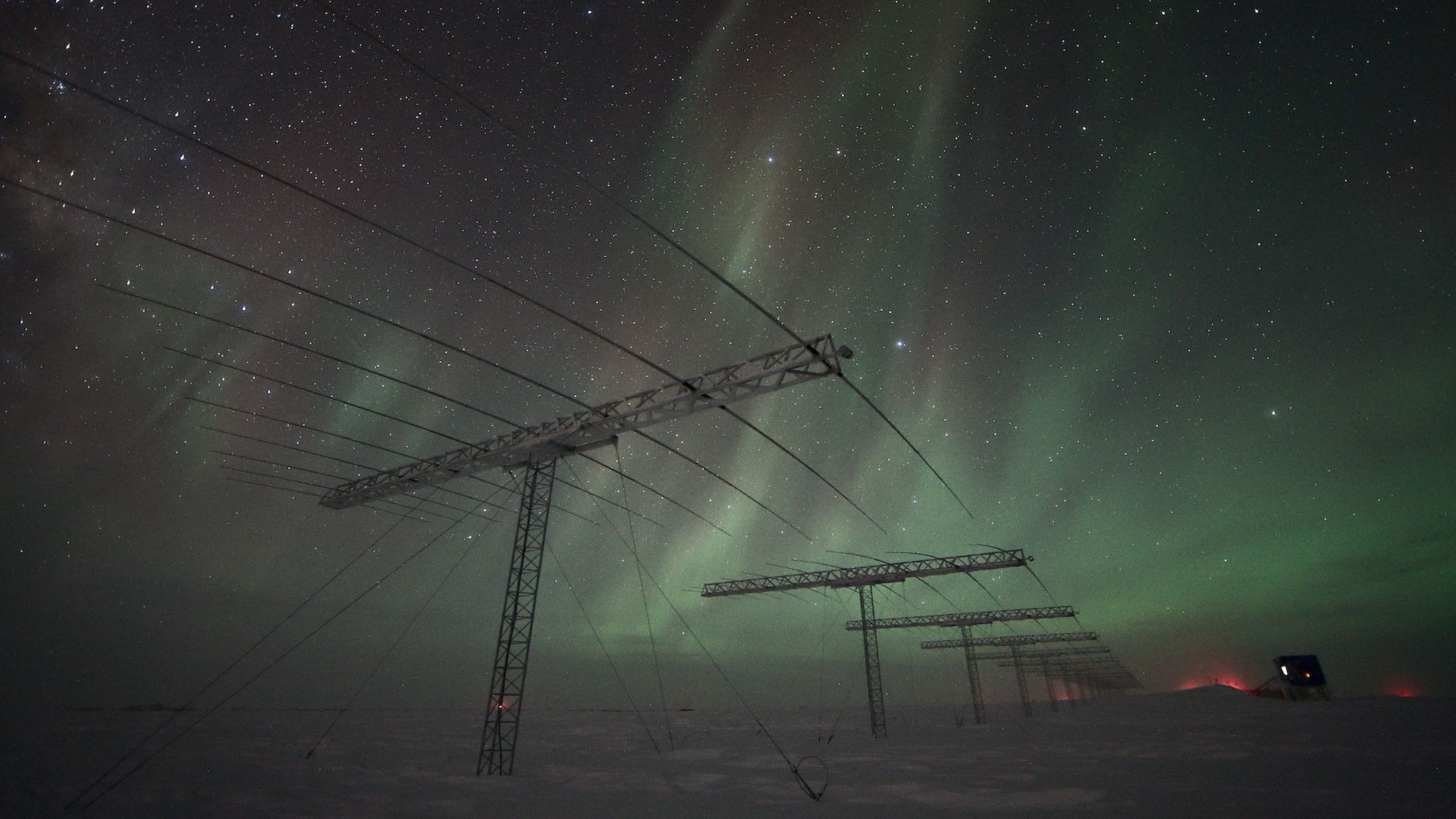
The geomagnetic field protects life on Earth’s surface from harmful charged particles in solar radiation. We can see the effects of charged particles from the Sun interacting with the geomagnetic field in the upper atmosphere during aurorae such as the northern lights.
And because it extends into space, the geomagnetic field also protects orbiting spacecraft, including most satellites and the International Space Station (ISS). However, the study authors warn that spacecraft — and spacefarers — that enter the South Atlantic weak spot during their orbits of our planet could now be exposed to more radiation.
For spacecraft hardware, this radiation could cause more malfunctions, damage, or even blackouts. “The main consequence is for our low-Earth-orbit satellite infrastructure,” Finlay said. “These satellites experience higher rates of charged particles when they pass through the weak field region, which can cause problems for the electronics.”
Danger to astronauts
People in orbit will also face higher risks from radiation, including a greater chance of DNA damage and of suffering cancer during their lifetimes. “Astronauts will also experience these charged particles, but their times in orbit are shorter than the lifetime of most low-Earth-orbit satellites,” Finlay said. (On average, astronauts on the ISS spend about 6 months in low Earth orbit, but satellites typically spend more than 5 years there — about 10 times as long.)
The geomagnetic field is relatively weak compared with more familiar forms of magnetism: Its intensity ranges from about 22,000 to 67,000 nanoteslas. In comparison, a typical refrigerator magnet has an intensity of about 10 million nanoteslas.
In the SAA, the geomagnetic field’s intensity is lower than 26,000 nanoteslas. According to the study, the region’s area has grown by almost 1% of the area of Earth’s surface since 2014. The weakest point in the SAA now measures 22,094 nanoteslas — a decrease of 336 nanoteslas since 2014.
In the region of strong geomagnetic field over northern Canada, the intensity is greater than 57,000 nanoteslas. The study found that the area has shrunk by 0.65% of the area of Earth’s surface, while its strongest spot has fallen to 58,031 nanoteslas, a drop of 801 nanoteslas since 2014. In contrast, a strong field region in Siberia has grown in size, increasing in area by 0.42% of Earth’s surface area, with the maximum field intensity increasing by 260 nanoteslas since 2014 to 61,619 nanoteslas today.
Image 1 of 2


These changes in the Northern Hemisphere were unexpected, Finlay said. “It is related to the circulation patterns of the liquid metal in the core, but we are not certain of the exact cause,” he said.
The study did not, however, find any sign of an impending magnetic field reversal. Earth’s magnetic field has already reversed hundreds of times, but “we know from paleomagnetic records that Earth’s magnetic field has weakened many times in the past, displaying weak field regions like the South Atlantic Anomaly, without reversing,” Finlay said. “We are more likely seeing a decade to century timescale fluctuation in the field.”
“Hardened” spacecraft
The heightened danger from solar radiation to satellites and astronauts passing over the SAA could be mitigated by ensuring that spacecraft are “hardened” to withstand it, Finlay said: “Since the weakness is growing, the satellites will experience such effects over a larger area, [so] this should be taken into account when designing future missions.”
Geophysicist Hagay Amit of Nantes Université in France, who wasn’t involved in the latest study but who has studied the SAA, noted that several scientists have proposed possible reasons for the observed changes in the geomagnetic field, but the actual mechanisms remain unknown. “Overall, [the authors] convincingly demonstrated that continuous high-quality geomagnetic measurements are crucial for providing vital insights into the dynamics in the deep Earth,” he told Eos in an email.
This article was originally published on Eos.org. Read the original article.
