Close Menu
  • Home
  • UNSUBSCRIBE
  • News
  • Lifestyle
  • Tech
  • Entertainment
  • Sports
  • Travel
Facebook X (Twitter) WhatsApp
Trending
  • George Kittle’s wife shares live reaction to Achilles injury
  • ‘The scientific cost would be severe’: A Trump Greenland takeover would put climate research at risk
  • Headlines Across OC as Angel Stadium Sale Debate Intensifies
  • Anti-Islam activists clash with pro-Muslim counter-protesters in Dearborn, Michigan
  • Best monitor deal: Get the 45-inch LG Ultragear gaming monitor for its lowest price yet
  • Slovakia U21 0 – 4 England U21
  • 13 Top Sleep Products That Transform Your Bedtime Routine for Better Rest
  • Firefighters rescue puppies from burning house
Facebook X (Twitter) WhatsApp
Baynard Media
  • Home
  • UNSUBSCRIBE
  • News
  • Lifestyle
  • Tech
  • Entertainment
  • Sports
  • Travel
Baynard Media
Home»Lifestyle»James Webb telescope may have found the universe’s first generation of stars
Lifestyle

James Webb telescope may have found the universe’s first generation of stars

EditorBy EditorNovember 13, 2025No Comments4 Mins Read
Share Facebook Twitter Pinterest LinkedIn Tumblr Reddit Telegram Email
Share
Facebook Twitter LinkedIn Pinterest Email

Astronomers using the James Webb telescope may have discovered some of the universe’s first stars, and they may offer clues to how galaxies form. Using the James Webb Space Telescope (JWST) and a phenomenon first predicted by Albert Einstein, the scientists spotted the early stars, known as Population III stars, in a distant cluster called LAP1-B, located 13 billion light-years from Earth. They described their results Oct. 27 in The Astrophysical Journal Letters.

Population III stars, sometimes called dark stars, are theorized to be some of the first stars that formed after the Big Bang about 13.8 billion years ago. According to this theory, hydrogen and helium combined with dark matter, creating gargantuan stars a million times the mass of the sun and a billion times as bright as our star.

There are several reasons the team suspects the stars spotted by JWST are Population III, lead study author Eli Visbal, an associate professor and astrophysicist at the University of Toledo in Ohio, told Live Science in an email.


You may like

For example, the stars’ spectra, which show their composition based on the light they absorb and emit, had emission lines suggesting lots of high-energy photons, which is consistent with Population III predictions. The spectra also suggested the stars are very large — each on the order of 100 solar masses — and the mass of the stars met some theoretical calculations.

“If indeed Pop III, this is the first detection of these primordial stars,” Visbal told Live Science.

However, JWST was suspected to have seen Population III stars before, the team noted in the study. For example, peer-reviewed research in March 2024 suggested that the telescope had spotted some in the galaxy GN-z11 that formed only 430 million years after the universe itself.

The new study argues, however, that the detection of LAP1-B is the only one that fits three theoretical conditions for Population III stars: It formed in a low-metallicity (hydrogen and helium) environment with a temperature suitable to host star formation; the stars formed in low-mass clusters with only a few very large stars present; and the cluster meets mathematical conditions for the initial mass function, or how star masses were distributed among a population when they formed.

Get the world’s most fascinating discoveries delivered straight to your inbox.

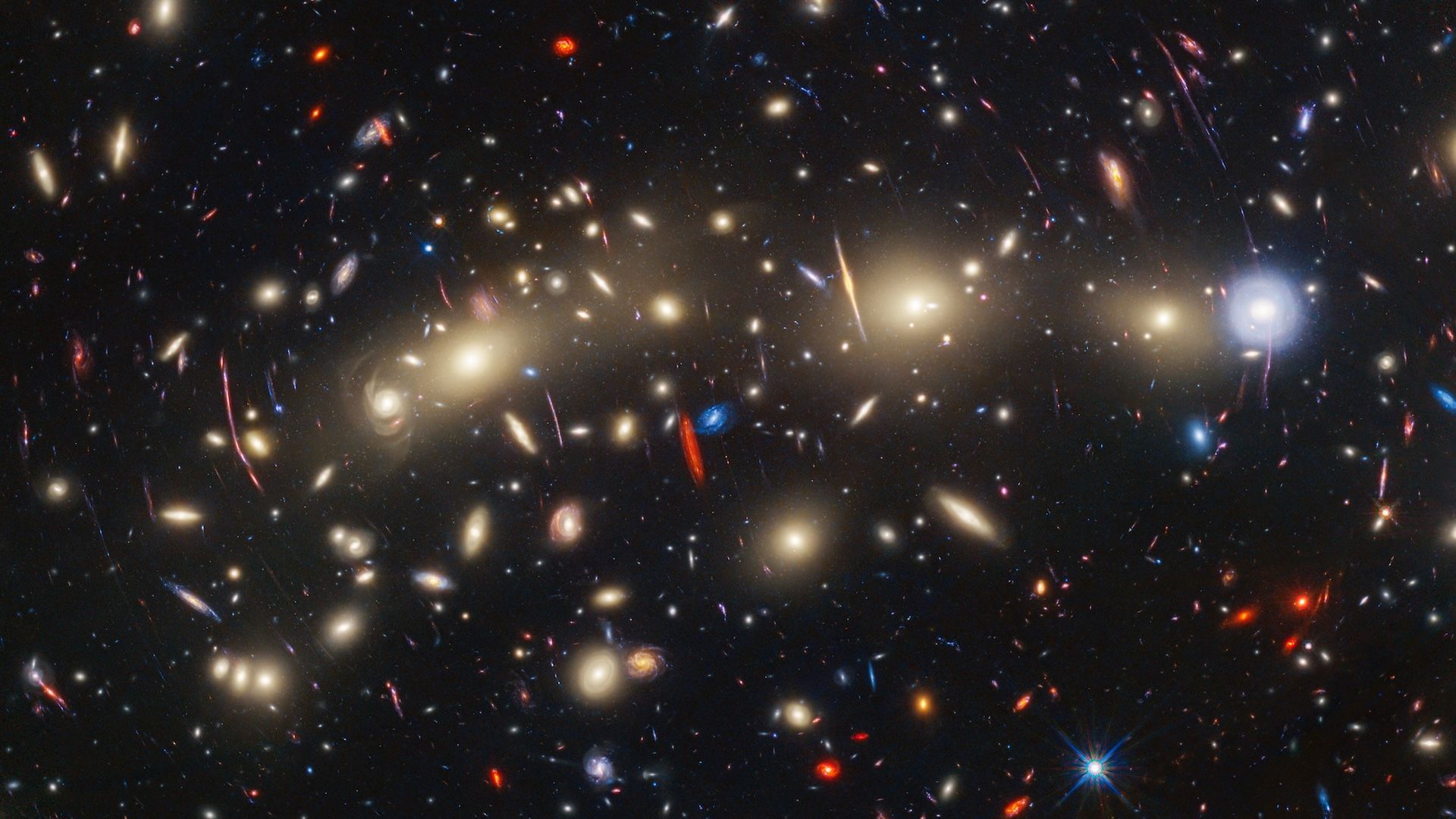
an image of many stars and galaxies in outer space

Another view of MACS J0416 taken with Hubble. The long streaks of colorful light show the effects of gravitational lensing — with the massive gravity of the foreground cluster warping and magnifying the light of distant objects behind it. (Image credit: NASA, ESA, and L. Infante (Pontificia Universidad Católica de Chile))

JWST was essential for the observations because its 6.5-meter (21 feet) mirror allows it to catch faint objects at incredible distances, Visbal said. But what helped LAP1-B pop into view was a phenomenon called gravitational lensing, which happens when a very massive object, such as a galaxy, bends space-time around it while a background object is in just the right spot. As light from the distant background object passes through the “warp” created by the foreground object, the background light is distorted into rings or arcs. This phenomenon is sometimes called an Einstein ring, as it confirms what Einstein suggested would happen more than a century ago.

In this case, LAP1-B became visible when a closer galaxy cluster, called MACS J0416, passed in front of it and “lensed” the light of LAP1-B.

JWST also allowed for observations of the emission lines from the stars, which were initially emitted in ultraviolet wavelengths but then stretched into infrared wavelengths due to the expansion of the universe, Visbal said. JWST is optimized for infrared observations, allowing the stars to be visible.

Aside from the novelty of the star finding, LAP1-B helps showcase how galaxies evolved, Visbal said. Because Population III stars are expected to form in small dark matter structures that also were building blocks for larger galaxies, “they teach us about the earliest stages of galaxy formation and evolution — for example, how metals pollute the initially pristine hydrogen and helium gas.”

Source link

Share. Facebook Twitter Pinterest LinkedIn Tumblr Email
Previous ArticleTrump signs bill ending longest government shutdown in US history
Next Article When will things return to normal post-shutdown?
Editor
  • Website

Related Posts

Lifestyle

‘The scientific cost would be severe’: A Trump Greenland takeover would put climate research at risk

January 17, 2026
Lifestyle

New ‘Transformer’ humanoid robot can launch a shapeshifting drone off its back — watch it in action

November 19, 2025
Lifestyle

Medieval spear pulled from Polish lake may have belonged to prince or nobleman

November 19, 2025
Add A Comment

Comments are closed.

Categories
  • Entertainment
  • Lifestyle
  • News
  • Sports
  • Tech
  • Travel
Recent Posts
  • George Kittle’s wife shares live reaction to Achilles injury
  • ‘The scientific cost would be severe’: A Trump Greenland takeover would put climate research at risk
  • Headlines Across OC as Angel Stadium Sale Debate Intensifies
  • Anti-Islam activists clash with pro-Muslim counter-protesters in Dearborn, Michigan
  • Best monitor deal: Get the 45-inch LG Ultragear gaming monitor for its lowest price yet
calendar
February 2026
M T W T F S S
 1
2345678
9101112131415
16171819202122
232425262728  
« Jan    
Recent Posts
  • George Kittle’s wife shares live reaction to Achilles injury
  • ‘The scientific cost would be severe’: A Trump Greenland takeover would put climate research at risk
  • Headlines Across OC as Angel Stadium Sale Debate Intensifies
About

Welcome to Baynard Media, your trusted source for a diverse range of news and insights. We are committed to delivering timely, reliable, and thought-provoking content that keeps you informed
and inspired

Categories
  • Entertainment
  • Lifestyle
  • News
  • Sports
  • Tech
  • Travel
Facebook X (Twitter) Pinterest WhatsApp
  • Contact Us
  • About Us
  • Privacy Policy
  • Disclaimer
  • UNSUBSCRIBE
© 2026 copyrights reserved

Type above and press Enter to search. Press Esc to cancel.