Close Menu
  • Home
  • UNSUBSCRIBE
  • News
  • Lifestyle
  • Tech
  • Entertainment
  • Sports
  • Travel
Facebook X (Twitter) WhatsApp
Trending
  • ‘In an unrecoverable state’: NASA confirms MAVEN spacecraft is officially dead after loss of signal behind Mars
  • 2 rivers merged to form the Euphrates 3.6 million years ago, eventually leading to the Fertile Crescent
  • NASA confirms fireball meteor exploded over northeastern US with force of 230 tons of TNT
  • Astronauts could use lightning-like plasma jets to kill germs on the moon and Mars, demo hints
  • First whole-genome sequence of a Greenland shark holds clues to their extreme longevity
  • Heading a soccer ball just once is enough to raise levels of proteins associated with brain damage
  • OpenAI’s internal AI model just solved an 80-year-old math problem ‪—‬ and mathematicians verified it
  • Skeletal remains of Queen Elisenda, one of the most powerful rulers in medieval Europe, unearthed in Barcelona — along with several others who bore unexplained stab wounds
Facebook X (Twitter) WhatsApp
Baynard Media
  • Home
  • UNSUBSCRIBE
  • News
  • Lifestyle
  • Tech
  • Entertainment
  • Sports
  • Travel
Baynard Media
Home»Lifestyle»Launch of historic Mars mission aboard Blue Origin’s New Glenn rocket delayed by solar storm
Lifestyle

Launch of historic Mars mission aboard Blue Origin’s New Glenn rocket delayed by solar storm

EditorBy EditorNovember 12, 2025No Comments3 Mins Read
Share Facebook Twitter Pinterest LinkedIn Tumblr Reddit Telegram Email
Share
Facebook Twitter LinkedIn Pinterest Email

While people around the world are getting auroral treats from an active sun, the recent solar activity has caused disappointment for Mars-mission fans. Due to the adverse space weather, they will now have to wait to see two Red Planet-bound spacecraft launch aboard a Blue Origin rocket.

NASA’s twin ESCAPADE spacecraft were supposed to fly to Mars as soon as this afternoon (Nov. 12), but strong solar activity means the mission will have to wait until an indeterminate date, Blue Origin officials said in a post on the social platform X. The mission has already been delayed several times from an expected October 2024 liftoff date due to technical and scheduling issues, and a recent launch attempt on Nov. 9 was stood down due to the weather on Earth.

“Due to highly elevated solar activity and its potential effects on the ESCAPADE spacecraft, NASA is postponing launch until space weather conditions improve,” Blue Origin officials wrote. “We are currently assessing opportunities to establish our next launch window based on forecasted space weather and range availability.”


You may like

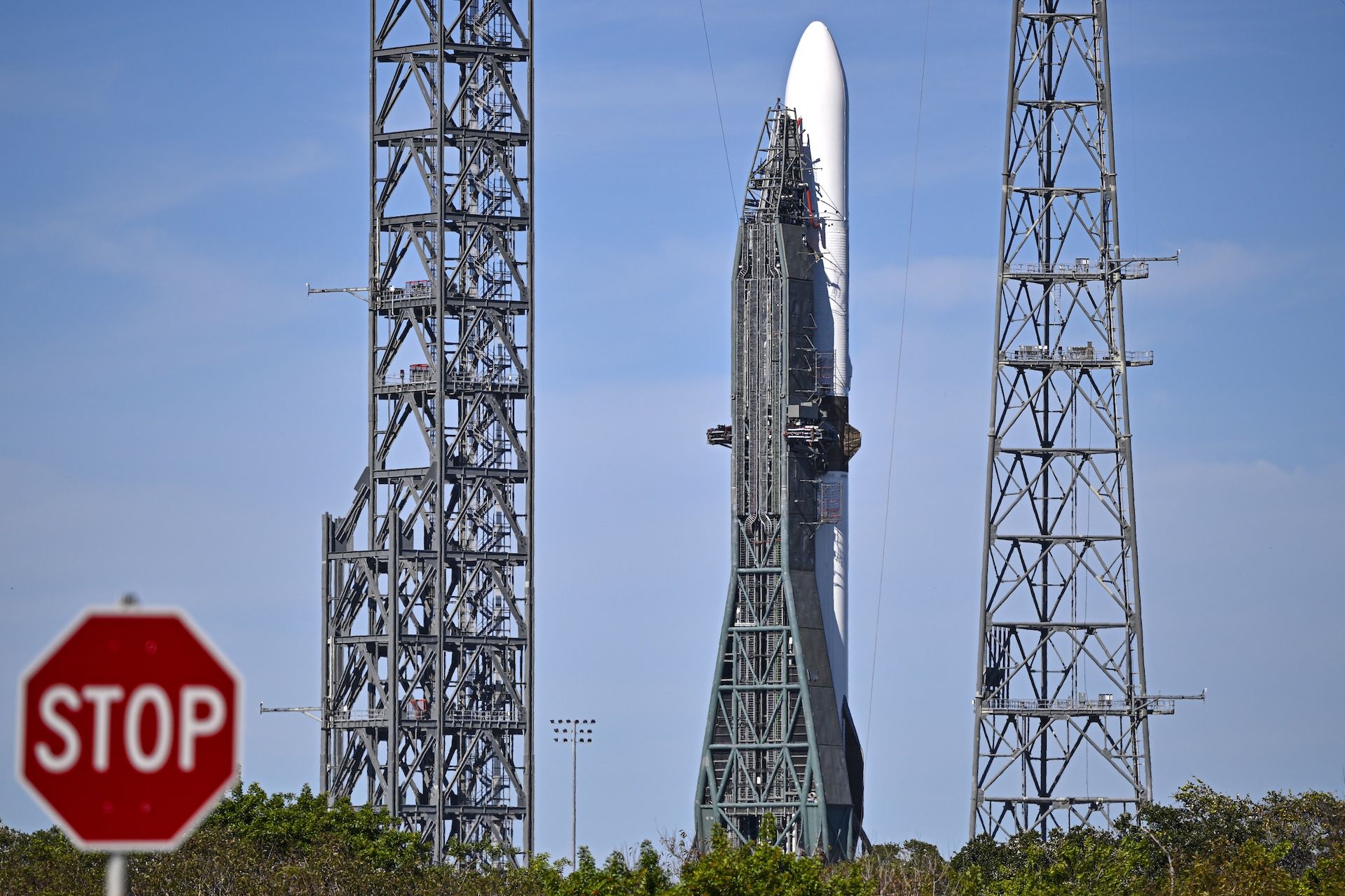
ESCAPADE — short for Escape and Plasma Acceleration and Dynamics Explorers — is a mission managed by NASA that uses two spacecraft built by California-based aerospace company Rocket Lab. The spacecraft will fly aboard the 321-foot-tall (98 meters) Blue Origin’s New Glenn rocket, which is designed for orbital and interplanetary missions like this Mars effort.

Ironically, ESCAPADE is designed to study the very same space weather that is delaying it. The sun has an 11-year cycle of solar activity and is at the peak in 2025. As the sun releases large, fast-moving clouds of plasma known as coronal mass ejections, this electrically charged material triggers auroras when the particles interact with Earth’s magnetic field lines and atmosphere. Severe solar storms can also affect satellites and power lines, which is why NASA and other groups are eager to keep an eye on the sky.

ESCAPADE will examine how this space weather as well as solar wind — the constant stream of charged particles the sun sends through the solar system — previously stripped Mars of the thicker atmosphere the Red Planet had in its ancient past. Scientists believe that as the atmosphere thinned, flowing water on the surface dried up, leaving Mars as a largely desert world aside from ice at the poles and suspected reserves of water underground.

The nearly $80 million ESCAPADE isn’t the only payload aboard New Glenn. Within the rocket’s second stage is a telemetry communications experiment for Viasat flying on behalf of NASA’s Communications Services Project, Blue Origin officials said in a report from Live Science’s sister website Space.com.

Get the world’s most fascinating discoveries delivered straight to your inbox.

New Glenn has only been used in one mission so far — during the NG-1 mission in January. Its first stage is designed to land on a barge in the ocean so it can be reused. However, during the January mission, it failed to land on its barge and was lost.

Blue Origin also eventually plans to use New Glenn for moon exploration, bringing both humans and scientific equipment to the lunar surface aboard its yet-to-be flown Blue Moon lander.

Rival aerospace company SpaceX is, for now, tasked with the first human landing of NASA’s Artemis moon program, which may happen aboard the company’s Starship as soon as 2027. But delays in Starship’s development recently prompted acting NASA administrator Sean Duffy to suggest he may reopen the Artemis 3 contract to Blue Origin and other companies.

Source link

Share. Facebook Twitter Pinterest LinkedIn Tumblr Email
Previous ArticleShutdown deal clears key House hurdle, setting stage for final vote tonight
Next Article Democrat Adelita Grijalva sworn in after 7-week delay
Editor
  • Website

Related Posts

Lifestyle

‘In an unrecoverable state’: NASA confirms MAVEN spacecraft is officially dead after loss of signal behind Mars

June 3, 2026
Lifestyle

2 rivers merged to form the Euphrates 3.6 million years ago, eventually leading to the Fertile Crescent

June 2, 2026
Lifestyle

NASA confirms fireball meteor exploded over northeastern US with force of 230 tons of TNT

June 2, 2026
Add A Comment

Comments are closed.

Categories
  • Entertainment
  • Lifestyle
  • News
  • Sports
  • Tech
  • Travel
Recent Posts
  • ‘In an unrecoverable state’: NASA confirms MAVEN spacecraft is officially dead after loss of signal behind Mars
  • 2 rivers merged to form the Euphrates 3.6 million years ago, eventually leading to the Fertile Crescent
  • NASA confirms fireball meteor exploded over northeastern US with force of 230 tons of TNT
  • Astronauts could use lightning-like plasma jets to kill germs on the moon and Mars, demo hints
  • First whole-genome sequence of a Greenland shark holds clues to their extreme longevity
calendar
June 2026
M T W T F S S
1234567
891011121314
15161718192021
22232425262728
2930  
« May    
Recent Posts
  • ‘In an unrecoverable state’: NASA confirms MAVEN spacecraft is officially dead after loss of signal behind Mars
  • 2 rivers merged to form the Euphrates 3.6 million years ago, eventually leading to the Fertile Crescent
  • NASA confirms fireball meteor exploded over northeastern US with force of 230 tons of TNT
About

Welcome to Baynard Media, your trusted source for a diverse range of news and insights. We are committed to delivering timely, reliable, and thought-provoking content that keeps you informed
and inspired

Categories
  • Entertainment
  • Lifestyle
  • News
  • Sports
  • Tech
  • Travel
Facebook X (Twitter) Pinterest WhatsApp
  • Contact Us
  • About Us
  • Privacy Policy
  • Disclaimer
  • UNSUBSCRIBE
© 2026 copyrights reserved

Type above and press Enter to search. Press Esc to cancel.