
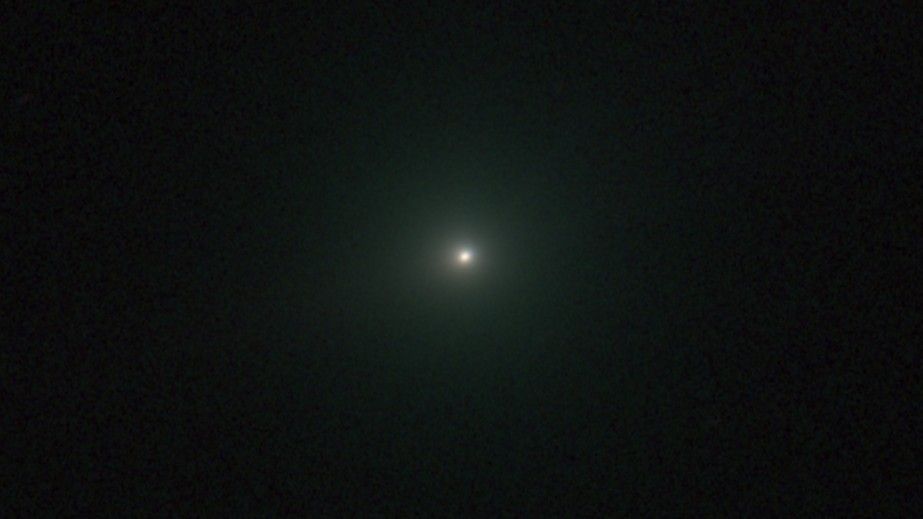

A new image of comet 3I/ATLAS has revealed that the interstellar visitor is glowing green and hiding its tail, but that doesn’t mean there’s anything wrong with it.
Comets develop an atmosphere, or coma, as they fly close to the sun. This cloud of gas and dust grows larger and brighter as the sun heats up ice and other materials on the comet, which sublimate into gases that astronomers can observe. In this case, the atmosphere is brightest when viewed with a green filter, like with most comets that fly close to our star.
Zhang used a filter to detect diatomic carbon (C2) particles, which glow green. He noted that there’s a bunch of large molecules in the comet that contain carbon and hydrogen (hydrocarbons). And when the comet gets close to the sun, ultraviolet (UV) light breaks these molecules apart.
“It’s sort of for the same reason that if we stay out in the sun too long without sunscreen, we get sunburnt,” Zhang told Live Science. “The UV rays are destroying our DNA [in our skin cells], which is kind of a similar type of molecule in the sense that it’s big and contains carbon.”
When this happens on a comet, some of the molecule chunks are two carbon atoms stuck together, or diatomic carbon, which are easy for astronomers to detect.
The comet appears to lack a dust tail in the image, but it’s still there. Zhang noted that if you look closely at the image, you can see it’s a bit brighter on the left side of the comet than on the right. That slight asymmetric glow occurs because we’re seeing the tail basically head-on, and it’s right behind the comet, curving slightly off to the left. In other words, the comet’s apparent lack of tail isn’t anything to get excited about.
Comet 3I/ATLAS has become a celestial celebrity since its discovery in July. A lot of this buzz stems from speculation that the comet might be an alien spacecraft, even though most astronomers are confident that the interstellar visitor is a comet from an unknown star system in the Milky Way.
However, describing 3I/ATLAS as just a regular comet would do this rare solar system interloper an injustice. The comet is only the third interstellar visitor ever recorded and could be the oldest comet ever seen, with one study suggesting it’s around 3 billion years older than the solar system.
Comet 3I/ATLAS has only recently become visible from Earth again after it briefly disappeared behind the sun, reaching its closest point to our star, known as perihelion, on Oct. 29. This post-perihelion phase opens up a critical window for astronomers hoping to learn more about the comet’s gases and makeup, as comets tend to be their most active at perihelion.

Preliminary research suggested that prolonged exposure to space radiation has given comet 3I/ATLAS a thick irradiated crust that no longer resembles its home star system. If confirmed, this crust could mean scientists will have a harder time deciphering 3I/ATLAS’ origins, as it will be venting irradiated material rather than pristine material from its home star system.
Zhang previously used the Lowell Discovery Telescope to get a first optical, post-perihelion look at 3I/ATLAS from Earth on Halloween (Oct. 31). As with his first observation, the new sighting was made during morning twilight. The comet is moving northward from our perspective, away from the northeastern horizon. At the moment, it’s possible to observe the comet early in the morning, when the comet is rising above the horizon.
Zhang took multiple images of the comet with different filters. The diatomic carbon image, which he first posted to his Cometary blog on Wednesday, roughly depicts what the comet might look like if humans were able to see it with the naked eye.
On Oct. 28, Zhang and his colleague posted a study to the preprint server arXiv that suggested comet 3I/ATLAS underwent rapid brightening ahead of perihelion and was distinctly bluer than the sun. The green in the new image doesn’t mean that the comet changed color after perihelion — it might have changed color before.
Zhang noted that, in astronomical terms, bluer or redder typically refers to longer (red) or shorter (blue) wavelengths of light, with the new observation matching the latter. The comet is a lot brighter when viewed with bluer filters than redder filters, though the bluer filters are more of a mix of green and blue, and not actually that sensitive to pure blue.
“It’s brightest in the bluest filter that we have,” Zhang said.
The Lowell Discovery Telescope was likely one of the largest telescopes that could point close enough to the horizon to see comet 3I/ATLAS immediately after perihelion, according to Zhang. However, he noted that the comet is now high enough above the horizon that a number of large telescopes can make observations — small personal telescopes with a 6-inch (15 centimeters) lens can also spot it.
Expect a flurry of interesting findings on the comet in the coming months.
