Close Menu
  • Home
  • UNSUBSCRIBE
  • News
  • Lifestyle
  • Tech
  • Entertainment
  • Sports
  • Travel
Facebook X (Twitter) WhatsApp
Trending
  • Artemis III crew revealed: NASA announces astronauts for ‘one of history’s most complex missions’
  • China unveils first-of-its-kind ‘dual-core’ quantum computer — its makers say it improves stability and efficiency
  • PMOS (formerly PCOS): Symptoms, diagnosis and treatment
  • 2,000 years ago in Scotland, people removed a corpse’s brain and fashioned the arm bones into tools
  • Scientists are fast-tracking 3 Ebola vaccines in hopes of shortening the outbreak — when could they be ready?
  • 2 vanished ‘super Earths’ once orbited near Uranus and Neptune, new study hints
  • Ditch full of 7,000-year-old headless human skeletons discovered in Slovakia, baffling archaeologists
  • Manhattan Project physicist Richard Feynman’s forgotten notes on ‘the restaurant problem’ deciphered after 50 years
Facebook X (Twitter) WhatsApp
Baynard Media
  • Home
  • UNSUBSCRIBE
  • News
  • Lifestyle
  • Tech
  • Entertainment
  • Sports
  • Travel
Baynard Media
Home»Lifestyle»James Webb and Very Large telescopes discover bizarre ‘runaway’ planet that’s acting like a star, eating 6 billion tons per second
Lifestyle

James Webb and Very Large telescopes discover bizarre ‘runaway’ planet that’s acting like a star, eating 6 billion tons per second

EditorBy EditorNovember 6, 2025No Comments4 Mins Read
Share Facebook Twitter Pinterest LinkedIn Tumblr Reddit Telegram Email
Share
Facebook Twitter LinkedIn Pinterest Email

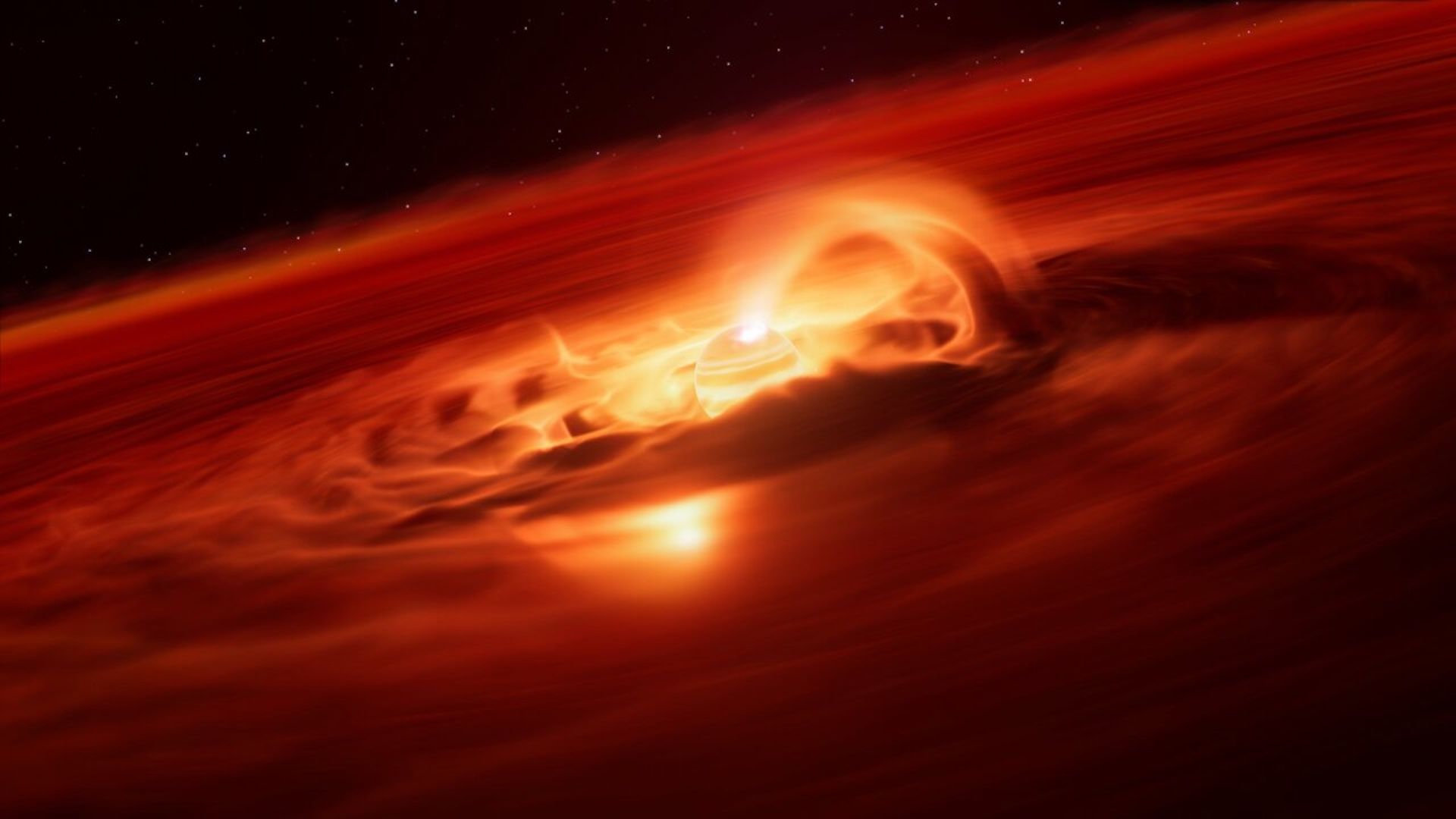
Astronomers have spotted a “rogue” planet gobbling gas and dust at a record rate, and they can’t explain its baffling behavior.

Although many rogue planets, which float freely through space without orbiting a star, have been discovered before, this one — known as Cha 1107-7626 — appears to be the fastest-growing free-floating planet ever discovered, gorging at a peak rate of 6.6 billion tons (6 billion metric tons) of matter per second, according to observations with the European Southern Observatory’s Very Large Telescope (VLT) in Chile and the James Webb Space Telescope (JWST).

The exoplanet‘s rapid growth spurt may help scientists learn more about the difference between large planets and small stars, the team reported Oct. 2 in The Astrophysical Journal Letters.


You may like

“Our main motivation to study this kind of object is to understand whether these objects are former planets that have been ejected from their planetary system, or they have formed ‘isolated’ from the gravitational collapse of molecular cloud material, like stars,” lead study author Víctor Almendros-Abad, an astronomer at the Palermo Astronomical Observatory in Italy, told Live Science in an email.

The team spotted an “accretion burst,” which happens when a planet suddenly pulls in a lot of material from its surrounding disk of gas and dust. Cha 1107-7626 is always accreting from this source material, but the study shows that the accretion rate is not steady. In fact, in August 2025, the planet was accreting eight times faster than it was a few months before.

Accretion bursts suggest that rogue worlds may be like young stars, since these sudden bursts of eating have been observed in stars. But because rogue planets are so much smaller than stars, it’s unclear where their formation pathways diverge.

“Accretion bursts have been known for quite some time; the first was discovered in the late 1930s, long before it was clear what we are witnessing,” study co-author Alexander Scholz, a professor of astrophysics at the University of St. Andrews in Scotland, told Live Science in an email. “Such events are now understood to play an important role in the assembly of stars. They also shape the environment in which planetary systems form, by heating the gas and dust nebula surrounding young stars.

Get the world’s most fascinating discoveries delivered straight to your inbox.

A telescope image of many stars in outer space

An infrared image, taken with ESO’s Visible and Infrared Telescope for Astronomy (VISTA), showing the position of the rogue planet Cha 1107-7626. The planet is a dot located exactly at the center of the frame. (Image credit: ESO/Meingast et al.)

“The relics of such bursts may be seen in the chemistry of meteorites in our own solar system,” Scholz continued. “It is not clear if bursts happen to all young stars, and what triggers them. The discovery of a similar event in a planetary-mass object may be a clue that there is a universal mechanism behind accretion bursts. In this sense, our discovery will have a much wider impact.”

Scientists have spotted more rogue planets in recent years, including a notable haul by JWST that discovered more than 500 of these worlds in a trapezoid-shaped spot within the Orion Nebula, a vast gas cloud noted for its star births.

Rogue planets remain hard to find, however, as they glow in infrared light (radiant energy) best visible in large telescopes such as JWST and VLT, Almendros-Abad said. The scientists hope VLT and JWST can look at more of these rogue planets, to learn whether they form like stars or planets. Almendros-Abad noted that the accretion parallels between stars and planets are not fully understood.

“One of the next steps is to understand how common these types of events are in ‘rogue planets,'” he said. “This will tell us how important [accretion events] are in their evolution.”

Source link

Share. Facebook Twitter Pinterest LinkedIn Tumblr Email
Previous ArticleSenate candidate Graham Platner indicates he isn’t mourning Dick Cheney’s death
Next Article Should you treat a kid’s fever? What doctors say as Trump Tylenol comments spark flu season debate
Editor
  • Website

Related Posts

Lifestyle

Artemis III crew revealed: NASA announces astronauts for ‘one of history’s most complex missions’

June 10, 2026
Lifestyle

China unveils first-of-its-kind ‘dual-core’ quantum computer — its makers say it improves stability and efficiency

June 10, 2026
Lifestyle

PMOS (formerly PCOS): Symptoms, diagnosis and treatment

June 10, 2026
Add A Comment

Comments are closed.

Categories
  • Entertainment
  • Lifestyle
  • News
  • Sports
  • Tech
  • Travel
Recent Posts
  • Artemis III crew revealed: NASA announces astronauts for ‘one of history’s most complex missions’
  • China unveils first-of-its-kind ‘dual-core’ quantum computer — its makers say it improves stability and efficiency
  • PMOS (formerly PCOS): Symptoms, diagnosis and treatment
  • 2,000 years ago in Scotland, people removed a corpse’s brain and fashioned the arm bones into tools
  • Scientists are fast-tracking 3 Ebola vaccines in hopes of shortening the outbreak — when could they be ready?
calendar
June 2026
M T W T F S S
1234567
891011121314
15161718192021
22232425262728
2930  
« May    
Recent Posts
  • Artemis III crew revealed: NASA announces astronauts for ‘one of history’s most complex missions’
  • China unveils first-of-its-kind ‘dual-core’ quantum computer — its makers say it improves stability and efficiency
  • PMOS (formerly PCOS): Symptoms, diagnosis and treatment
About

Welcome to Baynard Media, your trusted source for a diverse range of news and insights. We are committed to delivering timely, reliable, and thought-provoking content that keeps you informed
and inspired

Categories
  • Entertainment
  • Lifestyle
  • News
  • Sports
  • Tech
  • Travel
Facebook X (Twitter) Pinterest WhatsApp
  • Contact Us
  • About Us
  • Privacy Policy
  • Disclaimer
  • UNSUBSCRIBE
© 2026 copyrights reserved

Type above and press Enter to search. Press Esc to cancel.