Close Menu
  • Home
  • UNSUBSCRIBE
  • News
  • Lifestyle
  • Tech
  • Entertainment
  • Sports
  • Travel
Facebook X (Twitter) WhatsApp
Trending
  • Goodbye PCOS: Polycystic ovary syndrome is getting a new name that doctors say better reflects the underlying disease
  • Microplastics absorb heat in the atmosphere and contribute to global warming — as if they weren’t bad enough
  • ‘Insect apocalypse’ is already fueling malnutrition in some regions, first-of-its-kind study reveals
  • Hantavirus LIVE: American passengers from cruise head to specialized facilities in Nebraska
  • New ‘trick’ fixes major flaw in neutral-atom quantum computers — inching us closer to a superpowerful system
  • A 2025 Alaskan tsunami was one of the largest on record, new research finds
  • Lion’s head pendant: An ancient Egyptian board game piece that was later repurposed into a magical religious object with baboons
  • Are we more closely related to cats or dogs?
Facebook X (Twitter) WhatsApp
Baynard Media
  • Home
  • UNSUBSCRIBE
  • News
  • Lifestyle
  • Tech
  • Entertainment
  • Sports
  • Travel
Baynard Media
Home»Lifestyle»Venomous snake strikes captured in extreme detail through high-speed videos for first time
Lifestyle

Venomous snake strikes captured in extreme detail through high-speed videos for first time

EditorBy EditorOctober 24, 2025No Comments3 Mins Read
Share Facebook Twitter Pinterest LinkedIn Tumblr Reddit Telegram Email
Share
Facebook Twitter LinkedIn Pinterest Email

Scientists finally know how venomous snakes sink their teeth into prey thanks to a series of high-speed videos.

In a new study, published Thursday (Oct. 23) in the Journal of Experimental Biology, scientists recorded various species of snakes striking fake prey, capturing footage from multiple angles and in high definition. The videos revealed three different ways that the snakes take down their dinners.

Scientists have captured the moment when a venomous snake lunges for its meal in photographs and video since the early 1950s. But the strikes happen so quickly — in as little as 0.1 seconds — that older cameras weren’t fast enough to catch all the details. More recent field recordings of snake strikes, meanwhile, have often been limited by low resolution and dim lighting, researchers wrote in the new study.


You may like

To better understand how different types of snakes attack their food, researchers traveled to Venomworld in Paris, an animal facility where study co-author Remi Ksas and colleagues regularly extract venom from snakes and scorpions for medical and pharmaceutical work. There, they crafted fake prey from a muscle-like medical gel and dangled it in front of 36 species of venomous snakes while filming with multiple high-speed cameras.

While tempting the snakes to strike, “I flinched a couple of times,” study co-author Silke Cleuren, a biologist at Monash University in Australia, said in a statement.
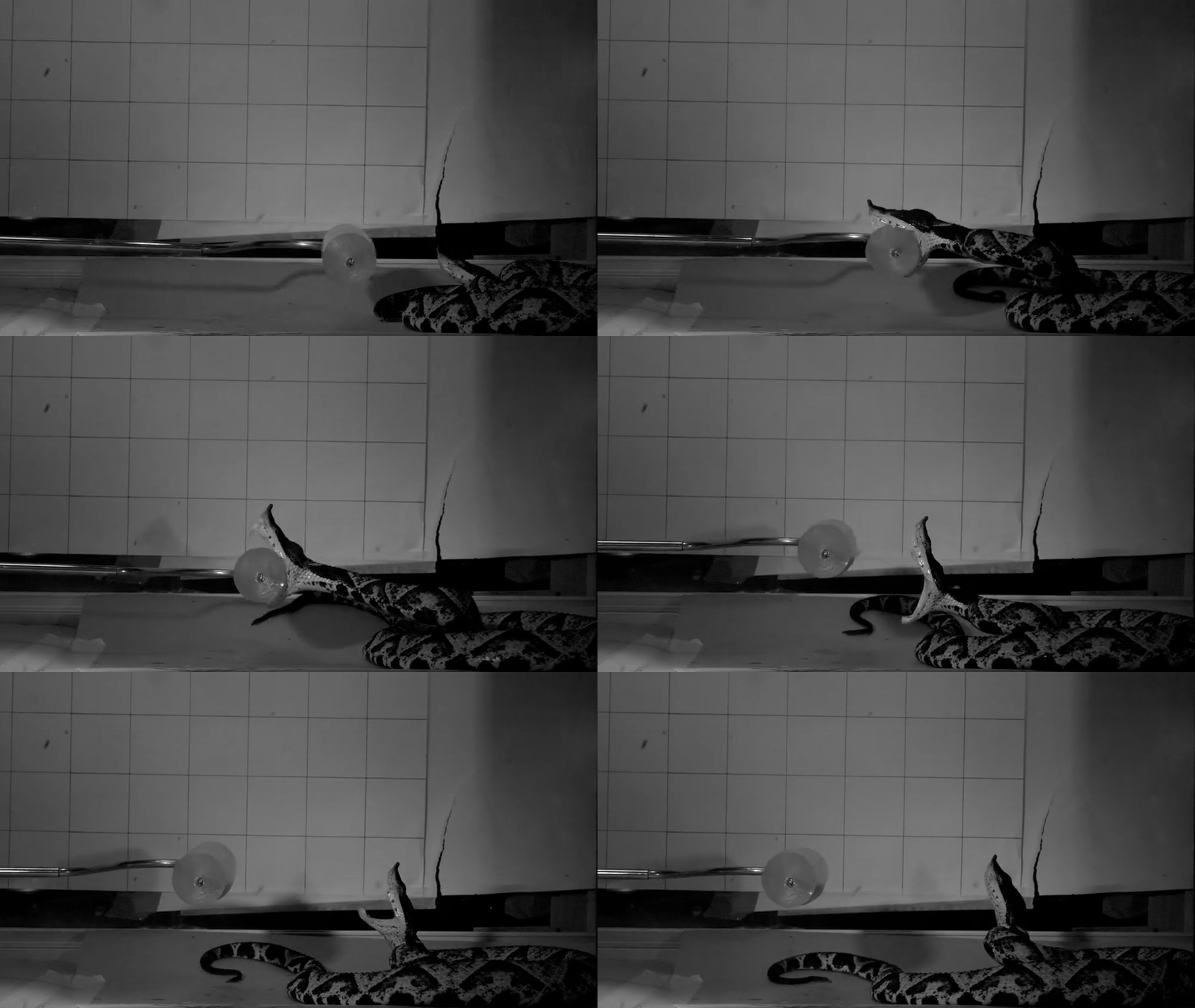
a snake strike in slow motion

Deinagkistrodon acutus, a species of viper endemic to Southeast Asia, striking the fake prey at high speed. (Image credit: Silke G. C. Cleuren, Alistair Evans, James Rule, David P. Hocking, Anthony Herrel)

After recording more than 100 high-speed videos of 36 different snake species striking at the fake prey, the scientists spotted patterns in how these reptiles attack. The footage revealed that most vipers bit their target within 0.1 seconds of lunging — faster than most mammals’ startle response, meaning their prey would be unlikely to escape. While some elapids — the family that includes the rough-scaled death adder (Acanthophis rugosus) and the Cape coral snake (Aspidelaps lubricus) — were just as fast as viperids, others took more than 0.3 seconds to reach their prey.

Different families of snakes injected their venom in different ways, too. Viperids struck quickly from a coiled position but sometimes didn’t get a good angle on their bites. If that happened, the viper would pull a fang out of its prey and reinsert it in a more favorable position before injecting its venom.

Get the world’s most fascinating discoveries delivered straight to your inbox.

Elapids took a sneakier approach, slithering up close to their prey to reduce the distance they had to lunge. They then slightly loosened their jaws and bit down again several times, “likely to prolong the venom flow into their prey,” the researchers wrote in the study.

The team also observed two snakes from the colubrid family, the mangrove snake (Boiga dendrophila) and Fischer’s tree snake (Toxicodryas pulverulenta). These “rear-fanged” snakes inject venom through teeth at the back of their upper jaw. When T. pulverulenta bit the fake prey, it dragged its fangs back and forth across the gel, creating crescent-shaped wounds that may help it deliver as much venom as possible.

Future studies could determine if the size of the prey has any effect on the snakes’ attack, the researchers wrote in the study.

Source link

Share. Facebook Twitter Pinterest LinkedIn Tumblr Email
Previous ArticleCalifornia CDL violation linked to deadly semi-truck crash, feds say
Next Article DC man sues after being detained for playing ‘Darth Vader’s Theme’ while following National Guard around
Editor
  • Website

Related Posts

Lifestyle

Goodbye PCOS: Polycystic ovary syndrome is getting a new name that doctors say better reflects the underlying disease

May 12, 2026
Lifestyle

Microplastics absorb heat in the atmosphere and contribute to global warming — as if they weren’t bad enough

May 12, 2026
Lifestyle

‘Insect apocalypse’ is already fueling malnutrition in some regions, first-of-its-kind study reveals

May 11, 2026
Add A Comment

Comments are closed.

Categories
  • Entertainment
  • Lifestyle
  • News
  • Sports
  • Tech
  • Travel
Recent Posts
  • Goodbye PCOS: Polycystic ovary syndrome is getting a new name that doctors say better reflects the underlying disease
  • Microplastics absorb heat in the atmosphere and contribute to global warming — as if they weren’t bad enough
  • ‘Insect apocalypse’ is already fueling malnutrition in some regions, first-of-its-kind study reveals
  • Hantavirus LIVE: American passengers from cruise head to specialized facilities in Nebraska
  • New ‘trick’ fixes major flaw in neutral-atom quantum computers — inching us closer to a superpowerful system
calendar
May 2026
M T W T F S S
 123
45678910
11121314151617
18192021222324
25262728293031
« Apr    
Recent Posts
  • Goodbye PCOS: Polycystic ovary syndrome is getting a new name that doctors say better reflects the underlying disease
  • Microplastics absorb heat in the atmosphere and contribute to global warming — as if they weren’t bad enough
  • ‘Insect apocalypse’ is already fueling malnutrition in some regions, first-of-its-kind study reveals
About

Welcome to Baynard Media, your trusted source for a diverse range of news and insights. We are committed to delivering timely, reliable, and thought-provoking content that keeps you informed
and inspired

Categories
  • Entertainment
  • Lifestyle
  • News
  • Sports
  • Tech
  • Travel
Facebook X (Twitter) Pinterest WhatsApp
  • Contact Us
  • About Us
  • Privacy Policy
  • Disclaimer
  • UNSUBSCRIBE
© 2026 copyrights reserved

Type above and press Enter to search. Press Esc to cancel.