Close Menu
  • Home
  • UNSUBSCRIBE
  • News
  • Lifestyle
  • Tech
  • Entertainment
  • Sports
  • Travel
Facebook X (Twitter) WhatsApp
Trending
  • An ancient piece of the moon found in Africa hints at a long-ago collision that turned the lunar surface molten
  • Do you really have to wash rice before you cook it?
  • Neuroscientists are searching for the ‘cellular substrate of loneliness’
  • Bow-Wow, Ding-Dong, Pooh-Pooh: Expert explains early theories of how human language evolved — and their silly names
  • Famous child mummies in Andes may belong to kids who were sacrificed to ‘ritually anchor’ the Inca’s presence as their empire expanded
  • Artemis II crew captures rare double auroras on the dark side of Earth as they zoom toward the moon — Space photo of the week
  • Has all the water on Earth been peed before?
  • ‘This might be the point of no return’: Experts on the current measles outbreak and where we go from here
Facebook X (Twitter) WhatsApp
Baynard Media
  • Home
  • UNSUBSCRIBE
  • News
  • Lifestyle
  • Tech
  • Entertainment
  • Sports
  • Travel
Baynard Media
Home»Lifestyle»Double comet alert! Comets Lemmon and SWAN will be at their closest and brightest this week. Here’s how to spot them.
Lifestyle

Double comet alert! Comets Lemmon and SWAN will be at their closest and brightest this week. Here’s how to spot them.

EditorBy EditorOctober 19, 2025No Comments3 Mins Read
Share Facebook Twitter Pinterest LinkedIn Tumblr Reddit Telegram Email
Share
Facebook Twitter LinkedIn Pinterest Email

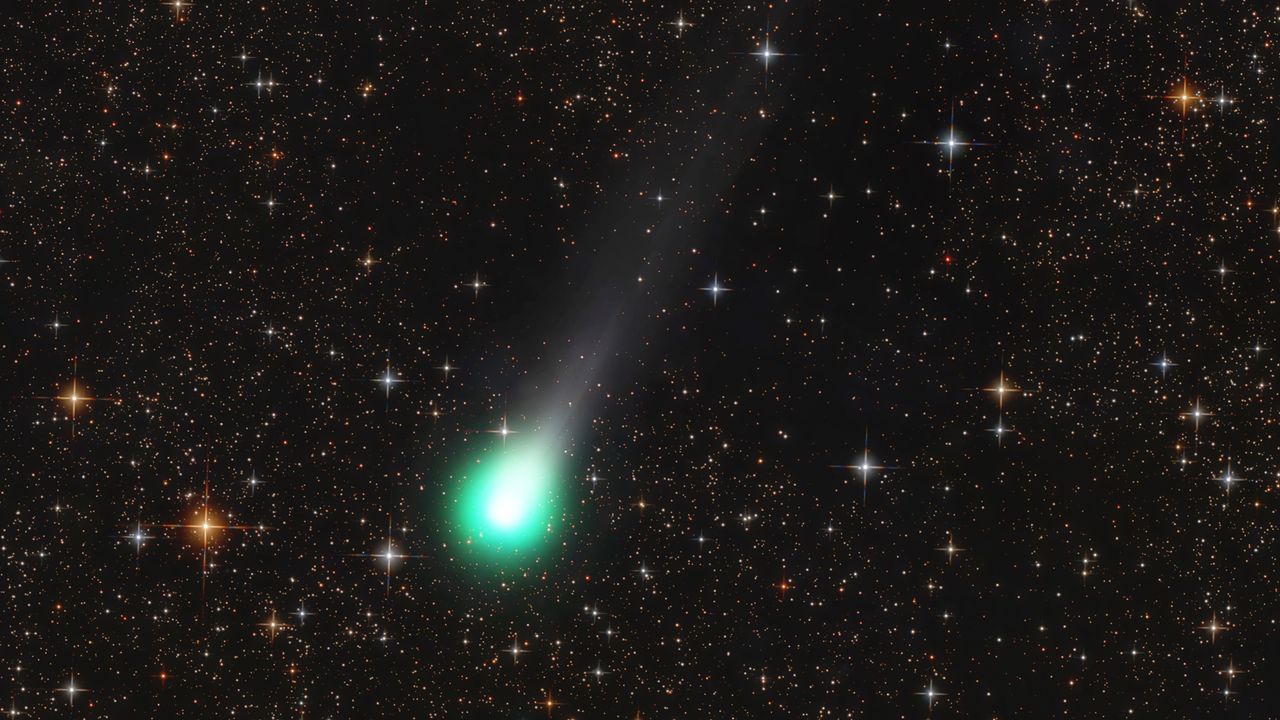
If you want to see two comets, your best chance will be early this week. After a year without any comets bright enough to be seen without specialist equipment, two — Comet C/2025 A6 (Lemmon) and Comet C/2025 R2 (SWAN) — have come along at once.

Comet Lemmon may look more like a lime than its name suggests, but on Tuesday (Oct. 21), the dusty snowball from the outer solar system will reach its closest point to Earth and most likely shine at its brightest. It’s now reached magnitude 4.5, according to SpaceWeather.com — about the same brightness as spring’s Beehive Cluster (M44) and only a little dimmer than the Andromeda galaxy (M31).

While Comet Lemmon is technically visible to the naked eye in very dark skies, you’ll need binoculars to glimpse another, fainter icy visitor, Comet C/2025 R2 (SWAN). Remarkably, Comet SWAN will get closest to Earth Monday (Oct. 20), the day before Comet Lemmon, but it’ll be about three times dimmer, at magnitude 5.9. (In astronomy, the higher the magnitude, the dimmer the object.)


You may like

The best time to see both comets any night this week will be about an hour and a half after sunset; you can check local times on Timeanddate.com. On Monday, Comet Lemmon will be visible in the northwest sky, near the Big Dipper and the bright star Arcturus, and close to the horizon.

Follow the shape of stars in the Big Dipper’s handle to “arc to Arcturus”; the comet will be about two-thirds of the way there. On Tuesday, it will be a little higher. For Comet SWAN, look for the Summer Triangle of bright stars — Vega, Deneb and Altair — in the southwest. You’ll find Comet SWAN about halfway between Altair and the horizon.

Helpful finder charts and sky maps for both comets are available at The Sky Live, In-The-Sky.org and Stellarium, as well as in night-sky apps such as Sky Guide, Sky Tonight and SkySafari 7 Pro. If you want to try photographing the comets, our guide has you covered.

The two comets are on vastly different journeys. Comet Lemmon will get to within 56 million miles (89 million kilometers) of Earth Tuesday, according to The Sky Live, on its way to looping around the sun Nov. 8 during its 1,350-year orbit of the sun. (However, Jupiter sapped some of Comet Lemmon’s orbital energy, shortening its period by nearly 200 years, according to Star Walk, so it will not return until 3179.)

Get the world’s most fascinating discoveries delivered straight to your inbox.

Comet SWAN is a long-period comet, orbiting the sun every 20,000 years, according to Universe Today, and on Monday, it will be 24 million miles (39 million km) away as it exits the inner solar system. That’s about a quarter the distance between Earth and the sun.

Source link

Share. Facebook Twitter Pinterest LinkedIn Tumblr Email
Previous ArticleRetired FBI agent blasts Mamdani for campaigning with WTC bombing co-conspirator
Next Article Thieves steal priceless jewels, Paris museum closed
Editor
  • Website

Related Posts

Lifestyle

An ancient piece of the moon found in Africa hints at a long-ago collision that turned the lunar surface molten

June 15, 2026
Lifestyle

Do you really have to wash rice before you cook it?

June 15, 2026
Lifestyle

Neuroscientists are searching for the ‘cellular substrate of loneliness’

June 14, 2026
Add A Comment

Comments are closed.

Categories
  • Entertainment
  • Lifestyle
  • News
  • Sports
  • Tech
  • Travel
Recent Posts
  • An ancient piece of the moon found in Africa hints at a long-ago collision that turned the lunar surface molten
  • Do you really have to wash rice before you cook it?
  • Neuroscientists are searching for the ‘cellular substrate of loneliness’
  • Bow-Wow, Ding-Dong, Pooh-Pooh: Expert explains early theories of how human language evolved — and their silly names
  • Famous child mummies in Andes may belong to kids who were sacrificed to ‘ritually anchor’ the Inca’s presence as their empire expanded
calendar
June 2026
M T W T F S S
1234567
891011121314
15161718192021
22232425262728
2930  
« May    
Recent Posts
  • An ancient piece of the moon found in Africa hints at a long-ago collision that turned the lunar surface molten
  • Do you really have to wash rice before you cook it?
  • Neuroscientists are searching for the ‘cellular substrate of loneliness’
About

Welcome to Baynard Media, your trusted source for a diverse range of news and insights. We are committed to delivering timely, reliable, and thought-provoking content that keeps you informed
and inspired

Categories
  • Entertainment
  • Lifestyle
  • News
  • Sports
  • Tech
  • Travel
Facebook X (Twitter) Pinterest WhatsApp
  • Contact Us
  • About Us
  • Privacy Policy
  • Disclaimer
  • UNSUBSCRIBE
© 2026 copyrights reserved

Type above and press Enter to search. Press Esc to cancel.