Close Menu
  • Home
  • UNSUBSCRIBE
  • News
  • Lifestyle
  • Tech
  • Entertainment
  • Sports
  • Travel
Facebook X (Twitter) WhatsApp
Trending
  • George Kittle’s wife shares live reaction to Achilles injury
  • ‘The scientific cost would be severe’: A Trump Greenland takeover would put climate research at risk
  • Headlines Across OC as Angel Stadium Sale Debate Intensifies
  • Anti-Islam activists clash with pro-Muslim counter-protesters in Dearborn, Michigan
  • Best monitor deal: Get the 45-inch LG Ultragear gaming monitor for its lowest price yet
  • Slovakia U21 0 – 4 England U21
  • 13 Top Sleep Products That Transform Your Bedtime Routine for Better Rest
  • Firefighters rescue puppies from burning house
Facebook X (Twitter) WhatsApp
Baynard Media
  • Home
  • UNSUBSCRIBE
  • News
  • Lifestyle
  • Tech
  • Entertainment
  • Sports
  • Travel
Baynard Media
Home»Lifestyle»Rare wampum beads discovered at 17th-century colony in Newfoundland
Lifestyle

Rare wampum beads discovered at 17th-century colony in Newfoundland

EditorBy EditorSeptember 25, 2025No Comments4 Mins Read
Share Facebook Twitter Pinterest LinkedIn Tumblr Reddit Telegram Email
Share
Facebook Twitter LinkedIn Pinterest Email

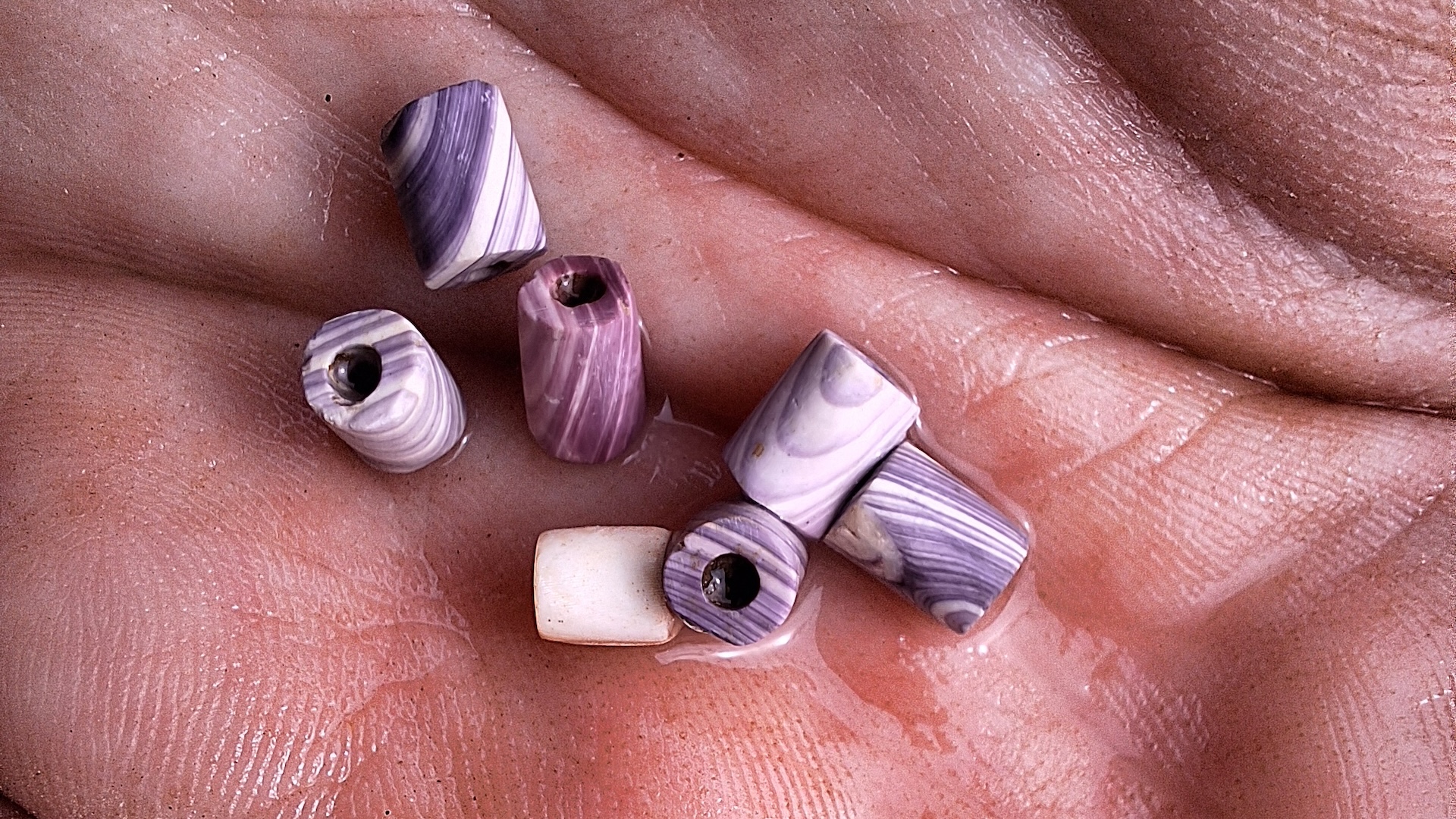
Seven tiny beads unearthed in Newfoundland, Canada, are a rare discovery — they may be the only wampum ever found in the province, and they hint at trade between Indigenous people and European colonists.

The beads were found in July at the Colony of Avalon site in Ferryland, which was an early European settlement and a trading post for Indigenous people in the 17th century.

The tubular beads are white and purple, and they were crafted from the shells of whelk (carnivorous sea snails) and quahog (hard-shelled clams). They were unearthed by archaeology student Calum Brydon, who told CBC News that at first he didn’t know what he had discovered. Minutes later, however, archaeologists in charge of the excavation recognized the beads as wampum.


You may like

“All the wampum beads were found in a 17th century midden [garbage] layer deposited inside a storage room associated with Ferryland’s principal dwelling or Mansion House,” archaeologist Barry Gaulton, a professor at Memorial University in St. John’s, Newfoundland and Labrador, told Live Science.

Indigenous people often used wampum as currency with colonial settlers, but these beads may be the first wampum ever found in Canada’s vast easternmost province.

“No wampum beads have been found at the Colony of Avalon in [more than] 30 years of ongoing archaeological investigation,” Gaulton said in an email. “To the best of our knowledge, no wampum beads have ever been found in the province of Newfoundland and Labrador.”

Shell money

“Wampum” is an English settler term derived from the Algonquin word “wampumpeag,” meaning “string of white shell beads.” Many Indigenous people, especially in the eastern parts of pre- and post-Colonial North America, originally used wampum beads for ceremonial purposes: elaborate belts and necklaces made from wampum beads, for example, were used to record important events, such as treaties and declarations of war.

Get the world’s most fascinating discoveries delivered straight to your inbox.

But Indigenous people also later used wampum beads as currency for trading with colonial settlers, and Gaulton thinks this is how these particular wampum beads arrived at the Colony of Avalon site.

“The wampum was likely brought to Ferryland through trade or exchange with Dutch or New England merchants who had previously traded or exchanged wampum with Indigenous peoples,” he said.

A museum exhibit of Wampum beads

Wampum beads were first used for ceremonial purposes and later as currency for trading with European settlers. (Image credit: Nosferattus, CC0, via Wikimedia Commons)

The site was mostly abandoned by the end of the 17th century, so the wampum is likely older than that.


You may like

The style of the beads and their drilling method indicates they were made in about 1600. The beads “likely arrived at Ferryland in the 1640s or 1650s,” Gaulton said. “Their discovery in a domestic midden dating from the mid- to late-17th century suggests that they were discarded or lost during this period.”

Wampum beads are often attributed to “First Nations” Indigenous groups in Canada, such as the Mi’kmaq people who lived in Newfoundland at this time; but it’s not known who made these or where, Gaulton said.

Colony of Avalon

The Colony of Avalon was officially the Province of Avalon under the British Crown and one of the first parts of North America colonized by European settlers.

It was founded in 1621, but it was abandoned a few years later because of the harsh winters in the region and conflicts with Indigenous people. It was resettled in the 1630s and was developed into a fishing and trading hub, according to the Newfoundland and Labrador Heritage website.

The site now forms part of the town of Ferryland, which is about 30 miles (50 kilometers) south of St. John’s.

An aerial view of the Colony of Avalon

The Colony of Avalon archaeological site is now part of the Newfoundland town of Ferryland. It was founded in 1621 and is one of the earliest colonial settlements in North America. (Image credit: Calum Brydon)

Since the 1980s, tens of thousands of artifacts have been found during excavations of the site, including fragments of English, Dutch and German pottery; glassware; colonial clay pipes; iron tools, such as knives and spoons; muskets and musket balls, for defending against attacks by Indigenous people and pirates; and pieces of settler jewelry.

Archaeologists have also unearthed the remains of cobblestone streets; part of a seawall that protected buildings from erosion and high waves; and the ruins of a large “Mansion House” possibly built by George Calvert, the settlement’s founder and effectively the first governor of the province.

Source link

Share. Facebook Twitter Pinterest LinkedIn Tumblr Email
Previous ArticleTrump group reveals California lacks standing in transgender sports lawsuit
Next Article Trump signs executive order on TikTok deal: what to know
Editor
  • Website

Related Posts

Lifestyle

‘The scientific cost would be severe’: A Trump Greenland takeover would put climate research at risk

January 17, 2026
Lifestyle

New ‘Transformer’ humanoid robot can launch a shapeshifting drone off its back — watch it in action

November 19, 2025
Lifestyle

Medieval spear pulled from Polish lake may have belonged to prince or nobleman

November 19, 2025
Add A Comment

Comments are closed.

Categories
  • Entertainment
  • Lifestyle
  • News
  • Sports
  • Tech
  • Travel
Recent Posts
  • George Kittle’s wife shares live reaction to Achilles injury
  • ‘The scientific cost would be severe’: A Trump Greenland takeover would put climate research at risk
  • Headlines Across OC as Angel Stadium Sale Debate Intensifies
  • Anti-Islam activists clash with pro-Muslim counter-protesters in Dearborn, Michigan
  • Best monitor deal: Get the 45-inch LG Ultragear gaming monitor for its lowest price yet
calendar
February 2026
M T W T F S S
 1
2345678
9101112131415
16171819202122
232425262728  
« Jan    
Recent Posts
  • George Kittle’s wife shares live reaction to Achilles injury
  • ‘The scientific cost would be severe’: A Trump Greenland takeover would put climate research at risk
  • Headlines Across OC as Angel Stadium Sale Debate Intensifies
About

Welcome to Baynard Media, your trusted source for a diverse range of news and insights. We are committed to delivering timely, reliable, and thought-provoking content that keeps you informed
and inspired

Categories
  • Entertainment
  • Lifestyle
  • News
  • Sports
  • Tech
  • Travel
Facebook X (Twitter) Pinterest WhatsApp
  • Contact Us
  • About Us
  • Privacy Policy
  • Disclaimer
  • UNSUBSCRIBE
© 2026 copyrights reserved

Type above and press Enter to search. Press Esc to cancel.