Close Menu
  • Home
  • UNSUBSCRIBE
  • News
  • Lifestyle
  • Tech
  • Entertainment
  • Sports
  • Travel
Facebook X (Twitter) WhatsApp
Trending
  • Tracking Air Wisconsin’s sale to CSI Aviation, an ICE contractor
  • Average Height by Country: Updated in 2024
  • Trump targets drug imports with tariffs up to 100%
  • Orange County Supervisors Confront Themselves
  • In photos: Artemis II’s historic launch for the moon
  • Florida AG warns social media firms face billions in fines over kids ban
  • Arizona girl who went missing 32 years ago found alive
  • Best Places To Live in South America: Top 10
Facebook X (Twitter) WhatsApp
Baynard Media
  • Home
  • UNSUBSCRIBE
  • News
  • Lifestyle
  • Tech
  • Entertainment
  • Sports
  • Travel
Baynard Media
Home»Lifestyle»Scientists spot a baby planet being born in real time (photo)
Lifestyle

Scientists spot a baby planet being born in real time (photo)

EditorBy EditorSeptember 24, 2025No Comments3 Mins Read
Share Facebook Twitter Pinterest LinkedIn Tumblr Reddit Telegram Email
Share
Facebook Twitter LinkedIn Pinterest Email

Protoplanets are celestial objects in the act of forming into full planets within the gas and dust disks surrounding hot, young stars. These objects, often several times the mass of Jupiter, are still embedded in their birth environments, actively feeding on surrounding material through their own circumplanetary disks. Unlike mature planets, protoplanets offer a rare glimpse into the violent, chaotic processes of planetary formation, revealing how the worlds we see today form.

An image of a round rocky object

Vesta is a known surviving protoplanet. (Image credit: NASA/JPL-Caltech/UCAL/MPS/DLR/IDA)

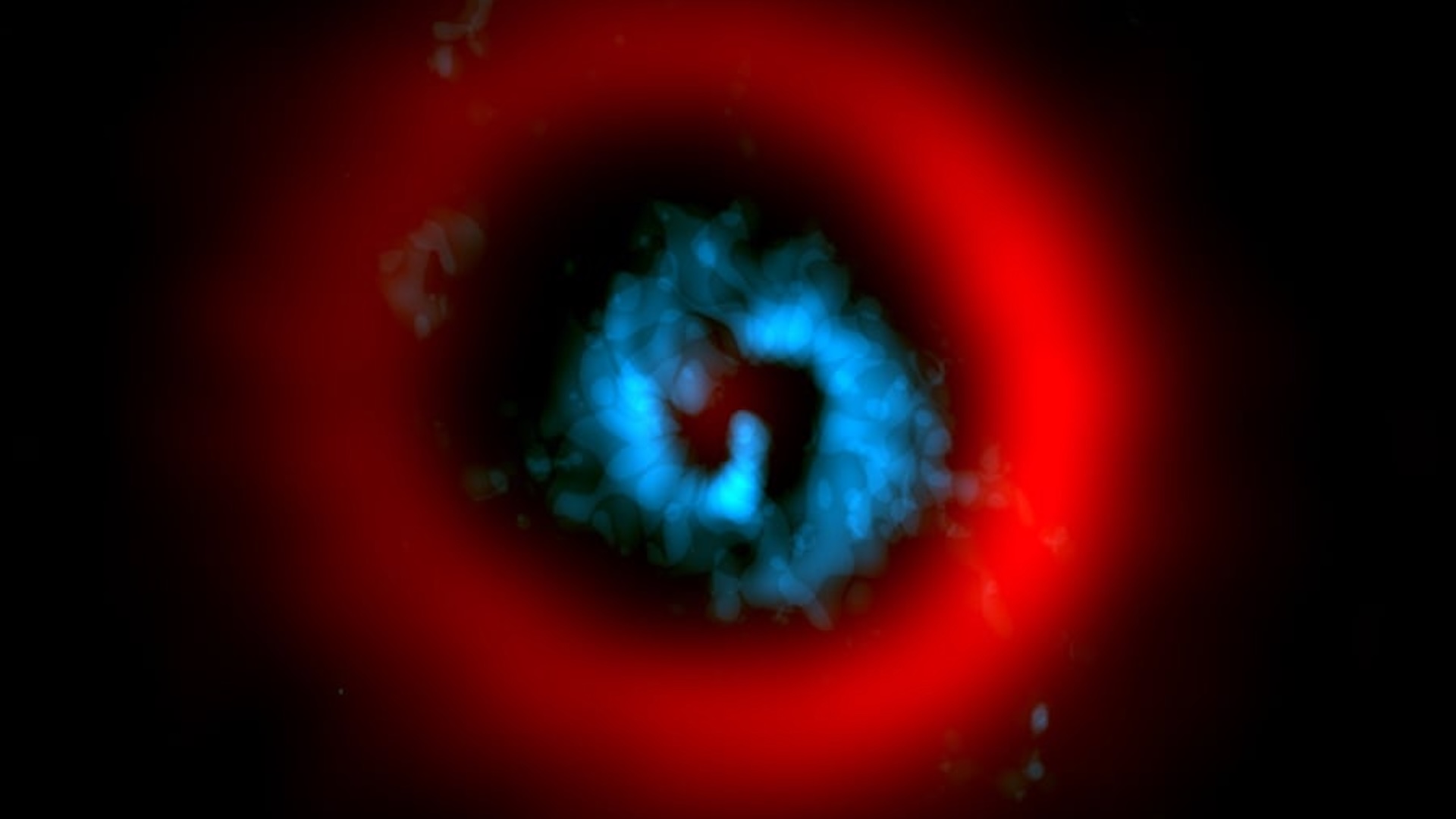
Now, a team of astronomers have caught one such object in the act of forming. The object in question is AB Aurigae b, a giant protoplanet about four times the mass of Jupiter, located 93 astronomical units from its young star, that’s roughly three times the distance between the Sun and Neptune. What makes this discovery particularly exciting is that astronomers have detected the planet actively accreting material, essentially watching it grow in real time.

Using the Very Large Telescope’s MUSE spectrograph in Chile, an international team led by researchers from the Astrobiology Center in Japan detected hydrogen alpha emission lines from the protoplanet. This hydrogen light comes from hot gas spiraling into the planet as it feeds from the surrounding protoplanetary disk.


You may like

The hydrogen emission detected from AB Aurigae b shows a distinctive pattern that reveals gas falling inward toward the planet rather than being blown away, this is known as an “inverse P Cygni profile.” This pattern has been seen in young stars undergoing rapid accretion, but AB Aurigae b represents the first protoplanet showing such clear evidence of ongoing mass accretion.

The emission appears at wavelengths slightly blue shifted from the hydrogen alpha line which indicates gas moving toward us at about 100 kilometres per second, while absorption features appear at red shifted wavelengths, showing material moving away at roughly 75 kilometres per second. This combination creates the characteristic “inverse” profile that indicates infalling material.

What makes AB Aurigae b particularly interesting is that, unlike other directly imaged young planets which orbit in cleared gaps in their disks, AB Aurigae b remains buried within its birth disk. This allows us to observe the actual feeding process as the planet accumulates mass from its surroundings The system’s young age of approximately 2 million years means we’re witnessing planetary formation in its earliest stages.

The observations of AB Aurigae b’s challenge standard models of planet formation. Located so far from its star, the planet likely formed through a process where dense regions of the disk rapidly collapse under their own gravity rather than the core accretion method that formed Jupiter and Saturn.

Get the world’s most fascinating discoveries delivered straight to your inbox.

A diagram comparing the size of the protoplanet AB Aurigae to the size of Neptune's oribt

Detection of the protoplanet AB Auriga b from the Subaru Telescope. (Image credit: 2632cgn, CC BY-SA 4.0, via Wikimedia Commons)

The detection of hydrogen emission provides direct evidence of mass accretion onto a protoplanet still within the disk it formed out of, offering crucial insights into how gas giant planets grow during their formation phase. The circumplanetary disk surrounding AB Aurigae b acts as a feeding mechanism, channeling material from the larger protoplanetary disk onto the growing planet.

The detection of AB Aurigae b marks just the beginning of a new era in studying planetary formation. Future observations will help determine exactly how much of the detected emission comes from the planet itself versus reprocessed light from the surrounding disk, and whether similar signatures can be found around other young stars.

The original version of this article was published on Universe Today.

Source link

Share. Facebook Twitter Pinterest LinkedIn Tumblr Email
Previous ArticleRadio hosts blast Gary Cohen over Matt Shaw-Charlie Kirk memorial attendance
Next Article Bradford the dog’s love for piano music goes viral
Editor
  • Website

Related Posts

Lifestyle

Average Height by Country: Updated in 2024

April 3, 2026
Lifestyle

In photos: Artemis II’s historic launch for the moon

April 3, 2026
Lifestyle

Best Places To Live in South America: Top 10

April 2, 2026
Add A Comment

Comments are closed.

Categories
  • Entertainment
  • Lifestyle
  • News
  • Sports
  • Tech
  • Travel
Recent Posts
  • Tracking Air Wisconsin’s sale to CSI Aviation, an ICE contractor
  • Average Height by Country: Updated in 2024
  • Trump targets drug imports with tariffs up to 100%
  • Orange County Supervisors Confront Themselves
  • In photos: Artemis II’s historic launch for the moon
calendar
April 2026
M T W T F S S
 12345
6789101112
13141516171819
20212223242526
27282930  
« Mar    
Recent Posts
  • Tracking Air Wisconsin’s sale to CSI Aviation, an ICE contractor
  • Average Height by Country: Updated in 2024
  • Trump targets drug imports with tariffs up to 100%
About

Welcome to Baynard Media, your trusted source for a diverse range of news and insights. We are committed to delivering timely, reliable, and thought-provoking content that keeps you informed
and inspired

Categories
  • Entertainment
  • Lifestyle
  • News
  • Sports
  • Tech
  • Travel
Facebook X (Twitter) Pinterest WhatsApp
  • Contact Us
  • About Us
  • Privacy Policy
  • Disclaimer
  • UNSUBSCRIBE
© 2026 copyrights reserved

Type above and press Enter to search. Press Esc to cancel.