Close Menu
  • Home
  • UNSUBSCRIBE
  • News
  • Lifestyle
  • Tech
  • Entertainment
  • Sports
  • Travel
Facebook X (Twitter) WhatsApp
Trending
  • George Kittle’s wife shares live reaction to Achilles injury
  • ‘The scientific cost would be severe’: A Trump Greenland takeover would put climate research at risk
  • Headlines Across OC as Angel Stadium Sale Debate Intensifies
  • Anti-Islam activists clash with pro-Muslim counter-protesters in Dearborn, Michigan
  • Best monitor deal: Get the 45-inch LG Ultragear gaming monitor for its lowest price yet
  • Slovakia U21 0 – 4 England U21
  • 13 Top Sleep Products That Transform Your Bedtime Routine for Better Rest
  • Firefighters rescue puppies from burning house
Facebook X (Twitter) WhatsApp
Baynard Media
  • Home
  • UNSUBSCRIBE
  • News
  • Lifestyle
  • Tech
  • Entertainment
  • Sports
  • Travel
Baynard Media
Home»Lifestyle»Comet SWAN R2: Space rock hiding behind the sun could be visible without binoculars this October
Lifestyle

Comet SWAN R2: Space rock hiding behind the sun could be visible without binoculars this October

EditorBy EditorSeptember 19, 2025No Comments3 Mins Read
Share Facebook Twitter Pinterest LinkedIn Tumblr Reddit Telegram Email
Share
Facebook Twitter LinkedIn Pinterest Email

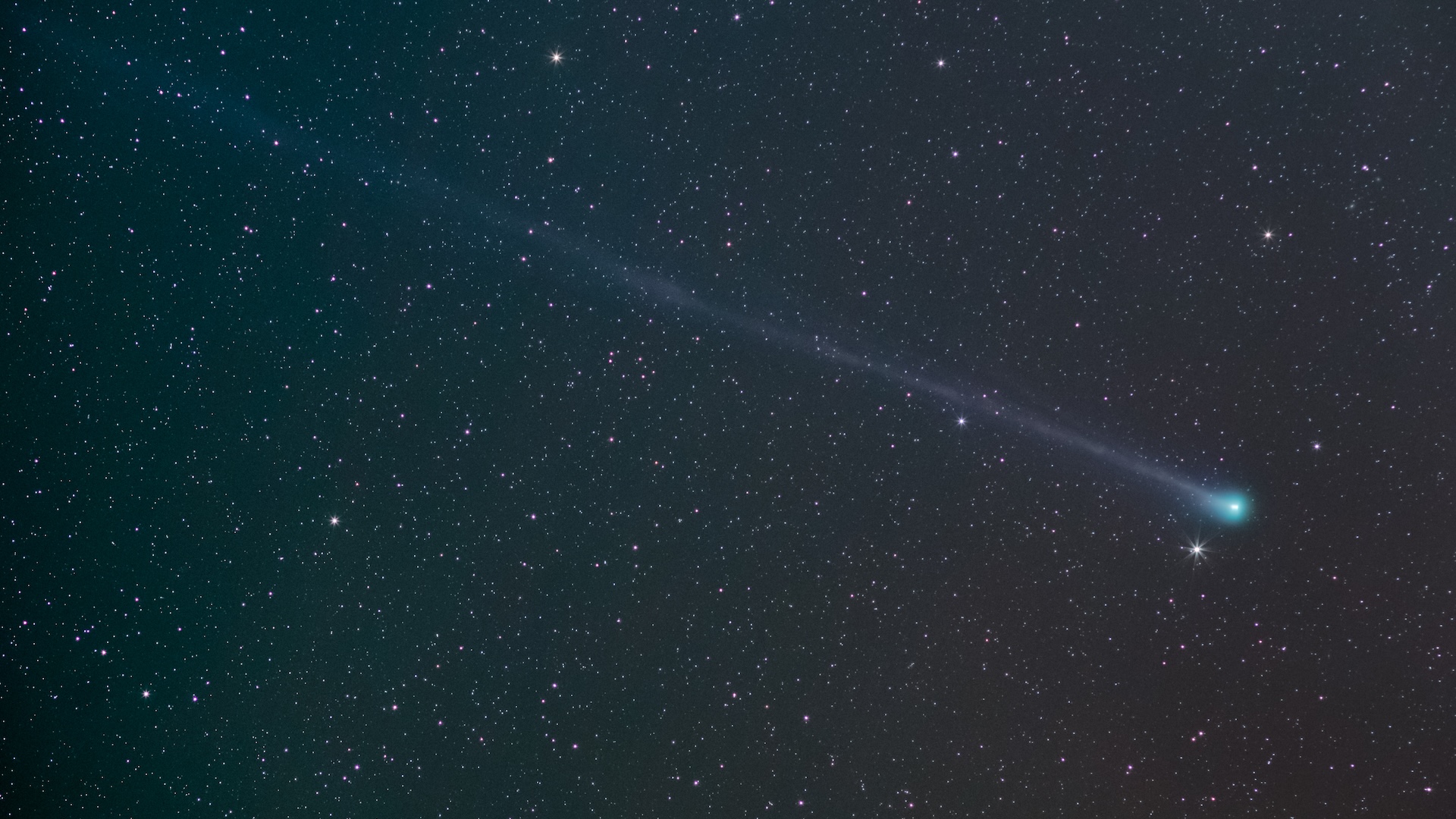
A long-tailed comet has been spotted close to the sun, and some astronomers are predicting it could be seen with the naked eye in mid-October — just as another comet is forecast to do the same. It could mean two bright comets will be visible in the night sky at the same time, on the peak night of a meteor shower.

Comet C/2025 R2 (SWAN), or SWAN R2 for short, was discovered on Sept. 12 by NASA’s orbiting Solar Dynamics Observatory, whose Solar Wind Anisotropies (SWAN) instrument is used to find comets close to the sun. The previously unknown comet was found in SWAN’s images by Vladimir Bezugly, a Ukrainian amateur astronomer, according to Universe Today, and it was initially called SWAN25B. Three days later, the International Astronomical Union’s Minor Planet Center classified the object as a comet and renamed it C/2025 R2 (SWAN).

This long-period comet appears to orbit the sun every 22,554 years, according to EarthSky, and its tail is about the same length as five full moons.


You may like

Although SWAN R2 is still very close to the sun — passing close to Mars just after dusk, and best seen from the Southern Hemisphere, for now — that’s set to change on Oct. 21, when SWAN R2 will be only 0.27 astronomical units (AU) from Earth, according to The Sky Live. That’s about one-quarter the distance from Earth to the sun.

At that time, the comet could get as bright as magnitude 4, potentially making it visible to the naked eye in dark skies, even in the Northern Hemisphere. Earth may even pass through debris from the comet around Oct. 4-6, which could potentially cause a unique meteor shower. Even if it doesn’t brighten sufficiently to be seen with the unaided eye, the comet should be easily visible through a pair of stargazing binoculars or a good backyard telescope.

This comet has come to light just as another comet is brightening. Discovered in January by the Mount Lemmon Survey in Arizona, Comet C/2025 A6 (Lemmon) will get closest to Earth on Oct. 21 — the same day as SWAN R2’s closest approach. Comet Lemmon will be about 0.60 AU from Earth and will be visible in the morning and evening. According to Space.com, Lemmon could also get as bright as magnitude 4, which would make it possible to see with the naked eye in a dark sky.

The best nights to see both comets — if they survive their increasingly close approaches to the sun, which is not guaranteed, and they brighten as predicted — will be Oct. 20-23, when they are closest to Earth. Oct. 21 is the date of the new moon, when night skies will be free of moonlight. Oct. 20-21 is also the peak of the Orionid meteor shower, when about 20 “shooting stars” per hour are expected. You won’t want to miss the prospect of two bright comets and meteors in a dark sky.

Get the world’s most fascinating discoveries delivered straight to your inbox.

The last bright comet that was visible to the naked eye was C/2020 F3 (NEOWISE), in summer 2020, although in October 2024, Comet C/2023 A3 (Tsuchinshan-ATLAS) became visible through binoculars during a close approach to Earth.

Source link

Share. Facebook Twitter Pinterest LinkedIn Tumblr Email
Previous ArticleUtah manhunt ends as suspected Charlie Kirk shooter Tyler Robinson surrenders
Next Article Trump suggests FCC could revoke broadcasters’ licenses
Editor
  • Website

Related Posts

Lifestyle

‘The scientific cost would be severe’: A Trump Greenland takeover would put climate research at risk

January 17, 2026
Lifestyle

New ‘Transformer’ humanoid robot can launch a shapeshifting drone off its back — watch it in action

November 19, 2025
Lifestyle

Medieval spear pulled from Polish lake may have belonged to prince or nobleman

November 19, 2025
Add A Comment

Comments are closed.

Categories
  • Entertainment
  • Lifestyle
  • News
  • Sports
  • Tech
  • Travel
Recent Posts
  • George Kittle’s wife shares live reaction to Achilles injury
  • ‘The scientific cost would be severe’: A Trump Greenland takeover would put climate research at risk
  • Headlines Across OC as Angel Stadium Sale Debate Intensifies
  • Anti-Islam activists clash with pro-Muslim counter-protesters in Dearborn, Michigan
  • Best monitor deal: Get the 45-inch LG Ultragear gaming monitor for its lowest price yet
calendar
February 2026
M T W T F S S
 1
2345678
9101112131415
16171819202122
232425262728  
« Jan    
Recent Posts
  • George Kittle’s wife shares live reaction to Achilles injury
  • ‘The scientific cost would be severe’: A Trump Greenland takeover would put climate research at risk
  • Headlines Across OC as Angel Stadium Sale Debate Intensifies
About

Welcome to Baynard Media, your trusted source for a diverse range of news and insights. We are committed to delivering timely, reliable, and thought-provoking content that keeps you informed
and inspired

Categories
  • Entertainment
  • Lifestyle
  • News
  • Sports
  • Tech
  • Travel
Facebook X (Twitter) Pinterest WhatsApp
  • Contact Us
  • About Us
  • Privacy Policy
  • Disclaimer
  • UNSUBSCRIBE
© 2026 copyrights reserved

Type above and press Enter to search. Press Esc to cancel.