Close Menu
  • Home
  • UNSUBSCRIBE
  • News
  • Lifestyle
  • Tech
  • Entertainment
  • Sports
  • Travel
Facebook X (Twitter) WhatsApp
Trending
  • Can NASA and SpaceX really build a moon base in the next 10 years?
  • Birds in cities appear to dislike men less than women, and experts have no idea why
  • ‘One of the most rapid transitions that I’ve seen’: NOAA forecaster on how this year’s El Niño could shatter records
  • May’s Flower ‘micromoon’ will look extra small tonight, with a rare Blue Moon following
  • ‘If astrological compatibility exists, its effects should be observable’: TL;DR — it’s not
  • Humanoid robots have outpaced human runners in the half-marathon, beating the world record ‪—‬ here are the secrets to this astonishing feat
  • Google AI breakthrough means chatbots use six times less memory during conversations without compromising performance
  • ZWO Seestar S30 Pro smart telescope review
Facebook X (Twitter) WhatsApp
Baynard Media
  • Home
  • UNSUBSCRIBE
  • News
  • Lifestyle
  • Tech
  • Entertainment
  • Sports
  • Travel
Baynard Media
Home»Lifestyle»China’s ‘Darwin Monkey’ is the world’s largest brain-inspired supercomputer
Lifestyle

China’s ‘Darwin Monkey’ is the world’s largest brain-inspired supercomputer

EditorBy EditorAugust 28, 2025No Comments3 Mins Read
Share Facebook Twitter Pinterest LinkedIn Tumblr Reddit Telegram Email
Share
Facebook Twitter LinkedIn Pinterest Email

Scientists in China have unveiled a supercomputer built on brain-like architecture — specifically, that of a monkey.

Called Darwin Monkey or “Wukong”, the system features over 2 billion artificial neurons and more than 100 billion synapses, putting it roughly on par with the neural structure of a macaque.

The researchers hope it will serve as a simulation tool for neuroscientists while also providing a stepping stone toward artificial general intelligence (AGI) — an artificial intelligence (AI) system that possesses human-like intelligence and reasoning.


You may like

Br(AI)n power

Unlike traditional artificial neural networks, which follow classical computing principles and process data via continuously changing binary values, neuromorphic systems like Darwin Monkey are driven by spiking neural networks (SNNs).

SNNs mimic how signals are transmitted between neurons in the brains of mammals, responding to electrical signals to process and transmit data through on-and-off bursts (or spikes) of activity.

Related: China develops new light-based chiplet that could power artificial general intelligence — where AI is smarter than humans

A biological neuron fires an electrical pulse when the signals it receives from other neurons reach a level strong enough to trigger a response. Artificial neurons in SNNs mimic this mechanism, firing only when they’ve built up enough electrical input.

Get the world’s most fascinating discoveries delivered straight to your inbox.

Where software-based neural networks are a collection of machine learning algorithms arranged to emulate the human brain, SNNs physically replicate the way information moves between biological neurons. This configuration allows SNNs to process data in parallel, potentially making them more powerful than conventional supercomputer architectures.

It may also be more energy efficient: artificial neurons enter a brief rest period after each spike, during which they can’t respond to new inputs. This limits how often they fire, helping to reduce overall power consumption.

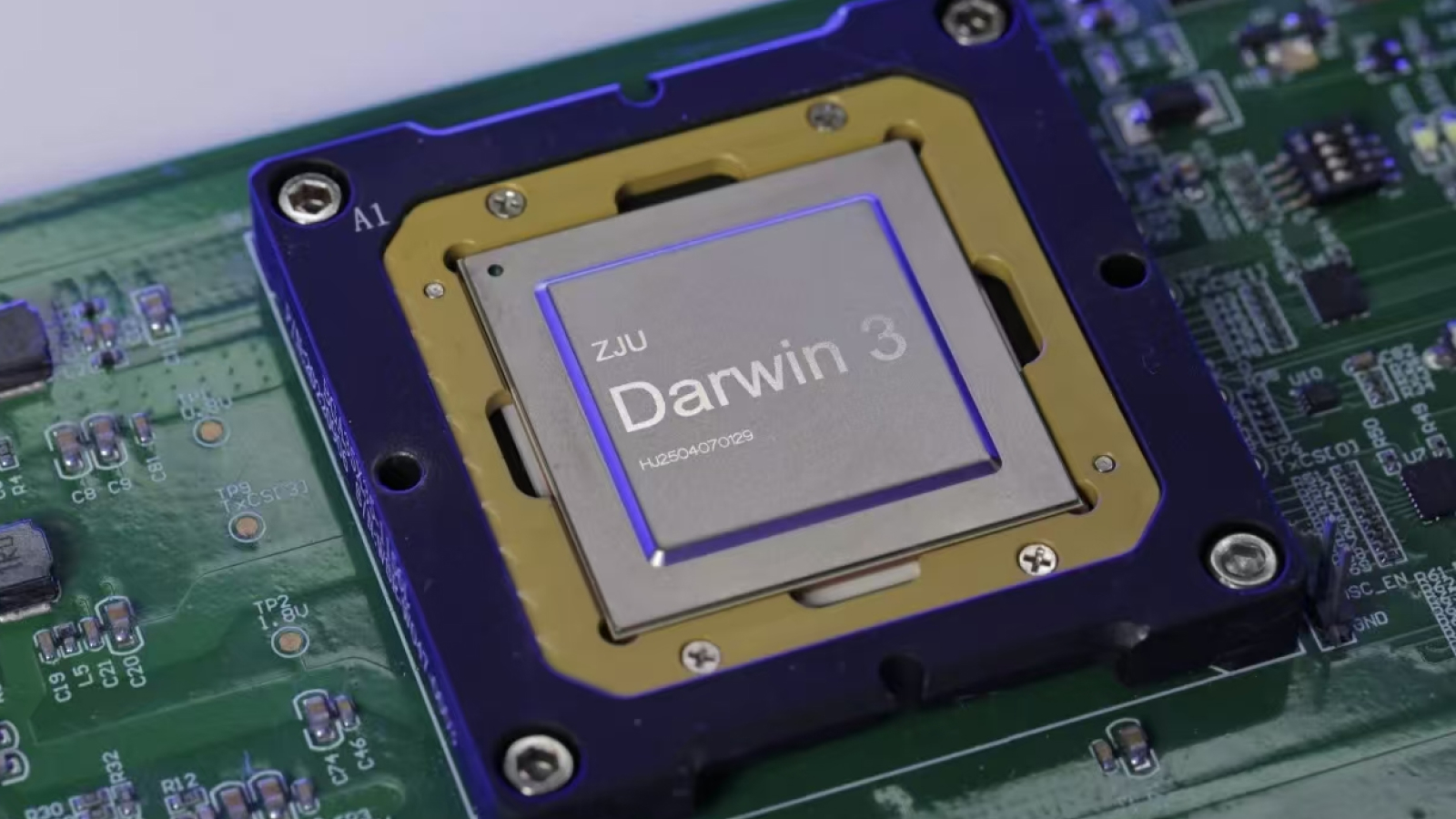
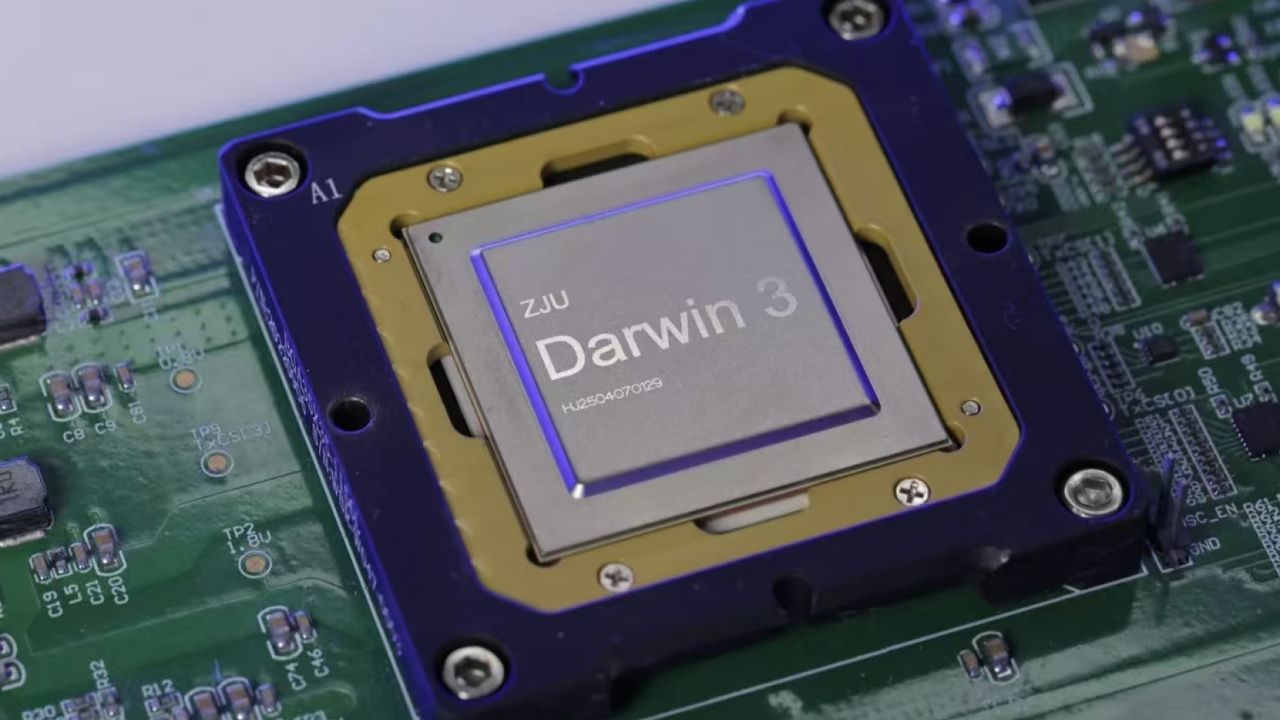
Researchers say Darwin Monkey consumes just 2,000 watts of power — roughly the equivalent of an electric kettle or hairdryer — despite being powered by 960 Darwin III neuromorphic chips, each of which supports up to 2.35 million spiking neurons.

Other neuromorphic computers

The previous record-holder in neuromorphic computing was Intel’s Hala Point system, which comprises 1.15 billion artificial neurons and 128 billion artificial synapses distributed over 140,544 processing cores.

Intel claims its system is capable of performing 20 quadrillion operations per second — or 20 petaops. But as there are very few neuromorphic computers currently in existence, and as they process data differently from supercomputers, it’s difficult to compare them on a like-for-like basis.

In a statement, translated into English using Google Translate, the team behind Darwin Monkey said the platform had already demonstrated its capabilities in cognitive tasks such as logical reasoning, content generation and mathematical problem-solving, using an AI model developed by Chinese AI startup DeepSeek.

The system is also being used to simulate the brains of animals with varying levels of neural complexity, including zebrafish and mice, as part of broader efforts to support brain science research.

Darwin Monkey was designed by researchers from Zhejiang University and Zhejiang Lab, a research institute jointly established by the Zhejiang provincial government and Alibaba Group, a Chinese technology conglomerate.

It follows the launch of Darwin Mouse (“Mickey”) in September 2020, which contains 120 million artificial neurons — the equivalent of a mouse’s brain.

Source link

Share. Facebook Twitter Pinterest LinkedIn Tumblr Email
Previous ArticleGunman who opened fire on Catholic school Mass identified and more top headlines
Next Article Search for answers after Minnesota shooting and CDC director fired: Morning Rundown
Editor
  • Website

Related Posts

Lifestyle

Can NASA and SpaceX really build a moon base in the next 10 years?

May 2, 2026
Lifestyle

Birds in cities appear to dislike men less than women, and experts have no idea why

May 1, 2026
Lifestyle

‘One of the most rapid transitions that I’ve seen’: NOAA forecaster on how this year’s El Niño could shatter records

May 1, 2026
Add A Comment

Comments are closed.

Categories
  • Entertainment
  • Lifestyle
  • News
  • Sports
  • Tech
  • Travel
Recent Posts
  • Can NASA and SpaceX really build a moon base in the next 10 years?
  • Birds in cities appear to dislike men less than women, and experts have no idea why
  • ‘One of the most rapid transitions that I’ve seen’: NOAA forecaster on how this year’s El Niño could shatter records
  • May’s Flower ‘micromoon’ will look extra small tonight, with a rare Blue Moon following
  • ‘If astrological compatibility exists, its effects should be observable’: TL;DR — it’s not
calendar
May 2026
M T W T F S S
 123
45678910
11121314151617
18192021222324
25262728293031
« Apr    
Recent Posts
  • Can NASA and SpaceX really build a moon base in the next 10 years?
  • Birds in cities appear to dislike men less than women, and experts have no idea why
  • ‘One of the most rapid transitions that I’ve seen’: NOAA forecaster on how this year’s El Niño could shatter records
About

Welcome to Baynard Media, your trusted source for a diverse range of news and insights. We are committed to delivering timely, reliable, and thought-provoking content that keeps you informed
and inspired

Categories
  • Entertainment
  • Lifestyle
  • News
  • Sports
  • Tech
  • Travel
Facebook X (Twitter) Pinterest WhatsApp
  • Contact Us
  • About Us
  • Privacy Policy
  • Disclaimer
  • UNSUBSCRIBE
© 2026 copyrights reserved

Type above and press Enter to search. Press Esc to cancel.