Close Menu
  • Home
  • UNSUBSCRIBE
  • News
  • Lifestyle
  • Tech
  • Entertainment
  • Sports
  • Travel
Facebook X (Twitter) WhatsApp
Trending
  • China calls US Strait of Hormuz blockade ‘dangerous and irresponsible’
  • Irvine Wrestles With Budget Shortfall Amid Questions on Future Stability
  • Physicists just witnessed pinpricks of darkness moving faster than the speed of light ‪—‬ without breaking the laws of relativity
  • JD Vance says the ball is ‘in Iran’s court’ on potential agreement and more top headlines
  • Trump family’s crypto company under fire from major investor
  • Moving to Europe from the US: Everything You Need to Know
  • ‘It was a good decision’: Top Dems praise Swalwell decision to resign from Congress
  • Do some Minnesota cities still have them?
Facebook X (Twitter) WhatsApp
Baynard Media
  • Home
  • UNSUBSCRIBE
  • News
  • Lifestyle
  • Tech
  • Entertainment
  • Sports
  • Travel
Baynard Media
Home»Lifestyle»Aye-ayes: The strange nocturnal lemurs with long, creepy fingers
Lifestyle

Aye-ayes: The strange nocturnal lemurs with long, creepy fingers

EditorBy EditorAugust 2, 2025No Comments3 Mins Read
Share Facebook Twitter Pinterest LinkedIn Tumblr Reddit Telegram Email
Share
Facebook Twitter LinkedIn Pinterest Email

QUICK FACTS

Name: Aye-aye (Daubentonia madagascariensis)

Where it lives: Madagascar

What it eats: Seeds, nuts, fruits, nectar, plant matter, fungi, insect larvae and honey

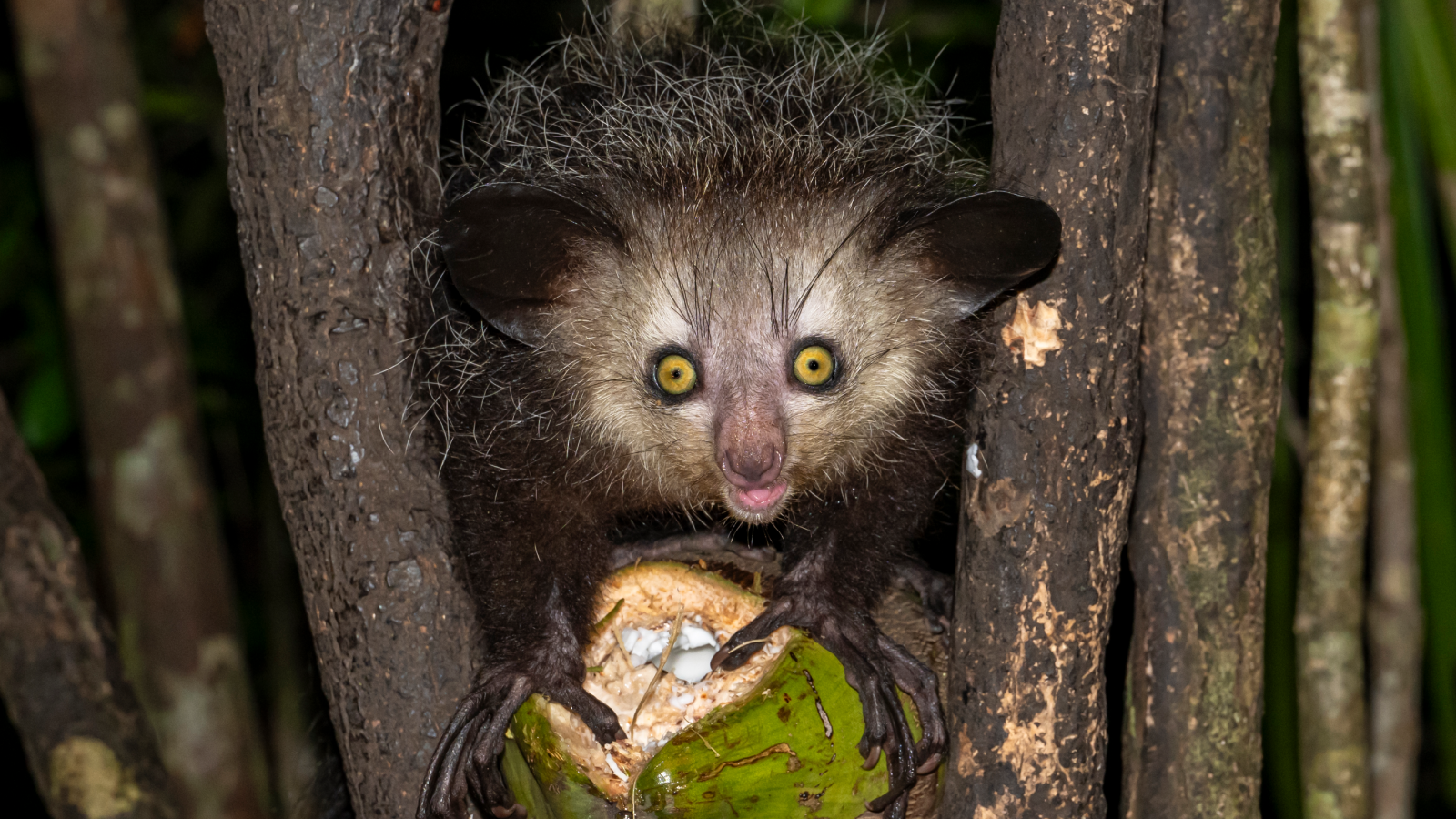
Native to Madagascar, this lemur looks like a strange mix of several animals. It has the round eyes of an owl, the ears of a bat, rodent-like teeth that never stop growing and a wiry, bushy tail longer than its body.

Aye-ayes are the world’s largest nocturnal lemur, weighing around 4 pounds (1.8 kilograms) and reaching up to 24 inches (60 centimeters) long from nose to tail tip. Young aye-ayes have a silver front with a stripe down their backs, but as they develop into adults, their thick fur turns a yellow-brown with white tips. During the day, they sleep in spherical nests crafted from leaves and branches, while at night they roam the treetops in search of food.

Aye-ayes have extra-long, bony middle fingers. As the animals move along tree branches at night, they tap the wood rapidly with their long fingers, listening for subtle changes in the echoes that signal the presence of hollow chambers where wood-boring insect larvae hide. Once a grub is located, the aye-aye gnaws a small hole into the bark using its teeth, then inserts its thin finger to fish the meal out. These long middle fingers have ball-and-socket joints, giving the lemurs a wide range of motion to better reach their prey.


You may like

However, biologists also found that the lemurs use these elongated fingers for another task: nose-picking. In a 2022 paper published in the Journal of Zoology, researchers described how aye-ayes reach through their noses to the back of the throat, then lick off the gathered mucus. The team noted that the lemurs may be attracted to the “texture, crunchiness and saltiness” of the mucus — which may also prevent bacteria from sticking to their teeth.

Aye-aye -Daubentonia madagascariensis- on a palm frond, Masoala Peninsula, Madagascar.

Aye-ayes were considered extinct until they were rediscovered in the wild in the 1950s. (Image credit: Thorsten Negro/Getty Images)

Like rodents, aye-ayes have continuously growing incisors. Their upper and lower front teeth never stop growing, but they are worn down by the wood, bark and nuts that they gnaw through.

In Malagasy folklore, aye-ayes are considered omens of death, and some believe that if an aye-aye points its finger at you, it’s a death sentence, according to the Natural History Museum in London. Because of these superstitions, aye-ayes are sometimes killed on sight, contributing to their declining population. Once listed as extinct, they were rediscovered in the wild in the 1950s, but they are still endangered.

To defend themselves against predators, aye-ayes rely mostly on stealth and camouflage. Their dark fur helps them blend into the nighttime shadows of the rainforest. Their large, sensitive ears enable them to detect the slightest rustle of leaves — a crucial ability for avoiding predators like fossas (Cryptoprocta ferox), carnivorous mammals endemic to Madagascar.

Get the world’s most fascinating discoveries delivered straight to your inbox.

When threatened, aye-ayes may freeze in place, relying on stillness and silence to avoid detection. They are also very agile and are able to leap and climb rapidly through dense forest canopies to escape danger.

Source link

Share. Facebook Twitter Pinterest LinkedIn Tumblr Email
Previous ArticleHow motherhood healed my childhood trauma and created my perfect squad
Next Article It’s a good time to be a nostalgic millennial
Editor
  • Website

Related Posts

Lifestyle

Physicists just witnessed pinpricks of darkness moving faster than the speed of light ‪—‬ without breaking the laws of relativity

April 14, 2026
Lifestyle

Moving to Europe from the US: Everything You Need to Know

April 14, 2026
Lifestyle

‘Oslo patient’ likely cured of HIV after getting stem cell transplant from his brother, who is genetically resistant to the virus

April 14, 2026
Add A Comment

Comments are closed.

Categories
  • Entertainment
  • Lifestyle
  • News
  • Sports
  • Tech
  • Travel
Recent Posts
  • China calls US Strait of Hormuz blockade ‘dangerous and irresponsible’
  • Irvine Wrestles With Budget Shortfall Amid Questions on Future Stability
  • Physicists just witnessed pinpricks of darkness moving faster than the speed of light ‪—‬ without breaking the laws of relativity
  • JD Vance says the ball is ‘in Iran’s court’ on potential agreement and more top headlines
  • Trump family’s crypto company under fire from major investor
calendar
April 2026
M T W T F S S
 12345
6789101112
13141516171819
20212223242526
27282930  
« Mar    
Recent Posts
  • China calls US Strait of Hormuz blockade ‘dangerous and irresponsible’
  • Irvine Wrestles With Budget Shortfall Amid Questions on Future Stability
  • Physicists just witnessed pinpricks of darkness moving faster than the speed of light ‪—‬ without breaking the laws of relativity
About

Welcome to Baynard Media, your trusted source for a diverse range of news and insights. We are committed to delivering timely, reliable, and thought-provoking content that keeps you informed
and inspired

Categories
  • Entertainment
  • Lifestyle
  • News
  • Sports
  • Tech
  • Travel
Facebook X (Twitter) Pinterest WhatsApp
  • Contact Us
  • About Us
  • Privacy Policy
  • Disclaimer
  • UNSUBSCRIBE
© 2026 copyrights reserved

Type above and press Enter to search. Press Esc to cancel.