Close Menu
  • Home
  • UNSUBSCRIBE
  • News
  • Lifestyle
  • Tech
  • Entertainment
  • Sports
  • Travel
Facebook X (Twitter) WhatsApp
Trending
  • Foodborne illnesses: Is the US really being hit harder this year?
  • James Webb telescope just spotted the oldest, closest pair of black holes in the early universe
  • Saving old trees may protect people’s health more than planting new ones, study of Chicago neighborhoods finds
  • Memory may not work how we thought, study of mice in artificial hibernation finds
  • Romans unceremoniously dumped plague victims down a well, mysterious mass grave in Croatia suggest
  • New AI lets robots complete tasks twice as fast
  • Mammal ancestors may have given live birth 90 million years earlier than we thought, rewriting evolutionary timelines
  • How to see and photograph the partial lunar eclipse on August 27-28
Facebook X (Twitter) WhatsApp
Baynard Media
  • Home
  • UNSUBSCRIBE
  • News
  • Lifestyle
  • Tech
  • Entertainment
  • Sports
  • Travel
Baynard Media
Home»Lifestyle»Astronomers witness a newborn planet emerging from the dust around a sun-like star: Space photo of the week
Lifestyle

Astronomers witness a newborn planet emerging from the dust around a sun-like star: Space photo of the week

EditorBy EditorJuly 27, 2025No Comments3 Mins Read
Share Facebook Twitter Pinterest LinkedIn Tumblr Reddit Telegram Email
Share
Facebook Twitter LinkedIn Pinterest Email

QUICK FACTS

What it is: A potential planet around the star HD 135344B

Where it is: 440 light-years away, in the constellation Lupus

When it was shared: July 21, 2025

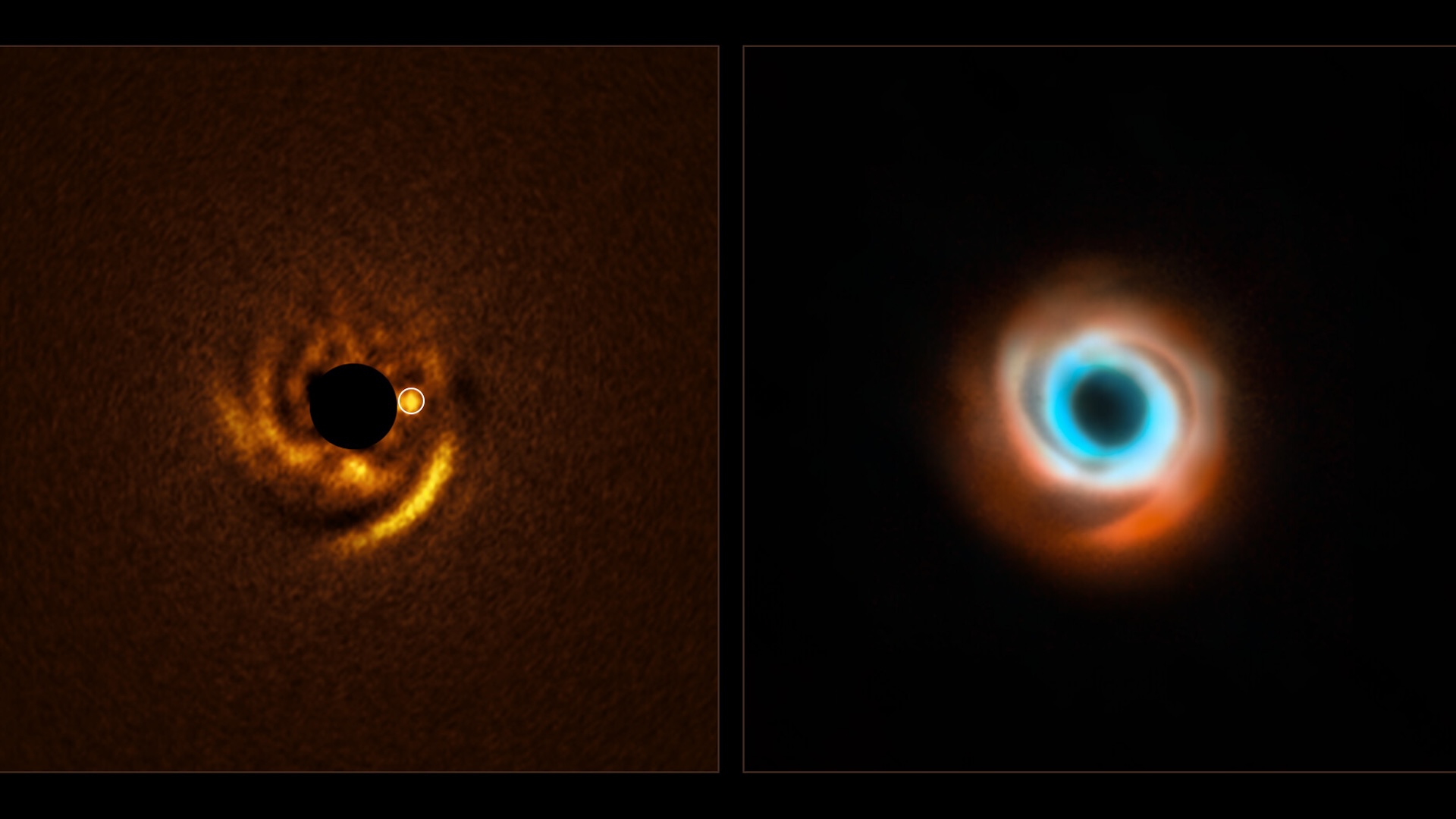
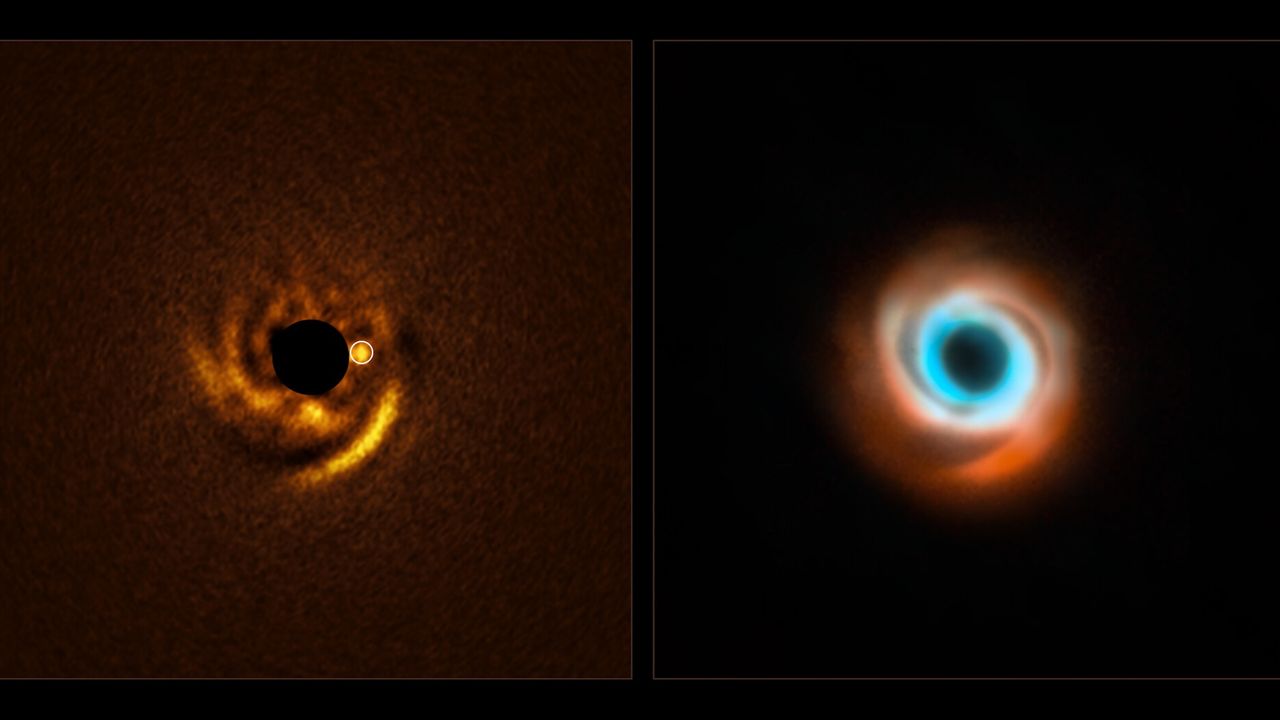
Deep within a swirling disk of gas and dust around the star HD 135344B, a young planet appears to be sculpting intricate spiral arms around its stellar host. It is the first time a planet has been found embedded inside a dust spiral around a star, actively shaping its environment.

The discovery is further proof that the building blocks of planets emerge from protoplanetary disks — giant, doughnut-shaped disks of gas and dust that circle young stars, according to NASA.

These dense, rotating clouds of material around young stars have been seen to feature rings and spirals suspected to be caused by the presence of baby planets, but this is the first direct evidence. In fact, the sculpted protoplanetary disk around the host star, HD 135344B, had been seen before by astronomers using the SPHERE (Spectro-Polarimetric High-contrast Exoplanet Research) instrument on the European Southern Observatory’s Very Large Telescope in Chile.


You may like

However, by using a new instrument called the Enhanced Resolution Imager and Spectrograph (ERIS), scientists finally discovered a planetary candidate. The planet is nestled at the base of one spiral arm — exactly where models predicted a planet would be needed to generate such a feature — and is thought to be twice the size of Jupiter. It’s about as far from its host star as Neptune is from the sun, or about 30 times the distance from Earth to the sun.

“What makes this detection potentially a turning point is that, unlike many previous observations, we are able to directly detect the signal of the protoplanet, which is still highly embedded in the disc,” Francesco Maio, a doctoral researcher at the University of Florence and lead author of a study describing the discovery, said in a statement.

Related: 32 alien planets that really exist

The existence of many exoplanets — planets that orbit a star other than the sun — is inferred from other information, such as the dip in a star’s brightness that is assumed to be caused by a planet. Observing the planet’s own light — reflected light from its host star — gives the proto-planet’s discoverers a much higher level of confidence in its existence.

Get the world’s most fascinating discoveries delivered straight to your inbox.

“We will never witness the formation of Earth, but here, around a young star 440 light-years away, we may be watching a planet come into existence in real time,” Maio said.

ERIS had a similarly decisive role in another recent discovery. Using ERIS, astronomers found an object — possibly a brown dwarf, an object halfway between a giant planet and a small star — in the protoplanetary disk around the young star V960 Mon, located 5,000 light-years away, in the constellation Monoceros.

For more sublime space images, check out our Space Photo of the Week archives.

Source link

Share. Facebook Twitter Pinterest LinkedIn Tumblr Email
Previous ArticleTennis star Anna Kalinskaya celebrates win with her dog
Next Article Sen. Lindsey Graham says there’s no way to for Israel to negotiate an end to the war with Hamas
Editor
  • Website

Related Posts

Lifestyle

Foodborne illnesses: Is the US really being hit harder this year?

August 14, 2026
Lifestyle

James Webb telescope just spotted the oldest, closest pair of black holes in the early universe

August 14, 2026
Lifestyle

Saving old trees may protect people’s health more than planting new ones, study of Chicago neighborhoods finds

August 14, 2026
Add A Comment

Comments are closed.

Categories
  • Entertainment
  • Lifestyle
  • News
  • Sports
  • Tech
  • Travel
Recent Posts
  • Foodborne illnesses: Is the US really being hit harder this year?
  • James Webb telescope just spotted the oldest, closest pair of black holes in the early universe
  • Saving old trees may protect people’s health more than planting new ones, study of Chicago neighborhoods finds
  • Memory may not work how we thought, study of mice in artificial hibernation finds
  • Romans unceremoniously dumped plague victims down a well, mysterious mass grave in Croatia suggest
calendar
August 2026
M T W T F S S
 12
3456789
10111213141516
17181920212223
24252627282930
31  
« Jul    
Recent Posts
  • Foodborne illnesses: Is the US really being hit harder this year?
  • James Webb telescope just spotted the oldest, closest pair of black holes in the early universe
  • Saving old trees may protect people’s health more than planting new ones, study of Chicago neighborhoods finds
About

Welcome to Baynard Media, your trusted source for a diverse range of news and insights. We are committed to delivering timely, reliable, and thought-provoking content that keeps you informed
and inspired

Categories
  • Entertainment
  • Lifestyle
  • News
  • Sports
  • Tech
  • Travel
Facebook X (Twitter) Pinterest WhatsApp
  • Contact Us
  • About Us
  • Privacy Policy
  • Disclaimer
  • UNSUBSCRIBE
© 2026 copyrights reserved

Type above and press Enter to search. Press Esc to cancel.