
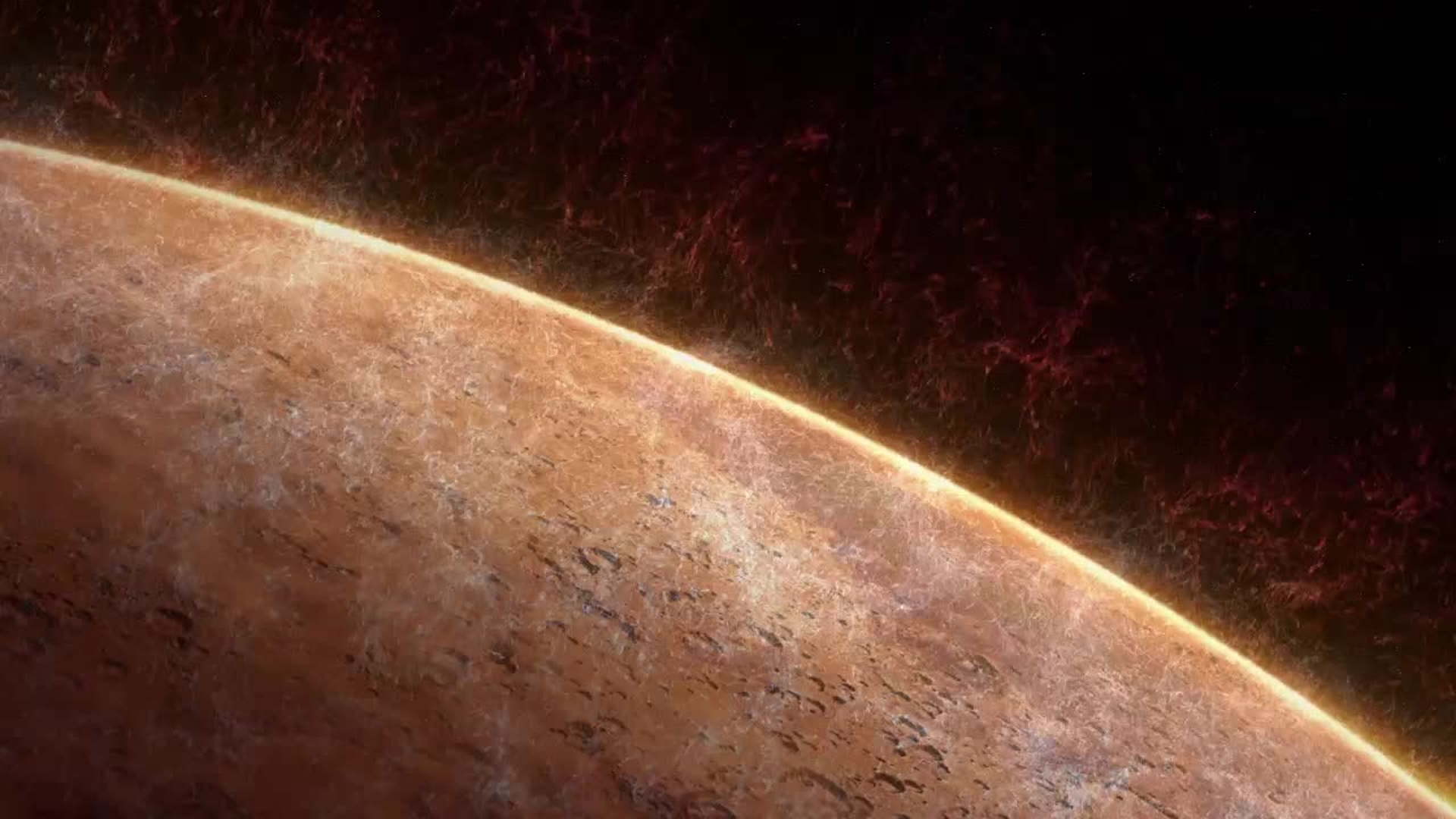
There might be a hidden ocean’s worth of liquid water below the surface of Mars, seismic evidence suggests.
According to a new paper published April 25 in the journal National Science Review, recordings of seismic waves from deep within the Red Planet indicate that a layer of liquid water may be lurking in the Martian rocks between 3.4 and 5 miles [5.4 to 8 kilometers] below the surface.
The total volume of hidden water could flood the whole of Mars’ surface with an ocean 1,700 to 2,560 feet [520 to 780 metres] deep, around the same volume of liquid that is contained within Antarctica’s ice sheet, the study authors estimated.
Related: NASA rover discovers out-of-place ‘Skull’ on Mars, and scientists are baffled
Our neighboring planet was once abundant in water. In the time between Mars’ formation 4.1 billion years ago to about 3 billion years ago, the Red Planet is thought to have been extremely wet, with features like valley networks, delta formations, and layered sedimentary rocks suggesting sustained water flow.
However, this abundant liquid water “vanished as the planet transitioned to become the cold, dry environment we see today,” paper co-author Hrvoje Tkalčić, a professor of geophysics at the Australian National University, said in a statement.
Over time, Mars lost its magnetic field, and solar radiation began stripping away its atmosphere. With a thinner atmosphere, surface temperatures dropped; the planet’s liquid water began to escape into space, become trapped as ice in the subsurface or polar caps, or become locked in hydrated minerals within the planet’s crust, the researchers said.
However, these methods of water loss have previously been shown to not entirely account for all the water that is estimated to have once flowed on the Red Planet, with a large volume of “missing” water going unaccounted for. This conundrum has long puzzled scientists, posing the question of whether there is still liquid water hidden on Mars that we have yet to find.

This new research suggests that there is indeed liquid water buried deep below the surface of the planet. Upon analyzing seismic data from NASA’s InSight lander, which landed on Mars in 2018, researchers found that seismic waves within the planet’s interior — caused by asteroid impacts and marsquakes in 2021 and 2022 — appeared to slow down between 3.4 and 5 miles [5.4 to 8 kilometers] below the surface. They suggest that this could be due to the presence of liquid water hidden within porous rocks, as seismic waves travel more slowly through liquid than they do through more solid materials.
“This ‘low-velocity layer’ is most likely highly porous rock filled with liquid water, like a saturated sponge,” Tkalčić and another study co-author Weijia Sun, a professor of geophysics at the Chinese Academy of Sciences, explained in an essay for the Conversation about the new study. “Something like Earth’s aquifers, where groundwater seeps into rock pores.”
The researchers suggest that this liquid water could make up the total volume of water missing from previous calculations.
“Our study indicates it’s possible that much of that ancient water percolated through the porous surface rocks and was retained underground,” Tkalčić said. “This also matches estimates of the ‘missing’ water on Mars from other studies.”
Previous studies have also found that large volumes of water may be stored beneath the Martian surface in ice form, and a study from 2024 suggested that liquid water could be stored within rocks between 7 to 13 miles (11.2 to 21 km) beneath the surface.
The potential presence of liquid water on Mars is exciting to scientists, as liquid water is essential to life as we know it. While these potential reservoirs deep below the planet’s surface could host some form of Martian life, we won’t know if the liquid water even exists until we can drill deep into Mars and find it for ourselves.
“Future missions with seismometers and drills are needed to confirm the presence of the water at these depths and gather more clues,” Tkalčić said.
