
Mathematics is the basis of all science and has come a long way since humans started counting. But when did people start doing math? The answer is complicated because abstract mathematics is thought to be different from counting — although counting is the foundation of math — and because many advanced types of mathematics, such as calculus, were developed only within the past few hundred years.
The origins of counting
Humans couldn’t have mastered complex and abstract math without figuring out how to count first, and evidence suggests our species was counting tens of thousands of years ago.
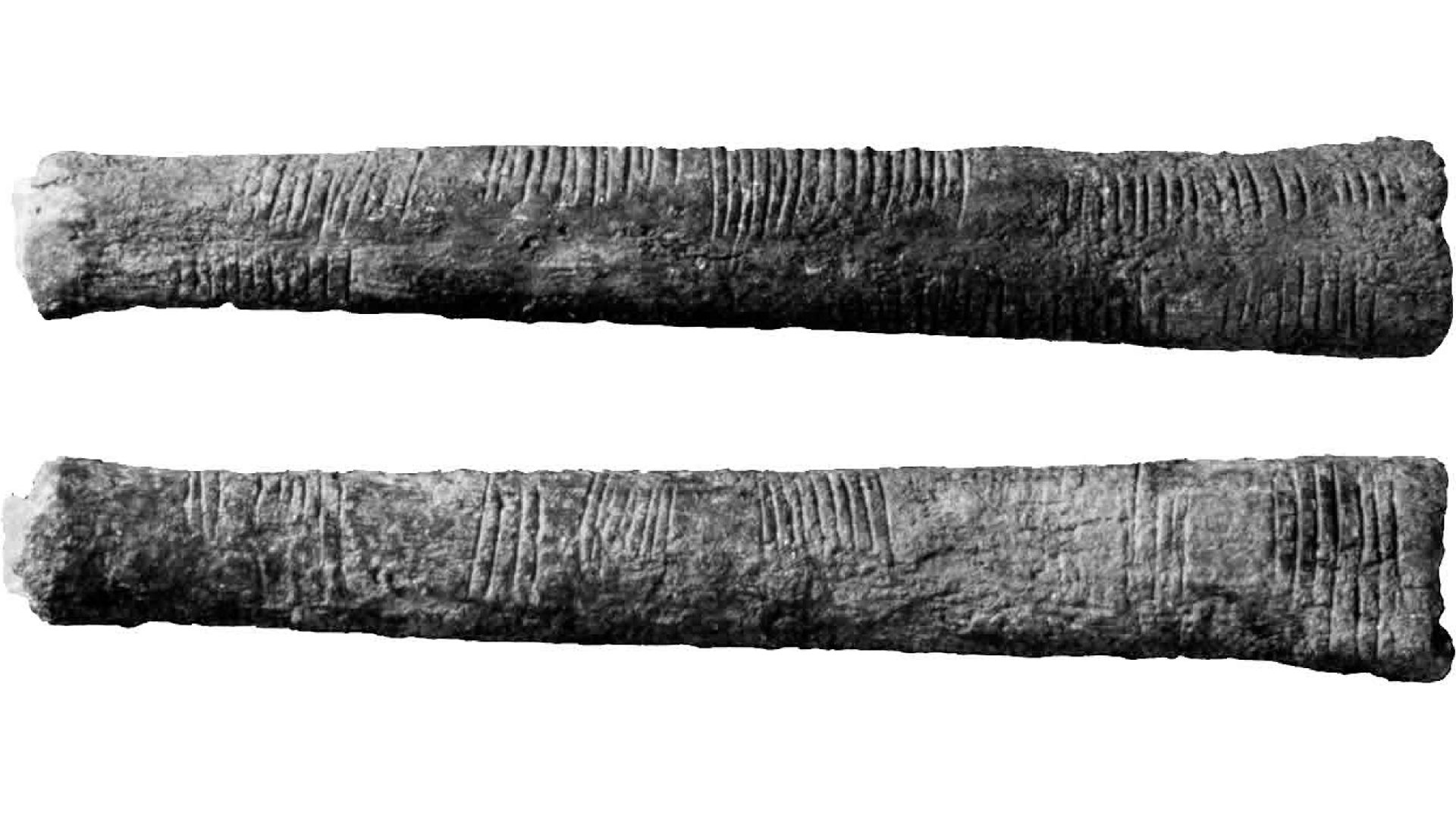
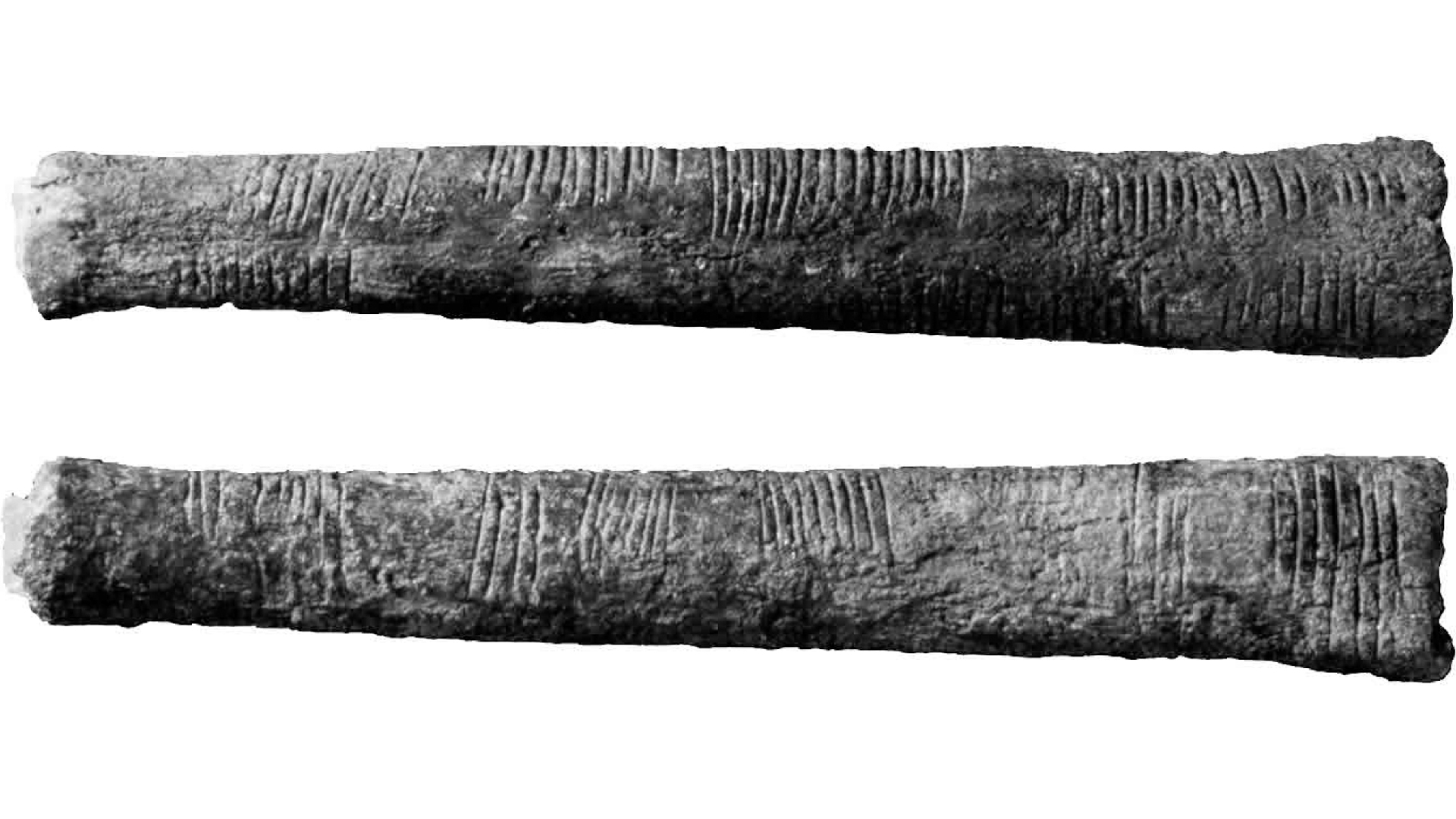
The Ishango bone from Africa’s Congo region indicates that Homo sapiens have been making “tallies” — a kind of counting — for at least 20,000 years. The 4-inch-long (10 centimeters) bone, probably from a baboon or a bobcat, was found in the 1950s. Researchers think the dozens of parallel notches cut into its surface were a “tally” — a recorded count of some unknown item — and in 1970, archaeologist Alexander Marshack argued it was a six-month lunar calendar.
There’s also the Lebombo bone, which was unearthed in southern Africa in the 1970s and was made about 43,000 years ago. It, too, is covered with cut notches and may have been a tally for the 29 days of a lunar month or for a human menstrual cycle.
Danish historian of mathematics Jens Høyrup told Live Science that the very ancient origins of counting could never be known but that it might have been inspired by observations of the night sky by early Homo sapiens, before our species left Africa.
“There was no artificial light then, only the fires within caves,” he said. “And when you have no light pollution, the moon and the stars are a wonder to look at.”
Related: When did humans discover how to use fire?
Sumerian advances
The next major step in mathematics came with the ancient Sumerians, who are also credited — perhaps coincidently — with inventing cuneiform, the earliest known type of writing.
The Sumerians were one of the first Mesopotamian civilizations, and their city-states thrived in what’s now southern Iraq from about 4500 to 1900 B.C. Among their key contributions were numerals that could be written on clay tablets in cuneiform’s wedge-shaped marks, and the sexagesimal number system, which is the traditional base-60 system still used today for trigonometry, navigation and timekeeping.
Mathematics, as opposed to simple counting, is the study of patterns and relationships using logical reasoning and abstract concepts. The ancient Sumerians developed the concepts of arithmetic — including tables for multiplication and division — and algebra, where unknown quantities were represented by symbols. They also developed formulas to calculate the areas of triangles, rectangles and irregular shapes, with which they measured land and designed irrigation systems.
St. Lawrence University mathematician Duncan Melville told Live Science these developments were driven by the growing Sumerian bureaucracy.
“Record-keepers needed to know not just what came into or left their stores, but how much or how many,” he said in an email. Different mathematical notations were used depending on what was measured, and Sumerian scribes converted between these systems in tasks such as finding the area of a field from its measurements. “In this way we see the beginnings of arithmetic and computational geometry,” he said.
Modern math
In addition to the developments of the Sumerians and their Mesopotamian successors, especially the Babylonians, early mathematical expertise and innovations came from ancient Egypt, Greece, India and China, and later from the Islamic civilization.
Mathematics flourished in early modern Europe, where two scientists both claimed to have invented calculus — a way to determine the geometric area enclosed by any curve and an important advance in mathematics that underpins much of modern engineering and science.
One was Isaac Newton, who said he’d invented calculus for his 1687 work “Principia Mathematica” (although he called his calculus “the method of fluxions”), and the other was the German polymath Gottfried Wilhelm Leibniz, who had published a mathematical system of differentials and integrals a few years earlier. (His notation is still used today.)
The two men and their supporters engaged in a bitter dispute about who deserved recognition for the invention, which included allegations that Leibniz had snuck a look at Newton’s unpublished manuscript. But historians now think Newton and Leibniz developed calculus independently of each other.
Pi quiz: How much do you know about this irrational number?
