Close Menu
  • Home
  • UNSUBSCRIBE
  • News
  • Lifestyle
  • Tech
  • Entertainment
  • Sports
  • Travel
Facebook X (Twitter) WhatsApp
Trending
  • NASA astronauts briefly shelter in ‘safe haven’ procedure following worsening leaks on International Space Station
  • Why can’t we figure out how strong gravity is?
  • Stupid hot: Heat waves cause cognitive changes in animals, making them more aggressive and unable to complete basic tasks
  • Tump administration to remove 900 deep sea monitoring instruments that would have studied the collapsing Atlantic current
  • Science news this week: Ötzi the Iceman used to make sourdough, Italian teenagers discover Roman villa under school, Google plans to release 64 million mosquitos, and RIP to NASA’s Maven probe
  • Coming El Niño will be the strongest ever recorded, new forecast predicts
  • World’s largest scorpion had 6-inch pincers, and prowled UK land and waters 415 million years ago
  • Arthritis drug shows antiviral effects against RSV, the leading cause of infant hospitalization
Facebook X (Twitter) WhatsApp
Baynard Media
  • Home
  • UNSUBSCRIBE
  • News
  • Lifestyle
  • Tech
  • Entertainment
  • Sports
  • Travel
Baynard Media
Home»Lifestyle»Archaeologists unearth tree-lined walkway that led to ancient Egyptian fortress in Sinai Desert
Lifestyle

Archaeologists unearth tree-lined walkway that led to ancient Egyptian fortress in Sinai Desert

EditorBy EditorMay 6, 2025No Comments3 Mins Read
Share Facebook Twitter Pinterest LinkedIn Tumblr Reddit Telegram Email
Share
Facebook Twitter LinkedIn Pinterest Email

A large ancient Egyptian fortress in the northern Sinai Desert had an elaborate landscape of 500 trees leading to its entrance more than 2,000 years ago, new excavations reveal.

Archaeologists made the finding while uncovering more of a fortress that was rebuilt and modified over several centuries. The existence of the fortress has been known for decades. However, new finds by archaeologists from Egypt’s Ministry of Tourism and Antiquities shed light on what the fortress was like more than two millennia ago.

Located at the site of Tell Abu Saifi, the fortress was in use during the Ptolemaic period (circa 304 to 30 B.C.), when Ptolemy I — a general of Alexander the Great — and his descendants ruled Egypt, and the Roman period (circa 30 B.C. to A.D. 642), when Egypt was a province in the Roman Empire.

They found that during the Ptolemaic period, there were 500 planting circles surrounded with clay on both sides of a road that led to the entrance of the fortress. These would have contained trees, the ministry said in a translated statement. It’s not clear what exactly the climate was like in the Sinai Desert around 2,000 years ago.

They also found that, during Ptolemaic times, the fortress was surrounded by a trench (a moat) that was more than 6.6 feet (2 meters) deep. This trench would have helped soldiers defend the fortress. The Ptolemies faced a number of adversaries at different times, including the Seleucid Empire, the Roman Republic and rebel groups operating in Egypt.

Related: Ancient Egyptians drew the Milky Way on coffins and tombs, linking them to sky goddess, study finds

Image 1 of 2

a photo showing where trees were planted in a desert landscape
(Image credit: Photo courtesy of the Egyptian Ministry of Tourism and Antiquities)

These circles held trees that led up to the entrance of the fortress.

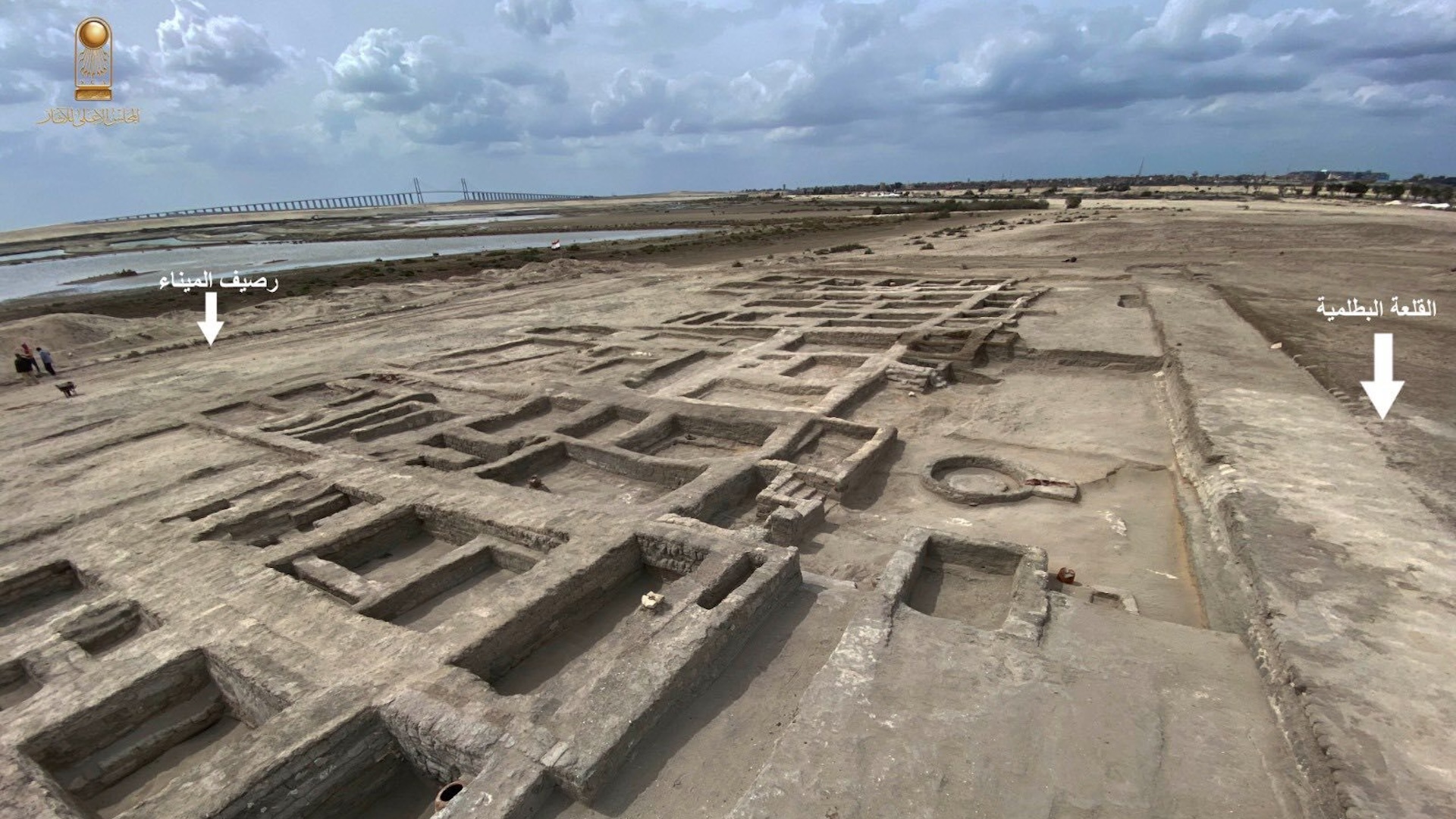
an aerial view of an excavated fortress
(Image credit: Photo courtesy of the Egyptian Ministry of Tourism and Antiquities)

The fortress was in use for centuries and was rebuilt and renovated over time.


The planting circles are an interesting find, Elizabeth Macaulay-Lewis, a classics professor at the City University of New York Graduate Center who was not involved in the excavation, told Live Science in an email.

Get the world’s most fascinating discoveries delivered straight to your inbox.

“It is certainly possible that clay planting circles could have been used to plant trees,” Macaulay-Lewis said. “500 trees would have been a lot, but we have evidence from papyri and archaeology for the large-scale cultivation of plants — vines, fruits, trees — in Ptolemaic Egypt.” She noted that if the excavation team uncovers the remains of roots, it would help confirm that these circles were used for planting. It might also allow for the identification of the tree species.

The archaeologists made several other finds, including living quarters of soldiers and perhaps their families. In addition, they unearthed a stretch of road that was 328 feet (100 m) long, 36 feet (11 m) wide, and paved with limestone slabs. It would have been used for military units traveling to the fortress.

In an unexpected finding, archaeologists unearthed four corners of a structure that may be from an even earlier period. It’s possible that this structure is also a fortress, but the team has not been able to date it or verify its purpose.

Live Science contacted the archaeologists who excavated the site but did not hear back by the time of publication.


Ancient Egypt quiz: Test your smarts about pyramids, hieroglyphs and King Tut

Source link

Share. Facebook Twitter Pinterest LinkedIn Tumblr Email
Previous ArticlePterosaurs were comfortable walking on land during the age of dinosaurs, tracks reveal
Next Article In a first, physicists spot elusive ‘free-range’ atoms — confirming a century-old theory about quantum mechanics
Editor
  • Website

Related Posts

Lifestyle

NASA astronauts briefly shelter in ‘safe haven’ procedure following worsening leaks on International Space Station

June 7, 2026
Lifestyle

Why can’t we figure out how strong gravity is?

June 6, 2026
Lifestyle

Stupid hot: Heat waves cause cognitive changes in animals, making them more aggressive and unable to complete basic tasks

June 6, 2026
Add A Comment

Comments are closed.

Categories
  • Entertainment
  • Lifestyle
  • News
  • Sports
  • Tech
  • Travel
Recent Posts
  • NASA astronauts briefly shelter in ‘safe haven’ procedure following worsening leaks on International Space Station
  • Why can’t we figure out how strong gravity is?
  • Stupid hot: Heat waves cause cognitive changes in animals, making them more aggressive and unable to complete basic tasks
  • Tump administration to remove 900 deep sea monitoring instruments that would have studied the collapsing Atlantic current
  • Science news this week: Ötzi the Iceman used to make sourdough, Italian teenagers discover Roman villa under school, Google plans to release 64 million mosquitos, and RIP to NASA’s Maven probe
calendar
June 2026
M T W T F S S
1234567
891011121314
15161718192021
22232425262728
2930  
« May    
Recent Posts
  • NASA astronauts briefly shelter in ‘safe haven’ procedure following worsening leaks on International Space Station
  • Why can’t we figure out how strong gravity is?
  • Stupid hot: Heat waves cause cognitive changes in animals, making them more aggressive and unable to complete basic tasks
About

Welcome to Baynard Media, your trusted source for a diverse range of news and insights. We are committed to delivering timely, reliable, and thought-provoking content that keeps you informed
and inspired

Categories
  • Entertainment
  • Lifestyle
  • News
  • Sports
  • Tech
  • Travel
Facebook X (Twitter) Pinterest WhatsApp
  • Contact Us
  • About Us
  • Privacy Policy
  • Disclaimer
  • UNSUBSCRIBE
© 2026 copyrights reserved

Type above and press Enter to search. Press Esc to cancel.