Close Menu
  • Home
  • UNSUBSCRIBE
  • News
  • Lifestyle
  • Tech
  • Entertainment
  • Sports
  • Travel
Facebook X (Twitter) WhatsApp
Trending
  • Science news this week: PCOS has a new name, Neanderthals were the world’s oldest dentists, and the first nuclear bomb explosion spawned an ‘alien’ crystal
  • Newly discovered, blue-whale-size asteroid will fly super close to Earth Monday — and you can watch it live
  • Don Juan Pond: Antarctica’s salty, syrupy lake that never freezes, even when it’s minus 58 F
  • Withings ScanWatch 2 review: Style meets next-level health monitoring
  • AI Chatbots are turbo-charging violence against women and girls: We urgently need to regulate them | Yvonne McDermott Rees
  • ‘The biggest El Niño event since the 1870s’: ‘Super’ El Niño is now the most likely scenario by the end of this year ‪—‬ and the humanitarian cost could be huge
  • Antarctica’s sudden sea ice loss is one of the most extreme and confusing events in the modern climate record. Scientists now know why it’s happening.
  • ‘I heard gasps’: Artemis II astronauts reveal inside story of their mind-bending solar eclipse
Facebook X (Twitter) WhatsApp
Baynard Media
  • Home
  • UNSUBSCRIBE
  • News
  • Lifestyle
  • Tech
  • Entertainment
  • Sports
  • Travel
Baynard Media
Home»Lifestyle»Has the James Webb Space Telescope discovered a ‘missing’ supermassive black hole? (video)
Lifestyle

Has the James Webb Space Telescope discovered a ‘missing’ supermassive black hole? (video)

EditorBy EditorApril 28, 2025No Comments3 Mins Read
Share Facebook Twitter Pinterest LinkedIn Tumblr Reddit Telegram Email
Share
Facebook Twitter LinkedIn Pinterest Email

Scientists have long believed that monster-sized supermassive black holes lurk at the heart of all large galaxies. That means that the failure to detect such a cosmic titan at the heart of the Southern Pinwheel Galaxy, officially known as Messier 83 (M83), has been a frustrating conundrum.

Now, using the James Webb Space Telescope (JWST), astronomers may have cracked this puzzle, finding the first evidence of a supermassive black hole at the heart of M83, also known as NGC 5236, a spiral galaxy located around 15 million light-years away.

“The JWST is revolutionizing our understanding of galaxies,” team member Linda Smith of the Space Telescope Science Institute said in a statement. “For years, astronomers have searched for a black hole in M83 without success. Now, we finally have a compelling clue that suggests one may be present.”

Related: Did the James Webb telescope really find evidence of alien life? Here’s the truth about exoplanet K2-18b.

A close-up view of a barred spiral galaxy. Two spiral arms reach horizontally away from the core in the centre, merging into a broad network of gas and dust which fills the image. This material glows brightest orange along the path of the arms, and is darker red across the rest of the galaxy. Through many gaps in the dust, countless tiny stars can be seen, most densely around the core

Full view of the M83 Southern Pinwheel galaxy as seen by the JWST (Image credit: ESA/Webb, NASA & CSA, A. Adamo (Stockholm University) and the FEAST JWST team)

Supermassive black holes have masses millions or even billions of times that of the sun. Situated at the hearts of distant galaxies, these black holes are pretty conspicuous when they are actively feeding and surrounded by gas and dust that they heat, causing them to glow brightly.

These regions, known as “active galactic nuclei” or “AGNs,” can often be seen even in galaxies that are otherwise too distant and too faint to be detected.

This has led scientists to speculate that either the supermassive black hole at the heart of M83 is dormant (not actively feeding on matter), or that the AGN it powers is hidden by a thick shroud of dust.

Get the world’s most fascinating discoveries delivered straight to your inbox.

That second explanation is favored by new data from the JWST which takes full advantage of the $10 billion space telescope’s unprecedented sensitivity and spatial resolution.
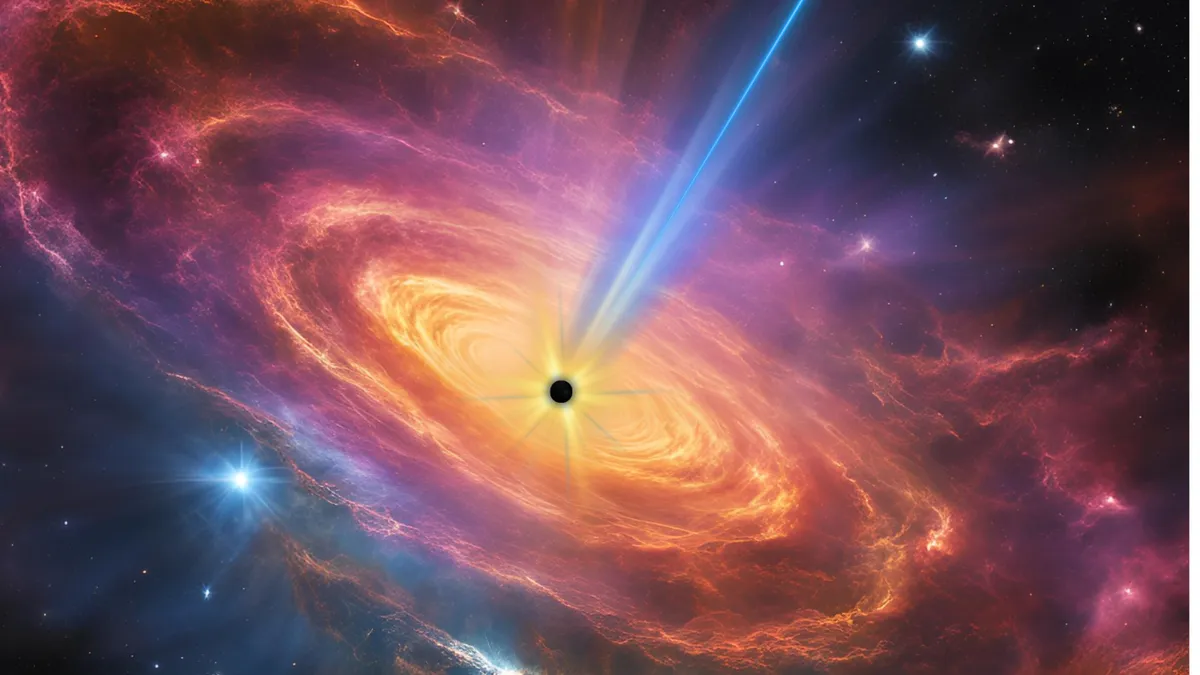
An illustration of a supermassive black hole in the early cosmos

An illustration of a supermassive black hole power AGN at the heart of a distant galaxy (Image credit: Robert Lea (created with Canva))

Clumps of highly ionized gas were the “smoking gun” hinting at the presence of an obscured AGN at the heart of M83.

“Our discovery of highly ionized neon emission in the nucleus of M83 was unexpected,” team leader Svea Hernandez, a European Space Agency (ESA) scientist at the Space Telescope Science Institute, said. “These signatures require large amounts of energy to be produced, more than what normal stars can generate.

“This strongly suggests the presence of an AGN that has been elusive until now.”

Even the explosive death of massive stars in supernovas couldn’t provide enough energy to create the signature spotted by the JWST. That makes an AGN the most likely suspect. But, not the only suspect.

The team behind this discovery now needs to eliminate other possible candidates for the creation of highly ionized neon gas, such as shockwaves travelling through the gases that exists between stars, the “interstellar medium.“

Astronomers will now follow up the investigation of M83 with the Hubble Space Telescope, the Atacama Large Millimeter/submillimeter Array (ALMA), and the Very Large Telescope (VLT).

In the meantime, this research proves how effective the JWST is at discovering hitherto unseen structures in the cosmos.

“This discovery showcases how the JWST is making unexpected breakthroughs,” Smith concluded, “Astronomers thought they had ruled out an AGN in M83, but now we have fresh evidence that challenges past assumptions and opens new avenues for exploration.”

The team’s research was published April 17 in The Astrophysical Journal.

Originally posted on Space.com.

Source link

Share. Facebook Twitter Pinterest LinkedIn Tumblr Email
Previous ArticleWhat is artificial superintelligence (ASI) and what could it mean for humanity?
Next Article ‘Totally unexpected’: Two new crocodile species discovered in the Caribbean
Editor
  • Website

Related Posts

Lifestyle

Science news this week: PCOS has a new name, Neanderthals were the world’s oldest dentists, and the first nuclear bomb explosion spawned an ‘alien’ crystal

May 16, 2026
Lifestyle

Newly discovered, blue-whale-size asteroid will fly super close to Earth Monday — and you can watch it live

May 16, 2026
Lifestyle

Don Juan Pond: Antarctica’s salty, syrupy lake that never freezes, even when it’s minus 58 F

May 16, 2026
Add A Comment

Comments are closed.

Categories
  • Entertainment
  • Lifestyle
  • News
  • Sports
  • Tech
  • Travel
Recent Posts
  • Science news this week: PCOS has a new name, Neanderthals were the world’s oldest dentists, and the first nuclear bomb explosion spawned an ‘alien’ crystal
  • Newly discovered, blue-whale-size asteroid will fly super close to Earth Monday — and you can watch it live
  • Don Juan Pond: Antarctica’s salty, syrupy lake that never freezes, even when it’s minus 58 F
  • Withings ScanWatch 2 review: Style meets next-level health monitoring
  • AI Chatbots are turbo-charging violence against women and girls: We urgently need to regulate them | Yvonne McDermott Rees
calendar
May 2026
M T W T F S S
 123
45678910
11121314151617
18192021222324
25262728293031
« Apr    
Recent Posts
  • Science news this week: PCOS has a new name, Neanderthals were the world’s oldest dentists, and the first nuclear bomb explosion spawned an ‘alien’ crystal
  • Newly discovered, blue-whale-size asteroid will fly super close to Earth Monday — and you can watch it live
  • Don Juan Pond: Antarctica’s salty, syrupy lake that never freezes, even when it’s minus 58 F
About

Welcome to Baynard Media, your trusted source for a diverse range of news and insights. We are committed to delivering timely, reliable, and thought-provoking content that keeps you informed
and inspired

Categories
  • Entertainment
  • Lifestyle
  • News
  • Sports
  • Tech
  • Travel
Facebook X (Twitter) Pinterest WhatsApp
  • Contact Us
  • About Us
  • Privacy Policy
  • Disclaimer
  • UNSUBSCRIBE
© 2026 copyrights reserved

Type above and press Enter to search. Press Esc to cancel.