Close Menu
  • Home
  • UNSUBSCRIBE
  • News
  • Lifestyle
  • Tech
  • Entertainment
  • Sports
  • Travel
Facebook X (Twitter) WhatsApp
Trending
  • George Kittle’s wife shares live reaction to Achilles injury
  • ‘The scientific cost would be severe’: A Trump Greenland takeover would put climate research at risk
  • Headlines Across OC as Angel Stadium Sale Debate Intensifies
  • Anti-Islam activists clash with pro-Muslim counter-protesters in Dearborn, Michigan
  • Best monitor deal: Get the 45-inch LG Ultragear gaming monitor for its lowest price yet
  • Slovakia U21 0 – 4 England U21
  • 13 Top Sleep Products That Transform Your Bedtime Routine for Better Rest
  • Firefighters rescue puppies from burning house
Facebook X (Twitter) WhatsApp
Baynard Media
  • Home
  • UNSUBSCRIBE
  • News
  • Lifestyle
  • Tech
  • Entertainment
  • Sports
  • Travel
Baynard Media
Home»Lifestyle»Runaway chain reaction of space debris will ‘threaten our future in space,’ according to ESA
Lifestyle

Runaway chain reaction of space debris will ‘threaten our future in space,’ according to ESA

EditorBy EditorApril 12, 2025No Comments4 Mins Read
Share Facebook Twitter Pinterest LinkedIn Tumblr Reddit Telegram Email
Share
Facebook Twitter LinkedIn Pinterest Email

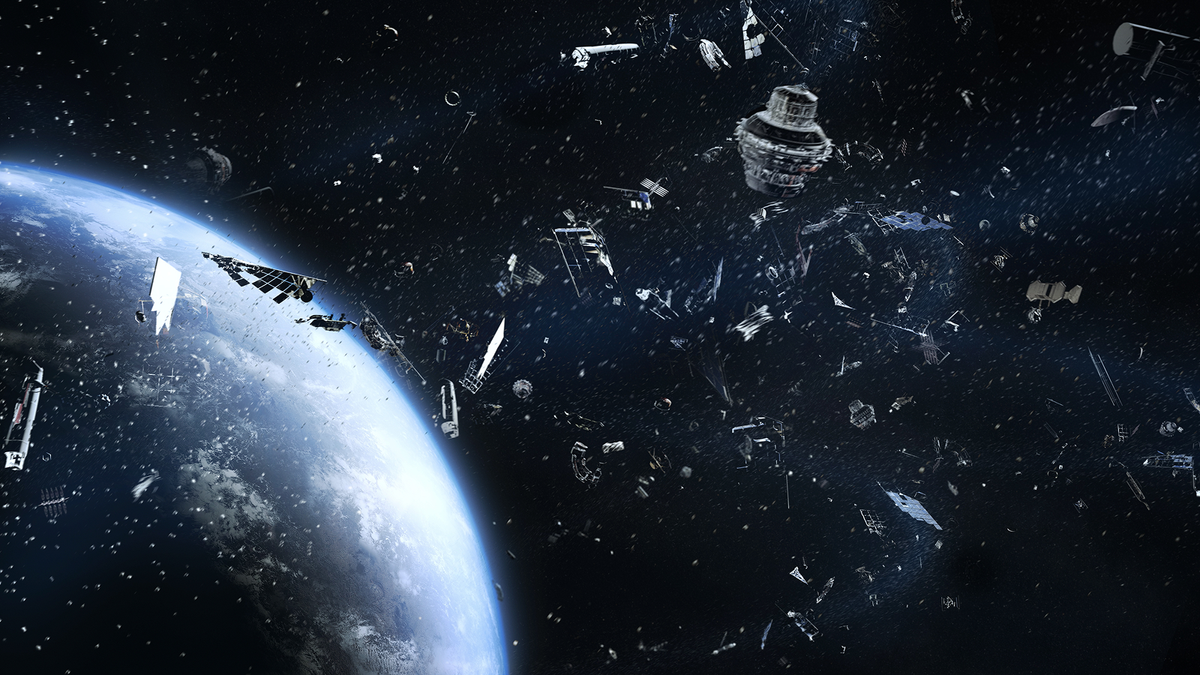
Left unchecked, the space around our planet could get so cluttered with debris that we might not be able to use some orbits anymore, according to the latest European Space Agency (ESA) report on the space environment.

The report, published April 1, states that although new standards to curb space debris are becoming more widely adopted, they aren’t enough to keep the debris currently in orbit from colliding with itself — creating dangerous debris clouds in a runaway process known as “Kessler syndrome.”

“Even if we created no new space debris, it would not be enough to prevent a runaway series of collisions and fragmentations,” ESA said in a statement. “The actual number of space debris objects larger than 1 cm in size – large enough to be capable of causing catastrophic damage – is estimated to be over 1.2 million, with over 50,000 objects of those larger than 10 cm.”

Impact by a 1 cm diameter object (about the size of a pea) could disable important satellite systems, according to ESA, while anything bigger could potentially puncture the International Space Station (ISS). “Anything larger than 10 cm could shatter a satellite or spacecraft into pieces,” the agency’s statement said, after a tiny fragment only a few thousandths of a millimeter across left a 7 mm chip in the ISS’s glass windows in 2016.

Related: Space junk: How broken satellites are creating a garbage crisis in the sky

The ESA report also discussed how recent changes in space traffic are making the existing debris problem worse, suggesting three major factors — traffic volume, spacecraft type and the number of commercial operators — that should be considered when planning sustainable space operations.

ESA astronaut Tim Peake took this photo from inside Cupola last month, showing a 7 mm-diameter circular chip gouged out by the impact from a tiny piece of space debris, possibly a paint flake or small metal fragment no bigger than a few thousandths of a millimetre across. The background just shows the inky blackness of space.

A 7-millimeter diameter chip in one of the glass windows making up the International Space Station’s Cupola, caused by the impact of a tiny piece of space debris estimated to be less than a few thousandths of a millimeter wide. (Image credit: ESA/NASA)

The number of launches taking place is higher now than it has ever been, and many of the spacecraft being launched are smaller systems deployed as large constellations of spacecraft. In other words, there is a lot more potential debris being added to orbit — at a time when there’s already too much junk orbiting Earth as it is.

Get the world’s most fascinating discoveries delivered straight to your inbox.

Space debris doesn’t stick around forever — some of it burns up in our atmosphere, and some of it crashes back down to Earth. However, the debris currently leaving orbit isn’t enough to match the debris being added, even though “intact satellites or rocket bodies are now re-entering the Earth atmosphere on average more than three times a day,” according to ESA.

Space debris makes more of itself by breaking apart into increasingly smaller pieces with every collision. There isn’t much in space to slow down fragments hurtling around our planet — they mostly keep going until they collide with something, or until their orbit decays (gets closer to Earth due to energy loss) enough for the atmosphere to burn them up.

It’s a vicious cycle: the more debris there is, the more chances there are for a collision to occur, and the more collisions there are, the more debris is created.

To reduce new debris, the ESA is now recommending spacecraft be designed to burn up within five years of the end of their life, five times shorter than the previous recommendation of 25 years. For the debris already circling the planet, the ESA says active removal is the next step — before the problem escalates out of control. ESA’s ClearSpace-1 mission, planned to launch in 2028, will be the first mission to attempt to capture and remove a defunct satellite from orbit, demonstrating active debris removal for the first time.

Source link

Share. Facebook Twitter Pinterest LinkedIn Tumblr Email
Previous Article3,400-year-old ancient Egyptian town discovered by Alexandria — a New Kingdom settlement connected to Nefertiti’s daughter
Next Article Viking quiz: How much do you know about these seaborne raiders, traders and explorers?
Editor
  • Website

Related Posts

Lifestyle

‘The scientific cost would be severe’: A Trump Greenland takeover would put climate research at risk

January 17, 2026
Lifestyle

New ‘Transformer’ humanoid robot can launch a shapeshifting drone off its back — watch it in action

November 19, 2025
Lifestyle

Medieval spear pulled from Polish lake may have belonged to prince or nobleman

November 19, 2025
Add A Comment

Comments are closed.

Categories
  • Entertainment
  • Lifestyle
  • News
  • Sports
  • Tech
  • Travel
Recent Posts
  • George Kittle’s wife shares live reaction to Achilles injury
  • ‘The scientific cost would be severe’: A Trump Greenland takeover would put climate research at risk
  • Headlines Across OC as Angel Stadium Sale Debate Intensifies
  • Anti-Islam activists clash with pro-Muslim counter-protesters in Dearborn, Michigan
  • Best monitor deal: Get the 45-inch LG Ultragear gaming monitor for its lowest price yet
calendar
February 2026
M T W T F S S
 1
2345678
9101112131415
16171819202122
232425262728  
« Jan    
Recent Posts
  • George Kittle’s wife shares live reaction to Achilles injury
  • ‘The scientific cost would be severe’: A Trump Greenland takeover would put climate research at risk
  • Headlines Across OC as Angel Stadium Sale Debate Intensifies
About

Welcome to Baynard Media, your trusted source for a diverse range of news and insights. We are committed to delivering timely, reliable, and thought-provoking content that keeps you informed
and inspired

Categories
  • Entertainment
  • Lifestyle
  • News
  • Sports
  • Tech
  • Travel
Facebook X (Twitter) Pinterest WhatsApp
  • Contact Us
  • About Us
  • Privacy Policy
  • Disclaimer
  • UNSUBSCRIBE
© 2026 copyrights reserved

Type above and press Enter to search. Press Esc to cancel.