Close Menu
  • Home
  • UNSUBSCRIBE
  • News
  • Lifestyle
  • Tech
  • Entertainment
  • Sports
  • Travel
Facebook X (Twitter) WhatsApp
Trending
  • ‘Nations need to prepare now’: Key Atlantic ocean current is much closer to collapse than scientists thought
  • Neanderthal toddlers grew faster than modern humans, probably because of the harsh environment they evolved in
  • NASA shuts off another Voyager 1 instrument as humanity’s most distant spacecraft prepares for risky ‘Big Bang’ maneuver to save power
  • Florida is facing its most intense drought in 15 years. Here’s how it got so bad and how long it will last.
  • New blood test aims to spot liver scarring when it’s still reversible and before it paves the way to cancer
  • ‘We’re the best servants anyone could dream of!’: AI superintelligence has no need to enslave humans because we’re already bowing to it
  • Glowing ring of plankton surrounding New Zealand islands linked to deadly underwater plateau — Earth from space
  • Omar files new financial form in response to Trump, GOP critics
Facebook X (Twitter) WhatsApp
Baynard Media
  • Home
  • UNSUBSCRIBE
  • News
  • Lifestyle
  • Tech
  • Entertainment
  • Sports
  • Travel
Baynard Media
Home»Lifestyle»Incredible photo shows supermassive black hole blowing a jet of matter into interstellar space
Lifestyle

Incredible photo shows supermassive black hole blowing a jet of matter into interstellar space

EditorBy EditorApril 5, 2025No Comments3 Mins Read
Share Facebook Twitter Pinterest LinkedIn Tumblr Reddit Telegram Email
Share
Facebook Twitter LinkedIn Pinterest Email

A distant galaxy is home to a ravenous supermassive black hole that appears to be playing with its food in a lively new image from the Very Large Telescope.

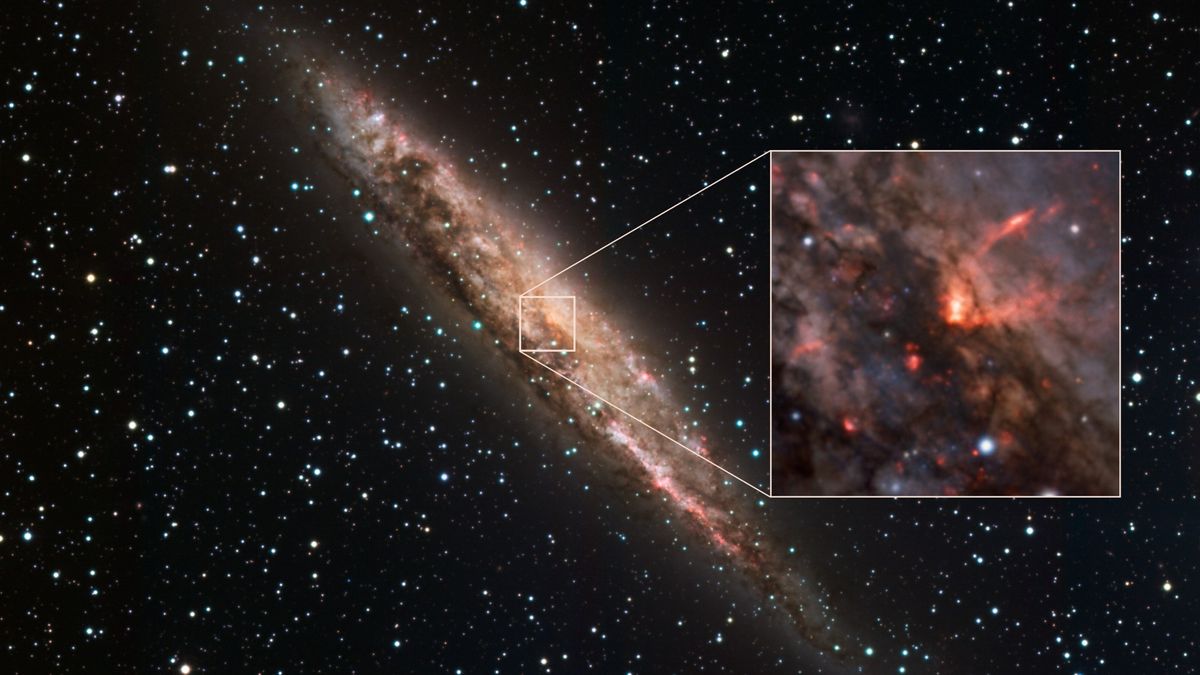
Located over 12 million light-years from Earth, a spiral galaxy known as NGC 4945 is blowing powerful winds of material from the supermassive black hole located at its core. Using the European Southern Observatory’s (ESO) Very Large Telescope (VLT), which is located on Cerro Paranal mountain in the Atacama Desert of northern Chile, astronomers captured an up-close view of the galaxy’s active core and the fast winds flowing out from the black hole.

The photo suggests that interstellar ‘scraps’ of matter are being strewn into space as the hungry black hole chows down on its dinner. “At the very center of nearly every galaxy is a supermassive black hole,” ESO officials said in a statement accompanying the new VLT image on March 31. “Some, like the one at the center of our own Milky Way, aren’t particularly hungry. But NGC 4945’s supermassive black hole is ravenous, consuming huge amounts of matter.”

The galactic winds, represented as bright cone-shaped jets of material in the image, are moving so fast that the gas and dust is likely escaping the galaxy and being ejected into intergalactic space before the black hole can even feast on it.

“This messy eater, contrary to a black hole’s typical all-consuming reputation, is blowing out powerful winds of material,” ESO officials added.

a bright red arc of light seen against greyish red clouds in space. hundreds of stars dot the background

A close-up view of the active core of galaxy NGC 4945 and the galactic winds flowing out from its supermassive black hole.  (Image credit: ESO/C. Marconcini et al.)

The recent VLT observations were taken as part of a larger study on how winds move in galaxies. The MUSE data shows that the galactic winds observed in NGC 4945 speed up as they travel away from the central black hole, toward the outskirts of the galaxy. This is unusual behavior, given galactic winds generally slow down as they travel further outwards in a galaxy.

These fast-moving winds can have a significant impact on their host galaxy. By ejecting material from the galaxy, the winds inhibit star formation.

Get the world’s most fascinating discoveries delivered straight to your inbox.

“It also shows that the more powerful black holes impede their own growth by removing the gas and dust they feed on, driving the whole system closer towards a sort of galactic equilibrium,” ESO officials said in the statement. “Now, with these new results, we are one step closer to understanding the acceleration mechanism of the winds responsible for shaping the evolution of galaxies, and the history of the universe.”

In the up-close view of NGC 4945, the galaxy’s active core is obscured by dust and gas drawn to this area by the strong gravitational pull of the black hole, which feeds on the interstellar material. The glowing galactic winds shine through the dust and gas clouds, flowing out from the black hole. The zoomed-in view was overlaid on a wider image of NGC 4945, taken by the MPG/ESO telescope at La Silla, Chile.

A study of these galactic winds was published in Nature Astronomy.

Originally posted on Space.com.


Black hole quiz: How supermassive is your knowledge of the universe?

Source link

Share. Facebook Twitter Pinterest LinkedIn Tumblr Email
Previous ArticlePhysicists claim to find ‘first observational evidence supporting string theory,’ which could finally reveal the nature of dark energy
Next Article $3 million Breakthrough Prize goes to scientists that completely changed our understanding of multiple sclerosis
Editor
  • Website

Related Posts

Lifestyle

‘Nations need to prepare now’: Key Atlantic ocean current is much closer to collapse than scientists thought

April 22, 2026
Lifestyle

Neanderthal toddlers grew faster than modern humans, probably because of the harsh environment they evolved in

April 21, 2026
Lifestyle

NASA shuts off another Voyager 1 instrument as humanity’s most distant spacecraft prepares for risky ‘Big Bang’ maneuver to save power

April 21, 2026
Add A Comment

Comments are closed.

Categories
  • Entertainment
  • Lifestyle
  • News
  • Sports
  • Tech
  • Travel
Recent Posts
  • ‘Nations need to prepare now’: Key Atlantic ocean current is much closer to collapse than scientists thought
  • Neanderthal toddlers grew faster than modern humans, probably because of the harsh environment they evolved in
  • NASA shuts off another Voyager 1 instrument as humanity’s most distant spacecraft prepares for risky ‘Big Bang’ maneuver to save power
  • Florida is facing its most intense drought in 15 years. Here’s how it got so bad and how long it will last.
  • New blood test aims to spot liver scarring when it’s still reversible and before it paves the way to cancer
calendar
April 2026
M T W T F S S
 12345
6789101112
13141516171819
20212223242526
27282930  
« Mar    
Recent Posts
  • ‘Nations need to prepare now’: Key Atlantic ocean current is much closer to collapse than scientists thought
  • Neanderthal toddlers grew faster than modern humans, probably because of the harsh environment they evolved in
  • NASA shuts off another Voyager 1 instrument as humanity’s most distant spacecraft prepares for risky ‘Big Bang’ maneuver to save power
About

Welcome to Baynard Media, your trusted source for a diverse range of news and insights. We are committed to delivering timely, reliable, and thought-provoking content that keeps you informed
and inspired

Categories
  • Entertainment
  • Lifestyle
  • News
  • Sports
  • Tech
  • Travel
Facebook X (Twitter) Pinterest WhatsApp
  • Contact Us
  • About Us
  • Privacy Policy
  • Disclaimer
  • UNSUBSCRIBE
© 2026 copyrights reserved

Type above and press Enter to search. Press Esc to cancel.