Close Menu
  • Home
  • UNSUBSCRIBE
  • News
  • Lifestyle
  • Tech
  • Entertainment
  • Sports
  • Travel
Facebook X (Twitter) WhatsApp
Trending
  • So CLOSE! Littler just misses out on nine-darter in Cardiff!
  • Jack Osbourne on Ozzy Osbourne Final Hours, Surprise Death
  • Trump criticizes MLB during Inter Miami White House celebration
  • Amazon outage: Here’s what we know so far
  • Mixed day for McIlroy as Berger leads at Bay Hill
  • Gypsy Rose Blanchard Weight Loss, Body Transformation
  • Strikes and explosions across the Middle East
  • James Webb Telescope updates odds that ‘city killer’ asteroid 2024 YR4 will hit the moon
Facebook X (Twitter) WhatsApp
Baynard Media
  • Home
  • UNSUBSCRIBE
  • News
  • Lifestyle
  • Tech
  • Entertainment
  • Sports
  • Travel
Baynard Media
Home»Lifestyle»Jaw-dropping NASA image reveals a dying star at the heart of the Helix Nebula — and it may have just murdered a planet
Lifestyle

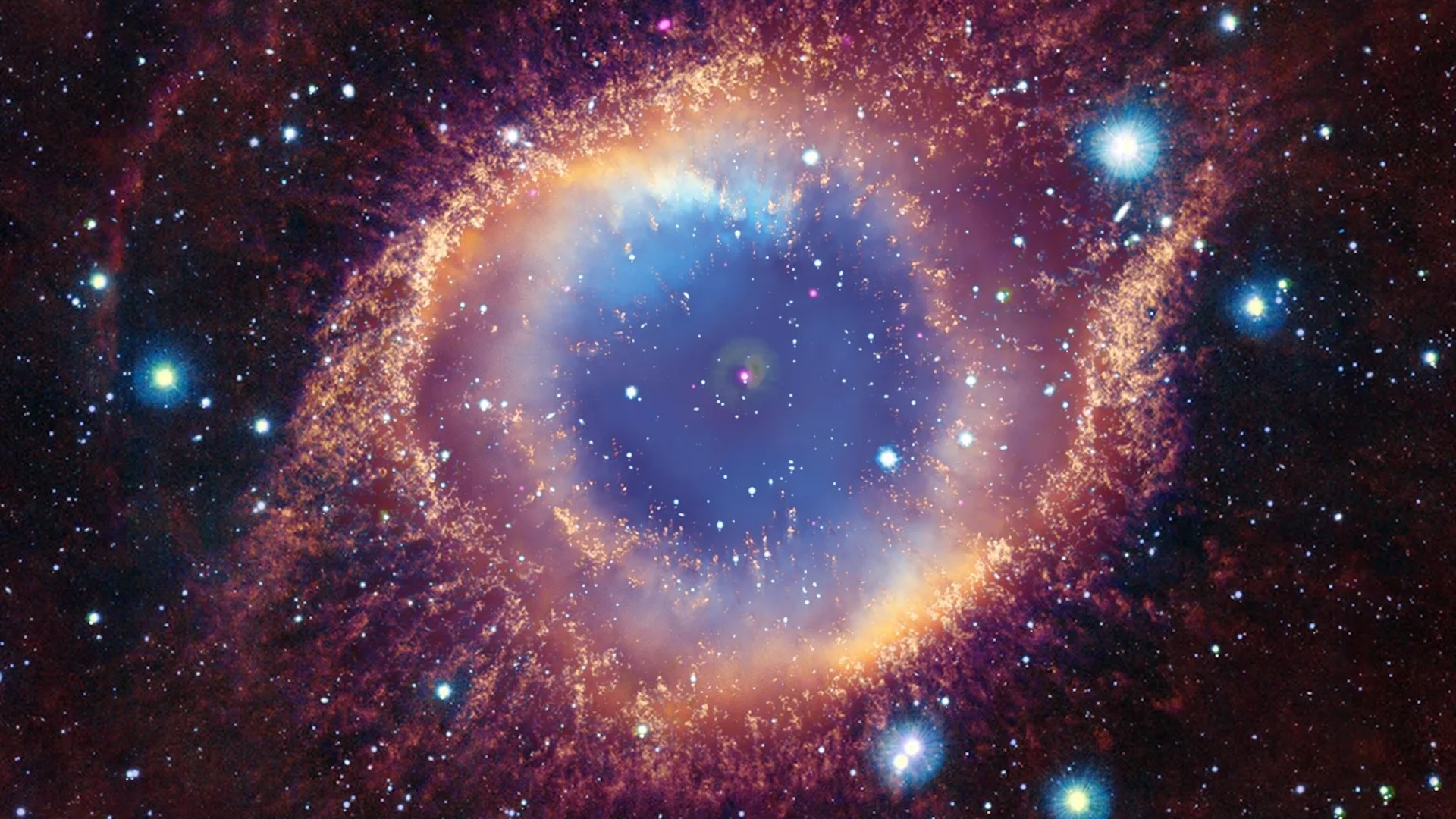
Jaw-dropping NASA image reveals a dying star at the heart of the Helix Nebula — and it may have just murdered a planet

EditorBy EditorApril 3, 2025No Comments3 Mins Read
Share Facebook Twitter Pinterest LinkedIn Tumblr Reddit Telegram Email
Share
Facebook Twitter LinkedIn Pinterest Email

A new X-ray look at the mesmerizing Helix Nebula reveals an alleged planet killer: a white dwarf that might be the source of strange emissions from the nebula.

The Helix Nebula, also known as Caldwell 63, is 650 million light-years from Earth, according to NASA. It’s the remains of a dying star, which is gradually shedding its outer gas layers into the surrounding space. Stellar radiation causes the gas to glow like a giant ring, which stretches about 3 light-years across, according to NASA observations.

Now, a new look at the nebula combines X-ray emissions detected by NASA’s Chandra X-ray Observatory, visible light seen by the Hubble Space Telescope, infrared light detected by the European Southern Observatory’s Visible and Infrared Survey Telescope for Astronomy, and ultraviolet light detected by NASA’s Galaxy Evolution Explorer space telescope.

This broad-spectrum view revealed the remnants of the dying white dwarf star that created the nebula, and indicates that this dying star may have gobbled up an orbiting planet that flew too close to its dying sun. Tidal forces from the white dwarf appear to have ripped the nearby planet to shreds and then pulled its leftover pieces onto the white dwarf’s surface, triggering powerful X-ray flares.

Related: 25 gorgeous nebula photos that capture the beauty of the universe

Our own sun will also die as a white dwarf, which is the final stage for medium-mass stars that run out of fuel. White dwarfs gradually dim and cool until they wink out of existence altogether. In the Helix Nebula, the star ejects hot gas into space, and that gas cools and falls back toward the star. Tendrils of hot gas and older cooling gas collide and create intricate, knot-like patterns that look a bit like comets.

In December 2024, a research team led by Sandino Estrada-Dorado, an astrophysicist at the National Autonomous University of Mexico, reported in the journal Monthly Notices of the Royal Astronomical Society that unexplained X-ray emissions from the nebula are likely the result of material from a “substellar donor companion” falling into the dying star. Substeller objects don’t undergo hydrogen fusion, as happens in stars. They include brown dwarfs (or “failed stars”), former stars and planets.

Get the world’s most fascinating discoveries delivered straight to your inbox.

If the white dwarf at the center did eat a planet, it has something else in common with Earth’s sun. By the time the sun reaches the white dwarf stage, it will have passed through a red giant phase, swelling in size and engulfing our planet (and those closer to it). Luckily for us, this won’t happen until 5 billion years from now, when the sun begins to run low on fuel.

Source link

Share. Facebook Twitter Pinterest LinkedIn Tumblr Email
Previous ArticleDark Skys DS-FX star projector review
Next Article SwitchBot air purifier table review: Stylish, smart and pet-friendly
Editor
  • Website

Related Posts

Lifestyle

James Webb Telescope updates odds that ‘city killer’ asteroid 2024 YR4 will hit the moon

March 6, 2026
Lifestyle

Groundbreaking new drug shows promise for treating children with a devastating form of epilepsy

March 5, 2026
Lifestyle

Microscopic swimming robots navigate ‘artificial space-time’ mazes using Einstein’s relativity

March 5, 2026
Add A Comment

Comments are closed.

Categories
  • Entertainment
  • Lifestyle
  • News
  • Sports
  • Tech
  • Travel
Recent Posts
  • So CLOSE! Littler just misses out on nine-darter in Cardiff!
  • Jack Osbourne on Ozzy Osbourne Final Hours, Surprise Death
  • Trump criticizes MLB during Inter Miami White House celebration
  • Amazon outage: Here’s what we know so far
  • Mixed day for McIlroy as Berger leads at Bay Hill
calendar
March 2026
M T W T F S S
 1
2345678
9101112131415
16171819202122
23242526272829
3031  
« Feb    
Recent Posts
  • So CLOSE! Littler just misses out on nine-darter in Cardiff!
  • Jack Osbourne on Ozzy Osbourne Final Hours, Surprise Death
  • Trump criticizes MLB during Inter Miami White House celebration
About

Welcome to Baynard Media, your trusted source for a diverse range of news and insights. We are committed to delivering timely, reliable, and thought-provoking content that keeps you informed
and inspired

Categories
  • Entertainment
  • Lifestyle
  • News
  • Sports
  • Tech
  • Travel
Facebook X (Twitter) Pinterest WhatsApp
  • Contact Us
  • About Us
  • Privacy Policy
  • Disclaimer
  • UNSUBSCRIBE
© 2026 copyrights reserved

Type above and press Enter to search. Press Esc to cancel.