Close Menu
  • Home
  • UNSUBSCRIBE
  • News
  • Lifestyle
  • Tech
  • Entertainment
  • Sports
  • Travel
Facebook X (Twitter) WhatsApp
Trending
  • New robotic heart mimics common, mysterious condition to help researchers study it
  • Canon EOS R6 III review: A wildlife wonder
  • Medieval babies and adults buried together in Sweden were not related, archaeologists discover — raising big questions about early Christian burial practices
  • NASA is creating a fifth state of matter on the ISS, thanks to an upgrade to a mini-fridge-sized quantum lab
  • New sodium metal battery design charges in just 4 minutes and retains its capacity for years
  • Quantum computing wielded to create extremely rare material critical to nuclear fusion
  • Scientists build tiny ‘diving suit’ for cockroaches, turning them into search-and-rescue cyborgs
  • Physicists develop the first working model of quantum mechanics using only ‘real’ numbers
Facebook X (Twitter) WhatsApp
Baynard Media
  • Home
  • UNSUBSCRIBE
  • News
  • Lifestyle
  • Tech
  • Entertainment
  • Sports
  • Travel
Baynard Media
Home»Lifestyle»Supersonic vehicles could become stronger, faster and more durable thanks to new findings
Lifestyle

Supersonic vehicles could become stronger, faster and more durable thanks to new findings

EditorBy EditorApril 3, 2025No Comments3 Mins Read
Share Facebook Twitter Pinterest LinkedIn Tumblr Reddit Telegram Email
Share
Facebook Twitter LinkedIn Pinterest Email

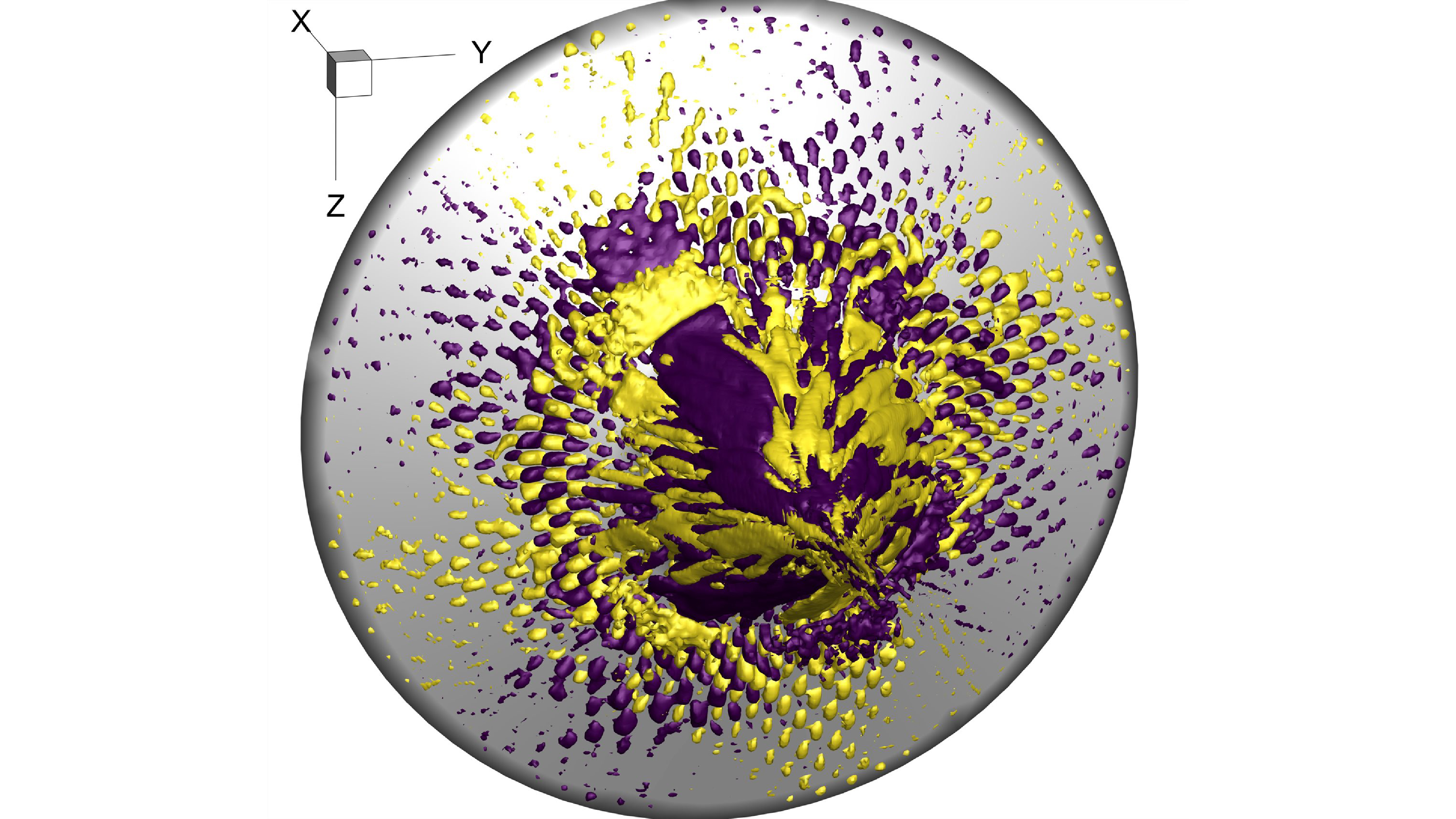
A close look at air flow around high-speed shapes reveals surprising turbulence, according to a new study. The findings, published March 7 in the journal Physical Review Fluids, could inform the design of future high-speed vehicles.

In the study, researchers used three-dimensional simulations to reveal unexpected disturbances around fast-moving cones.

At hypersonic speeds — above Mach 5, or more than 5 times the speed of sound (3,836 mph or 6,174 kilometers per hour) — the flow of air around a vehicle’s surface becomes complex and bumpy. Most simulations assume that the flow is symmetrical around the whole cone, but until recently, studies of the transition from streamlined to turbulent were only possible in two dimensions so we couldn’t be sure that there weren’t any asymmetries in flow around a three-dimensional structure.

The findings could help engineers design stronger, faster vehicles able to withstand the extreme temperatures, pressures and vibrations felt during hypersonic flight.

“Transitioning flows are 3D and unsteady in nature, regardless of the flow geometry,” study co-author Irmak Taylan Karpuzcu, an aerospace engineer at the University of Illinois Urbana-Champaign, said in a statement. “Experiments were conducted in 3D in the early 2000s [but they] didn’t provide enough data to determine any 3D effects or unsteadiness because there weren’t enough sensors all around the cone-shaped model. It wasn’t wrong. It was just all that was possible then.”

Using the Frontera supercomputer at the Texas Advanced Computing Center, Karpuzcu and aerospace engineer Deborah Levin simulated how air flow around a cone-shaped object — often used as a simplified model for hypersonic vehicles — changes in three dimensions at high speed. They studied both a single cone and a double cone, which helps scientists study how multiple shock waves interact with each other.

“Normally, you would expect the flow around the cone to be concentric ribbons, but we noticed breaks in the flow within shock layers both in the single and double cone shapes,” Karpuzcu said.

Get the world’s most fascinating discoveries delivered straight to your inbox.

These breaks were particularly prevalent around the tip of the cone. At high speeds, the shock wave lies closer to the cone, squeezing air molecules into unstable layers and amplifying instabilities in the airflow. The team confirmed their findings by running a program that tracks each simulated air molecule and captures how collisions between the molecules affect air flow.

The disturbances also seem to develop at high speeds. “As you increase the Mach number, the shock gets closer to the surface and promotes these instabilities. It would be too expensive to run the simulation at every speed, but we did run it at Mach 6 and did not see a break in the flow,” Karpuzcu said.

The breaks could affect design considerations for hypersonic vehicles, which could be used for shipping, weapons and transportation, Karpuzcu said, as engineers will need to account for the newly observed discontinuities.

Source link

Share. Facebook Twitter Pinterest LinkedIn Tumblr Email
Previous ArticleSpaceX ‘Fram2’ mission to Earth’s Poles is more about ‘vanity’ than science, spaceflight experts say
Next Article Morento MR5866 smart air purifier review
Editor
  • Website

Related Posts

Lifestyle

New robotic heart mimics common, mysterious condition to help researchers study it

July 11, 2026
Lifestyle

Canon EOS R6 III review: A wildlife wonder

July 10, 2026
Lifestyle

Medieval babies and adults buried together in Sweden were not related, archaeologists discover — raising big questions about early Christian burial practices

July 10, 2026
Add A Comment

Comments are closed.

Categories
  • Entertainment
  • Lifestyle
  • News
  • Sports
  • Tech
  • Travel
Recent Posts
  • New robotic heart mimics common, mysterious condition to help researchers study it
  • Canon EOS R6 III review: A wildlife wonder
  • Medieval babies and adults buried together in Sweden were not related, archaeologists discover — raising big questions about early Christian burial practices
  • NASA is creating a fifth state of matter on the ISS, thanks to an upgrade to a mini-fridge-sized quantum lab
  • New sodium metal battery design charges in just 4 minutes and retains its capacity for years
calendar
July 2026
M T W T F S S
 12345
6789101112
13141516171819
20212223242526
2728293031  
« Jun    
Recent Posts
  • New robotic heart mimics common, mysterious condition to help researchers study it
  • Canon EOS R6 III review: A wildlife wonder
  • Medieval babies and adults buried together in Sweden were not related, archaeologists discover — raising big questions about early Christian burial practices
About

Welcome to Baynard Media, your trusted source for a diverse range of news and insights. We are committed to delivering timely, reliable, and thought-provoking content that keeps you informed
and inspired

Categories
  • Entertainment
  • Lifestyle
  • News
  • Sports
  • Tech
  • Travel
Facebook X (Twitter) Pinterest WhatsApp
  • Contact Us
  • About Us
  • Privacy Policy
  • Disclaimer
  • UNSUBSCRIBE
© 2026 copyrights reserved

Type above and press Enter to search. Press Esc to cancel.