Close Menu
  • Home
  • UNSUBSCRIBE
  • News
  • Lifestyle
  • Tech
  • Entertainment
  • Sports
  • Travel
Facebook X (Twitter) WhatsApp
Trending
  • ‘Nations need to prepare now’: Key Atlantic ocean current is much closer to collapse than scientists thought
  • Neanderthal toddlers grew faster than modern humans, probably because of the harsh environment they evolved in
  • NASA shuts off another Voyager 1 instrument as humanity’s most distant spacecraft prepares for risky ‘Big Bang’ maneuver to save power
  • Florida is facing its most intense drought in 15 years. Here’s how it got so bad and how long it will last.
  • New blood test aims to spot liver scarring when it’s still reversible and before it paves the way to cancer
  • ‘We’re the best servants anyone could dream of!’: AI superintelligence has no need to enslave humans because we’re already bowing to it
  • Glowing ring of plankton surrounding New Zealand islands linked to deadly underwater plateau — Earth from space
  • Omar files new financial form in response to Trump, GOP critics
Facebook X (Twitter) WhatsApp
Baynard Media
  • Home
  • UNSUBSCRIBE
  • News
  • Lifestyle
  • Tech
  • Entertainment
  • Sports
  • Travel
Baynard Media
Home»Lifestyle»NASA rover spots hundreds of ‘spider eggs’ on Mars — and scientists have no idea how they got there
Lifestyle

NASA rover spots hundreds of ‘spider eggs’ on Mars — and scientists have no idea how they got there

EditorBy EditorMarch 29, 2025No Comments3 Mins Read
Share Facebook Twitter Pinterest LinkedIn Tumblr Reddit Telegram Email
Share
Facebook Twitter LinkedIn Pinterest Email

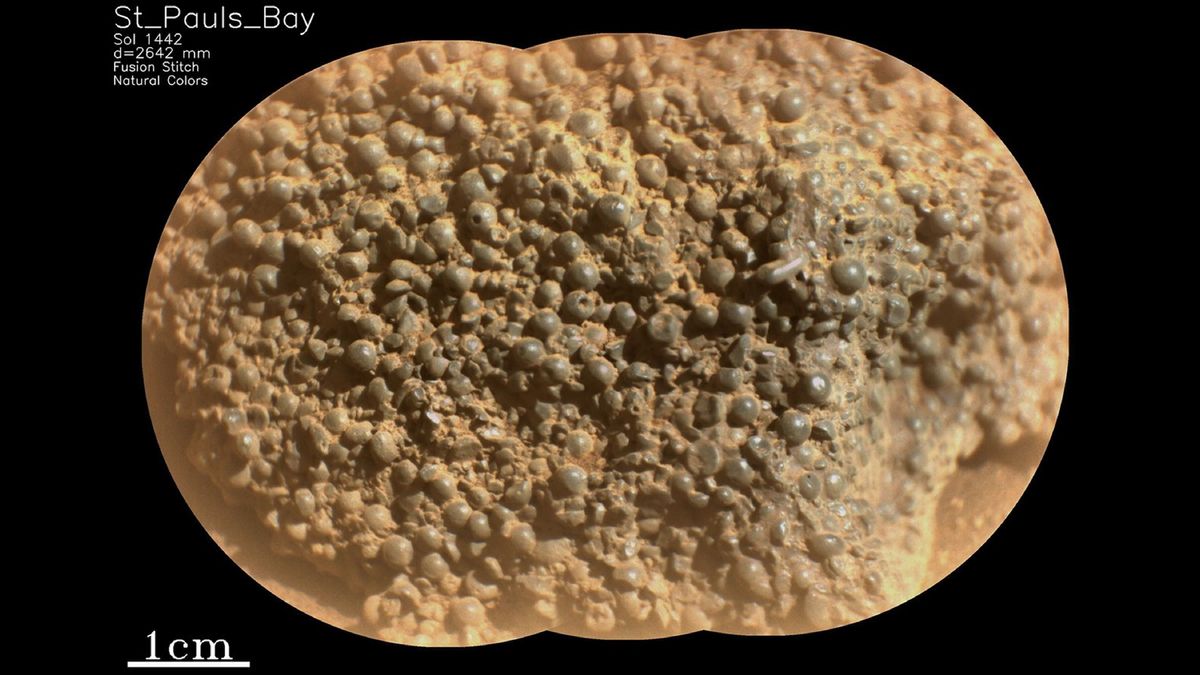
NASA’s Perseverance Mars rover has spotted a strange object out of the corner of its “eye”: a mysterious rock that resembles a cluster of hundreds of spider eggs. The rock, which was discovered on the slopes of Witch Hazel Hill on the rim of Jezero Crater, is lightly dusted with red sand and conspicuously out of place.

a picture of a rock on Mars with a bubbly surface

The mysterious rock, named “St. Pauls Bay,” is surrounded by lighter rocks and red-brown sand. (Image credit: NASA/JPL-Caltech/ASU)

This rock, which the Perseverance team named “St. Pauls Bay,” is float rock, meaning it wasn’t found where it formed. As a result, it’s missing context clues that could explain its strange texture, according to NASA’s statement.

It isn’t just the geologic context that’s missing, either. Something caused the rock to move from its original location, and that movement could reveal insights about Martian geology. Maybe this rock formed when a meteorite struck Mars, vaporizing rock before it condensed into the little granules seen in the photo. If this was the case, the rock could have originated far from its current resting place, and it could reveal how meteor strikes transport materials on Mars, NASA noted.

Related: ‘Spiders on Mars’ fully awakened on Earth for 1st time — and scientists are shrieking with joy

a map of Mars showing the location of Witch Hazel Hill

This map shows the approximate path Perseverance has taken to reach Witch Hazel Hill, with important landmarks labeled. Some of the landmarks are places where Perseverance took rock samples. (Image credit: NASA/JPL-Caltech/University of Arizona)

It’s also possible that the rock rolled down Witch Hazel Hill, according to NASA. It may have originated from one of the darker layers on the hill that scientists have detected from orbit. Closer study of Witch Hazel Hill could tell scientists what those darker layers are made of. If they’re similar in composition to St. Pauls Bay, it could indicate a layer of volcanic activity, an old meteor strike, the presence of groundwater in the past, or something else entirely, NASA representatives wrote in the statement.

Rocks like St. Pauls Bay give scientists important clues about how the Red Planet has changed over time. Their formation and transportation reveal complex interactions between water, rock and geologic forces on Mars, which can help answer whether the planet could have harbored life in the past.

If Witch Hazel Hill once had groundwater, some of the rock samples Perseverance has been collecting might contain fossilized microbial life. NASA’s Mars Sample Return mission, currently planned for sometime in the 2030s, will scoop up these rock samples and return them to Earth for further study.

Get the world’s most fascinating discoveries delivered straight to your inbox.

Source link

Share. Facebook Twitter Pinterest LinkedIn Tumblr Email
Previous ArticleSouth Carolina wildfire keeps growing as firefighters protect homes
Next Article Taliban releases American detained in Afghanistan
Editor
  • Website

Related Posts

Lifestyle

‘Nations need to prepare now’: Key Atlantic ocean current is much closer to collapse than scientists thought

April 22, 2026
Lifestyle

Neanderthal toddlers grew faster than modern humans, probably because of the harsh environment they evolved in

April 21, 2026
Lifestyle

NASA shuts off another Voyager 1 instrument as humanity’s most distant spacecraft prepares for risky ‘Big Bang’ maneuver to save power

April 21, 2026
Add A Comment

Comments are closed.

Categories
  • Entertainment
  • Lifestyle
  • News
  • Sports
  • Tech
  • Travel
Recent Posts
  • ‘Nations need to prepare now’: Key Atlantic ocean current is much closer to collapse than scientists thought
  • Neanderthal toddlers grew faster than modern humans, probably because of the harsh environment they evolved in
  • NASA shuts off another Voyager 1 instrument as humanity’s most distant spacecraft prepares for risky ‘Big Bang’ maneuver to save power
  • Florida is facing its most intense drought in 15 years. Here’s how it got so bad and how long it will last.
  • New blood test aims to spot liver scarring when it’s still reversible and before it paves the way to cancer
calendar
April 2026
M T W T F S S
 12345
6789101112
13141516171819
20212223242526
27282930  
« Mar    
Recent Posts
  • ‘Nations need to prepare now’: Key Atlantic ocean current is much closer to collapse than scientists thought
  • Neanderthal toddlers grew faster than modern humans, probably because of the harsh environment they evolved in
  • NASA shuts off another Voyager 1 instrument as humanity’s most distant spacecraft prepares for risky ‘Big Bang’ maneuver to save power
About

Welcome to Baynard Media, your trusted source for a diverse range of news and insights. We are committed to delivering timely, reliable, and thought-provoking content that keeps you informed
and inspired

Categories
  • Entertainment
  • Lifestyle
  • News
  • Sports
  • Tech
  • Travel
Facebook X (Twitter) Pinterest WhatsApp
  • Contact Us
  • About Us
  • Privacy Policy
  • Disclaimer
  • UNSUBSCRIBE
© 2026 copyrights reserved

Type above and press Enter to search. Press Esc to cancel.