
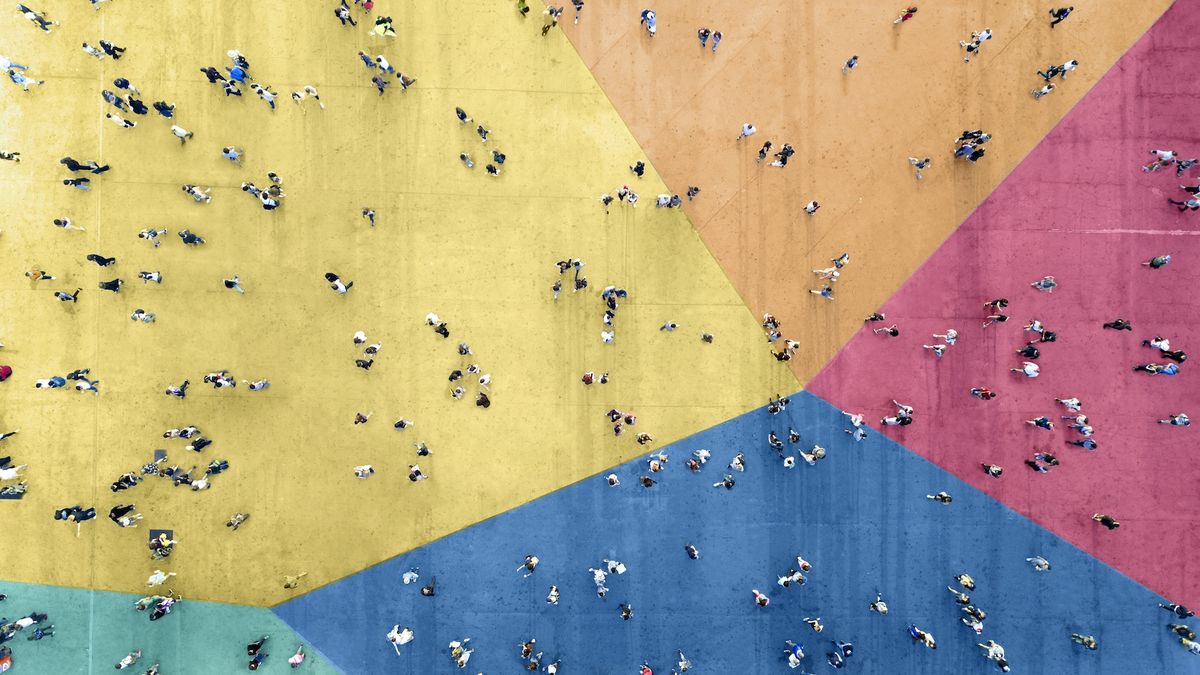
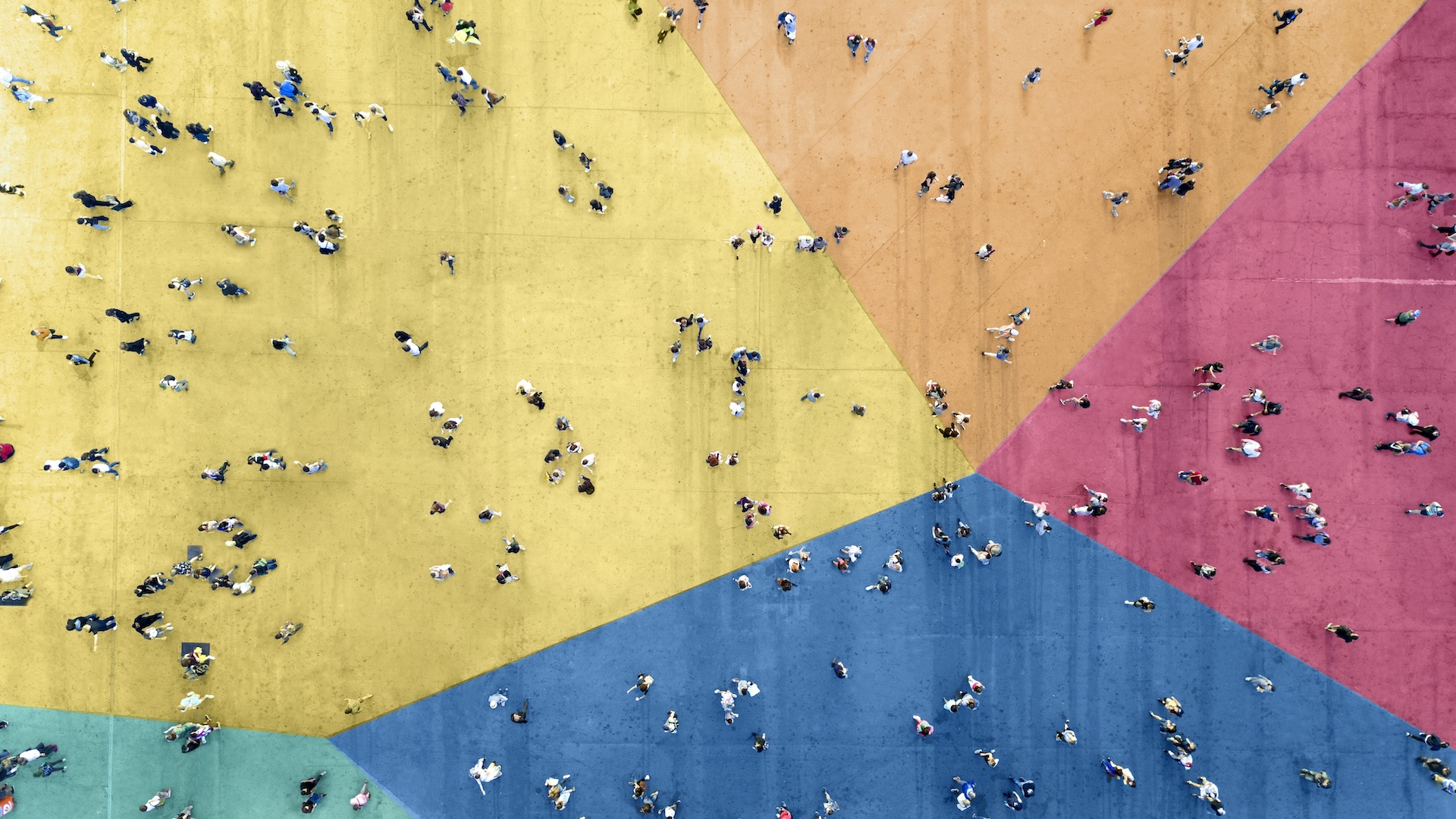
Navigating a busy crowd is often an awkward experience, but sometimes, it feels much easier than others. In a crowded hallway, people seem to spontaneously organize themselves into lanes, while in an open city square, people travel in every direction, darting from one side to the other.
But what determines the way people move in busy spaces?
Karol Bacik, a mathematician at MIT, and colleagues have developed a mathematical theory that accurately predicts pedestrian flow and the point where it changes from organized lanes to an entangled crowd. The work, which they reported in the journal PNAS March 24, could help architects and city planners design safer and more efficient public spaces that promote ordered crowds.
The team started by creating a mathematical simulation of a moving crowd in different spaces, using fluid dynamics equations to analyze the motion of pedestrians across various scenarios.
“If you think about the whole crowd flowing, rather than individuals, you can use fluid-like descriptions,” Bacik said in a statement. “If you only care about the global characteristics like, are there lanes or not, then you can make predictions without detailed knowledge of everyone in the crowd.”
Crowd math
Both the width of the space and the angles at which people moved across it heavily influenced the overall order of the crowd. Bacik’s team identified “angular spread” — the number of people walking in different directions — as the key factor in whether people self-organized into lanes.
Related: 14-year-old known as ‘the human calculator’ breaks 6 math world records in 1 day
Where the spread of people walking in different directions is relatively small — such as in a narrow corridor or on pavement — pedestrians tend to form lanes and meet oncoming traffic head-on. However, a broader range of individual travel directions — for example, in an open square or airport concourse — dramatically increases the likelihood of disorder as pedestrians dodge and weave around one another to reach their separate destinations.
The tipping point, according to this theoretical analysis, was an angular spread of around 13 degrees, meaning ordered lanes could descend into disordered flow once pedestrians start traveling at more extreme angles.
“This is all very common sense,” Bacik said. “[But] now we have a way to quantify when to expect lanes — this spontaneous, organized, safe flow — versus disordered, less efficient, potentially more dangerous flow.”
However, the researchers were keen to investigate whether the reality of a human crowd bears out this theory, so they devised an experiment to simulate a busy road crossing. Volunteers, each wearing a paper hat labeled with a unique barcode, were assigned various start and end positions and were asked to walk between opposite sides of a gymnasium without bumping into other participants. An overhead camera recorded each scenario, tracking both the movement of individual pedestrians and the overall motion of the crowd.
Subsequent analysis of the 45 trials confirmed the importance of angular spread, showing a transition from ordered lanes to disordered movement at angles close to the theoretically predicted 13 degrees. Furthermore, as disorder increased, pedestrians were forced to move more slowly to avoid collisions, with a roughly 30% speed reduction for random crowds versus ordered lanes, the team found.
Bacik’s team is now looking to test these predictions in real-world scenarios, and they hope the work will ultimately help improve crowded environments.
“We would like to analyze footage and compare that with our theory,” he said. “We can imagine that, for anyone designing a public space, if they want to have a safe and efficient pedestrian flow, our work could provide a simpler guideline, or some rules of thumb.”
