
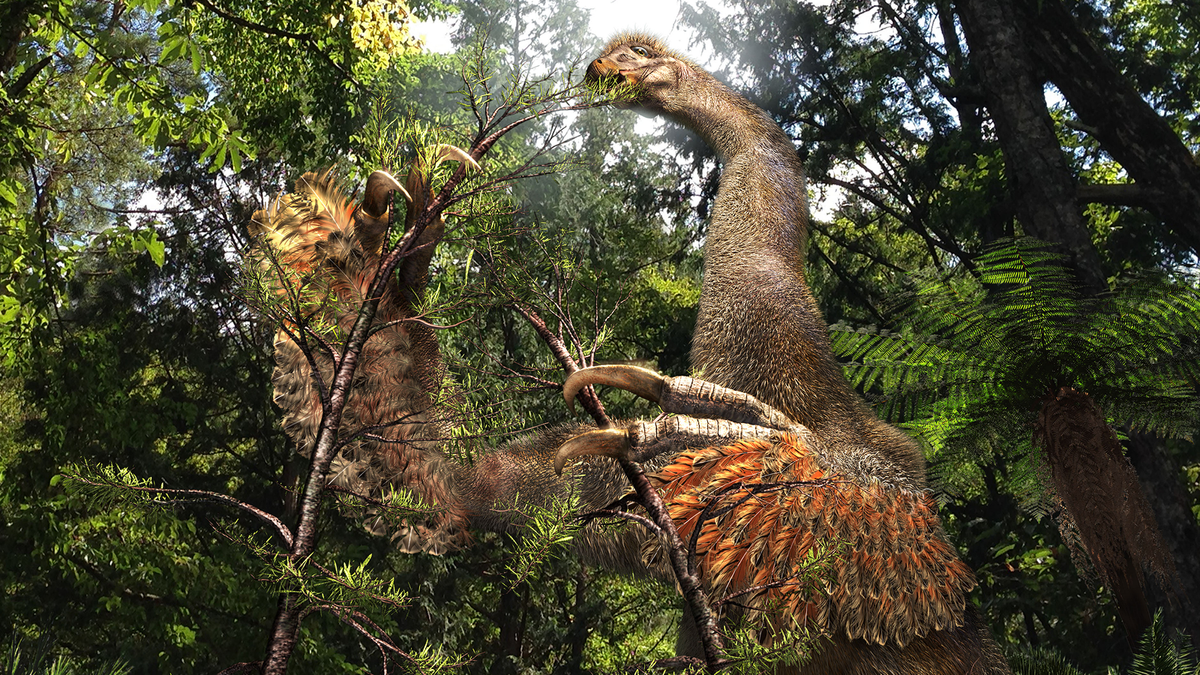
A new species of dinosaur with strange claws has been unearthed in Mongolia by paleontologists.
This new genus and species is a therizinosaur, plant-eating, two-legged giants with long claws, and was discovered buried in the Gobi Desert, according to a new study published Tuesday (March 25) in the journal iScience.
Unlike other therizinosaurs, which have three fingers on their hands equipped with long, sharp claws, this new species only has two fingers. This unique anatomy inspired its scientific name, named Duonychus tsogtbaatari, which is Greek for “two digits” and honors the Mongolian paleontologist Khishigjav Tsogtbaatar.
“Many species of therizinosaurs have been discovered, and this group had pretty much been defined by their three-fingered hands sporting large claws,” study co-author Darla Zelenitsky, a paleontologist at the University of Calgary in Canada, told Live Science in an email. “To find a specimen with only two fingers/claws was surprising as this was so out of the ordinary for this group of dinosaurs.”
Related: 166 million-year-old fossil found on Isle of Skye belongs to pony-size dinosaur from Jurassic
Therizinosaurs are a group of dinosaurs that lived across what is now Asia and North America during the Late Cretaceous Period (100 million to 66 million years ago). Despite being part of the theropod group of dinosaurs — typically associated with carnivorous dinosaurs like Tyrannosaurus rex — therizinosaurs were herbivorous. These dinosaurs are known for their enormous, sickle-shaped claws, with some species growing talons as long as 20 inches (50 centimeters).
All other therizinosaurs that have previously been discovered, including Therizinosaurus and Beipiaosaurus, have three clawed fingers on their hands, making the discovery of two-clawed D. tsogtbaatari unusual.
“Therizinosaurs are already some of the most unusual dinosaurs out there, but Duonychus tsogtbaatari takes it to another level,” study lead author Yoshitsugu Kobayashi, a paleontologist at Hokkaido University in Japan, told Live Science in an email. “This newly discovered species from Mongolia breaks the mold with just two fingers instead of the typical three, offering a rare glimpse into how theropod hands evolved and adapted.” “But what truly makes this discovery exciting is the incredibly well-preserved keratinous sheath on its claw — the first such case in a medium- to large-sized theropod dinosaur,” Kobayashi added.
Image 1 of 2


The new fossil was unearthed during the construction of a water pipeline in the Bayanshiree Formation in Ömnögovi Province, southern Mongolia. The specimen had excellently preserved hands, with a 3D sheath where the claw — made out of keratin, like our fingernails — would have been. Parts of the arms, spine and hips were also preserved.
“The hands, a hallmark of therizinosaurs, are exquisitely preserved with all the finger and wrist bones intact in this specimen,” Zelenitsky said. “Even the keratinous sheath of the claw is preserved revealing how big and sharp its claws really were.”
Other species of dinosaur, such as T. rex, had two fingers, but this marks the first time a therizinosaur has been found with fewer than three digits. This species likely evolved to lose one of the three fingers of its ancestors, the study authors suggested.

The researchers think that D. tsogtbaatari may have evolved this unique hand in order to better grip vegetation, allowing for more efficient feeding.
“The loss of the third finger in Duonychus tsogtbaatari might actually have made its remaining two fingers even better at what they were designed for — grasping,” Kobayashi said. “Based on the shape of its well-preserved claw and how it curved, Duonychus was likely using its hands to grab onto branches and pull vegetation closer, kind of like how chameleons do today.” “We think many therizinosaurs may have used their hands for foraging in a ‘hook-and-pull’ motion, but Duonychus takes this to another level with its extreme claw structure.”
Additionally, Kobayashi suggested that the claws may have played other roles, such as in “defense, courtship, or even play.”
The researchers are thrilled by this discovery, as it not only reveals unexpected diversity within therizinosaurs, but also marks the fifth time that a theropod dinosaur group has evolved to lose their third finger.
“While more fossils would help confirm this, all signs point to Duonychus representing a true evolutionary shift, not just a fluke,” Kobayashi said. “It’s a remarkable find that reshapes our understanding of therizinosaurs and theropod evolution as a whole.”
