
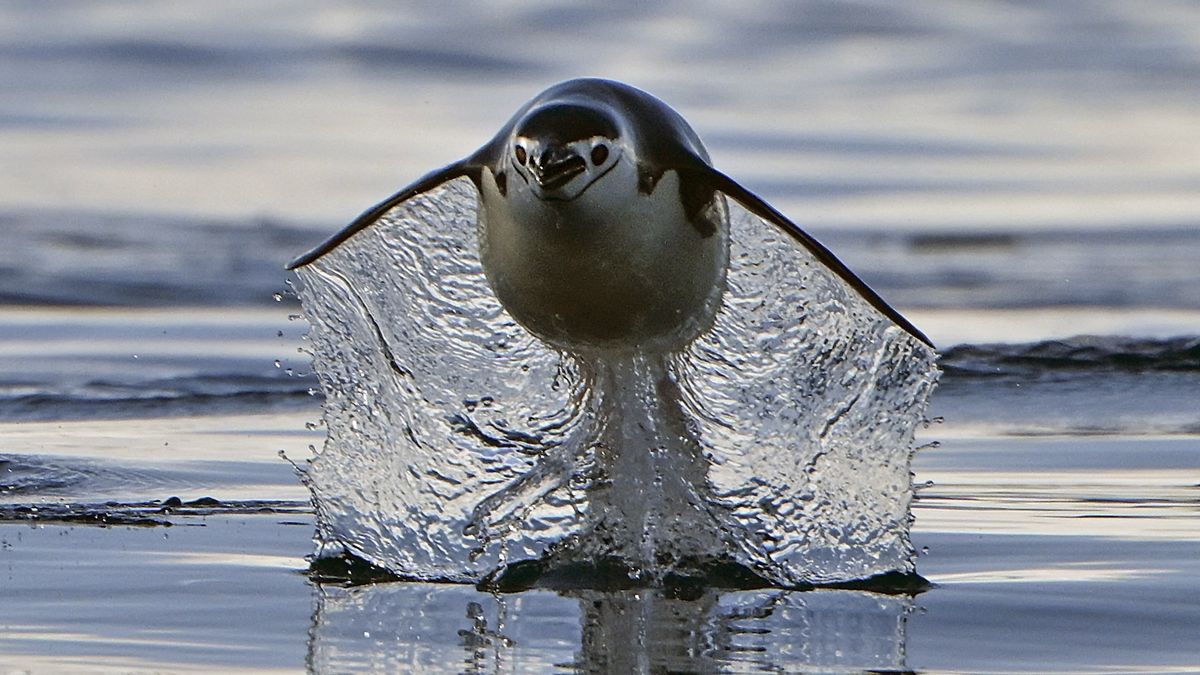
Birds are often associated with flight, but not all of them take to the skies. Around 60 species — fewer than 1% of all bird species — are flightless, including ostriches, penguins and kiwis. These birds evolved from flying ancestors but lost their ability to fly, instead adapting to life on land or in the water.
But why did they give up flight? Why don’t all birds fly?
The ability to fly is especially useful for escaping predators and traveling long distances in search of food and favorable living conditions. However, flight requires a lot of energy; birds burn about 75% more energy per day than similarly sized mammals do.
“If flight isn’t necessary, birds can better survive and reproduce if they divert that energetic investment elsewhere,” Natalie Wright, an associate professor of biology at Kenyon College in Ohio, told Live Science in an email.
In a 2016 paper published in the journal PNAS, Wright and her colleagues noted that island-dwelling birds, facing few to no predators and less competition for food and habitat, tend to evolve toward flightlessness.
“When living on an island without predators and without the need to migrate or travel long distances, for many kinds of birds the costs of flight outweigh the benefits,” Wright said.
Related: Why do parrots live so long?
The shift to flightlessness leads to physical changes in birds. Over evolutionary time, their pectoral flight muscles shrink. The sternum (breastbone) with its central ridge (keel) — where flight muscles attach — also becomes smaller, Wright said. Wing bones — the humerus, ulna and carpometacarpus — become shorter and less robust, while their legs grow longer and sturdier as an adaptation to a more terrestrial lifestyle, she added.
Some birds have traded flight for superior swimming abilities. Penguins, for instance, retained their flight muscles and keel but repurposed them for swimming. “They use their wings to fly underwater,” Peter Ryan, a professor emeritus of ornithology at the University of Cape Town in South Africa, told Live Science in an email. The flightless auk (Pinguinus impennis) also uses its wings to propel itself through water.
In birds that have been flightless for a long time, the long, stiff feathers needed for flight (flight feathers) disappear too, Ryan said. In some species, like kiwis and the Inaccessible Island rail (Atlantisia rogersi), the body feathers lose barbules — the tiny, hook-like structures that normally keep them aerodynamic — giving them a fluffier, fur-like appearance, Ryan added.
A 2025 study published in the journal Evolution found that flightless birds lose feather features in the reverse order of how they first evolved. The research also concluded that skeletal changes occur before changes in plumage, as it takes significantly more energy to grow and maintain bones than it does to maintain feathers.

Although flightless birds are uncommon today, fossils reveal that they were far more prevalent and diverse a few thousand years ago, Tim Blackburn, a professor of invasion biology at University College London, told Live Science in an email. However, the arrival of humans and animals like rats and dogs exposed these birds to predators.
“Having sacrificed their capacity to take to the air, there was no time for them to re-evolve this useful ability,” Blackburn said. This led to the rapid extinction of iconic birds like the dodo (Raphus cucullatus) on Mauritius, the moa in New Zealand, and many others.
A 2020 study co-authored by Blackburn and published in the journal Science Advances found that there would be four times as many flightless bird species on Earth today were it not for human-driven extinctions.
The loss of flight happened at least 150 times in different groups of birds throughout evolutionary history, Ferran Sayol, first author of the study and a researcher at Centre for Ecological Research and Forestry Applications (CREAF) in Barcelona, Spain, told Live Science in an email.
“Many of these species thrived on islands without predators but disappeared shortly after when humans arrived (due to direct hunting or introduced predators), making flightlessness seem rarer than it actually was,” Sayol said.
