Close Menu
  • Home
  • UNSUBSCRIBE
  • News
  • Lifestyle
  • Tech
  • Entertainment
  • Sports
  • Travel
Facebook X (Twitter) WhatsApp
Trending
  • George Kittle’s wife shares live reaction to Achilles injury
  • ‘The scientific cost would be severe’: A Trump Greenland takeover would put climate research at risk
  • Headlines Across OC as Angel Stadium Sale Debate Intensifies
  • Anti-Islam activists clash with pro-Muslim counter-protesters in Dearborn, Michigan
  • Best monitor deal: Get the 45-inch LG Ultragear gaming monitor for its lowest price yet
  • Slovakia U21 0 – 4 England U21
  • 13 Top Sleep Products That Transform Your Bedtime Routine for Better Rest
  • Firefighters rescue puppies from burning house
Facebook X (Twitter) WhatsApp
Baynard Media
  • Home
  • UNSUBSCRIBE
  • News
  • Lifestyle
  • Tech
  • Entertainment
  • Sports
  • Travel
Baynard Media
Home»Lifestyle»‘I was astonished’: Ancient galaxy discovered by James Webb telescope contains the oldest oxygen scientists have ever seen
Lifestyle

‘I was astonished’: Ancient galaxy discovered by James Webb telescope contains the oldest oxygen scientists have ever seen

EditorBy EditorMarch 21, 2025No Comments3 Mins Read
Share Facebook Twitter Pinterest LinkedIn Tumblr Reddit Telegram Email
Share
Facebook Twitter LinkedIn Pinterest Email

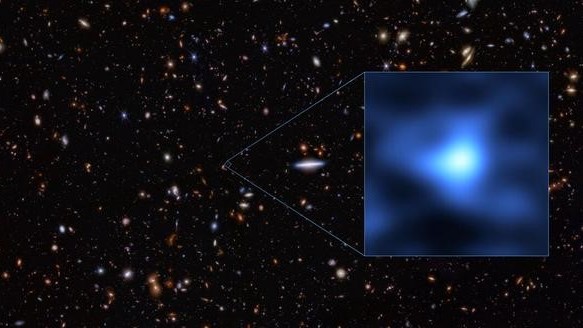
Astronomers have found oxygen in the most distant known galaxy, upending assumptions about how quickly galaxies matured.

Named JADES-GS-z14-0, the galaxy where the record-breaking detection was made formed at least 290 million years after the Big Bang and was first spotted by the James Webb Space Telescope (JWST) in 2024.

Heavy elements like oxygen are forged in the nuclear fires of stars. As the newfound oxygen existed when the universe was just 2% of its present age, this primordial element is a major head-scratcher for astronomers because it suggests that stars in the early universe were born and died to seed their surroundings with heavy elements much faster than previously expected. The findings, made by two different research teams, were published March 20 in two papers in the journals Astronomy & Astrophysics and The Astrophysical Journal.

“It is like finding an adolescent where you would only expect babies,” Sander Schouws, a researcher at Leiden University in the Netherlands and lead author of the second study, said in a statement. “The results show the galaxy has formed very rapidly and is also maturing rapidly, adding to a growing body of evidence that the formation of galaxies happens much faster than was expected.”

The earliest oxygen

Astronomers aren’t certain when the first globules of stars began to clump into the galaxies we see today, but cosmologists previously estimated that the process began slowly within the first few hundred million years after the Big Bang.

The detection of JADES-GS-z14-0 and other galaxies like it, however, turned this assumption on its head. The light detected by JWST’s Near Infrared Spectrograph originated in an enormous halo of young stars surrounding the galaxy’s core that were burning for at least 90 million years before its observation.

Related: James Webb telescope confirms there is something seriously wrong with our understanding of the universe

Get the world’s most fascinating discoveries delivered straight to your inbox.

Young stars are typically composed of hydrogen and helium, and they fuse them into heavier elements, like oxygen, as they grow old and scatter them throughout their host galaxies upon the stars’ violent deaths. At the roughly 300 million-year mark where we can see JADES-GS-z14-0, astronomers expected the universe to still be too young to be rife with heavy elements.

But after pointing the Atacama Large Millimeter/submillimeter Array (ALMA) telescope in Chile’s Atacama Desert at the distant galaxy, the researchers were stunned by what they found: JADES-GS-z14-0 had roughly 10 times more oxygen than they expected.

“I was astonished by the unexpected results because they opened a new view on the first phases of galaxy evolution,” Stefano Carniani, an astronomer at the Scuola Normale Superiore of Pisa in Italy and lead author of the first paper, said in the statement. “The evidence that a galaxy is already mature in the infant universe raises questions about when and how galaxies formed.”

How galaxies like JADES-GS-z14-0 birthed so many heavy-element-producing stars so quickly remains a mystery for further research. Currently, astronomers speculate that this surprisingly rapid element seeding could be due to the early appearance of gigantic black holes; feedback from other star deaths; or dark energy, the mysterious force that’s driving the accelerated expansion of the universe.

Source link

Share. Facebook Twitter Pinterest LinkedIn Tumblr Email
Previous ArticleFuturistic, ‘alien-like’ nuclear fusion rockets developed in total secret could revolutionize space travel — if they actually work
Next Article Alexandria Ocasio-Cortez and Bernie Sanders rally Democrats
Editor
  • Website

Related Posts

Lifestyle

‘The scientific cost would be severe’: A Trump Greenland takeover would put climate research at risk

January 17, 2026
Lifestyle

New ‘Transformer’ humanoid robot can launch a shapeshifting drone off its back — watch it in action

November 19, 2025
Lifestyle

Medieval spear pulled from Polish lake may have belonged to prince or nobleman

November 19, 2025
Add A Comment

Comments are closed.

Categories
  • Entertainment
  • Lifestyle
  • News
  • Sports
  • Tech
  • Travel
Recent Posts
  • George Kittle’s wife shares live reaction to Achilles injury
  • ‘The scientific cost would be severe’: A Trump Greenland takeover would put climate research at risk
  • Headlines Across OC as Angel Stadium Sale Debate Intensifies
  • Anti-Islam activists clash with pro-Muslim counter-protesters in Dearborn, Michigan
  • Best monitor deal: Get the 45-inch LG Ultragear gaming monitor for its lowest price yet
calendar
February 2026
M T W T F S S
 1
2345678
9101112131415
16171819202122
232425262728  
« Jan    
Recent Posts
  • George Kittle’s wife shares live reaction to Achilles injury
  • ‘The scientific cost would be severe’: A Trump Greenland takeover would put climate research at risk
  • Headlines Across OC as Angel Stadium Sale Debate Intensifies
About

Welcome to Baynard Media, your trusted source for a diverse range of news and insights. We are committed to delivering timely, reliable, and thought-provoking content that keeps you informed
and inspired

Categories
  • Entertainment
  • Lifestyle
  • News
  • Sports
  • Tech
  • Travel
Facebook X (Twitter) Pinterest WhatsApp
  • Contact Us
  • About Us
  • Privacy Policy
  • Disclaimer
  • UNSUBSCRIBE
© 2026 copyrights reserved

Type above and press Enter to search. Press Esc to cancel.