Close Menu
  • Home
  • UNSUBSCRIBE
  • News
  • Lifestyle
  • Tech
  • Entertainment
  • Sports
  • Travel
Facebook X (Twitter) WhatsApp
Trending
  • New robotic heart mimics common, mysterious condition to help researchers study it
  • Canon EOS R6 III review: A wildlife wonder
  • Medieval babies and adults buried together in Sweden were not related, archaeologists discover — raising big questions about early Christian burial practices
  • NASA is creating a fifth state of matter on the ISS, thanks to an upgrade to a mini-fridge-sized quantum lab
  • New sodium metal battery design charges in just 4 minutes and retains its capacity for years
  • Quantum computing wielded to create extremely rare material critical to nuclear fusion
  • Scientists build tiny ‘diving suit’ for cockroaches, turning them into search-and-rescue cyborgs
  • Physicists develop the first working model of quantum mechanics using only ‘real’ numbers
Facebook X (Twitter) WhatsApp
Baynard Media
  • Home
  • UNSUBSCRIBE
  • News
  • Lifestyle
  • Tech
  • Entertainment
  • Sports
  • Travel
Baynard Media
Home»Lifestyle»Earth from space: Erupting ‘sharkcano’ spits out a giant underwater plume in Oceania
Lifestyle

Earth from space: Erupting ‘sharkcano’ spits out a giant underwater plume in Oceania

EditorBy EditorMarch 11, 2025No Comments3 Mins Read
Share Facebook Twitter Pinterest LinkedIn Tumblr Reddit Telegram Email
Share
Facebook Twitter LinkedIn Pinterest Email

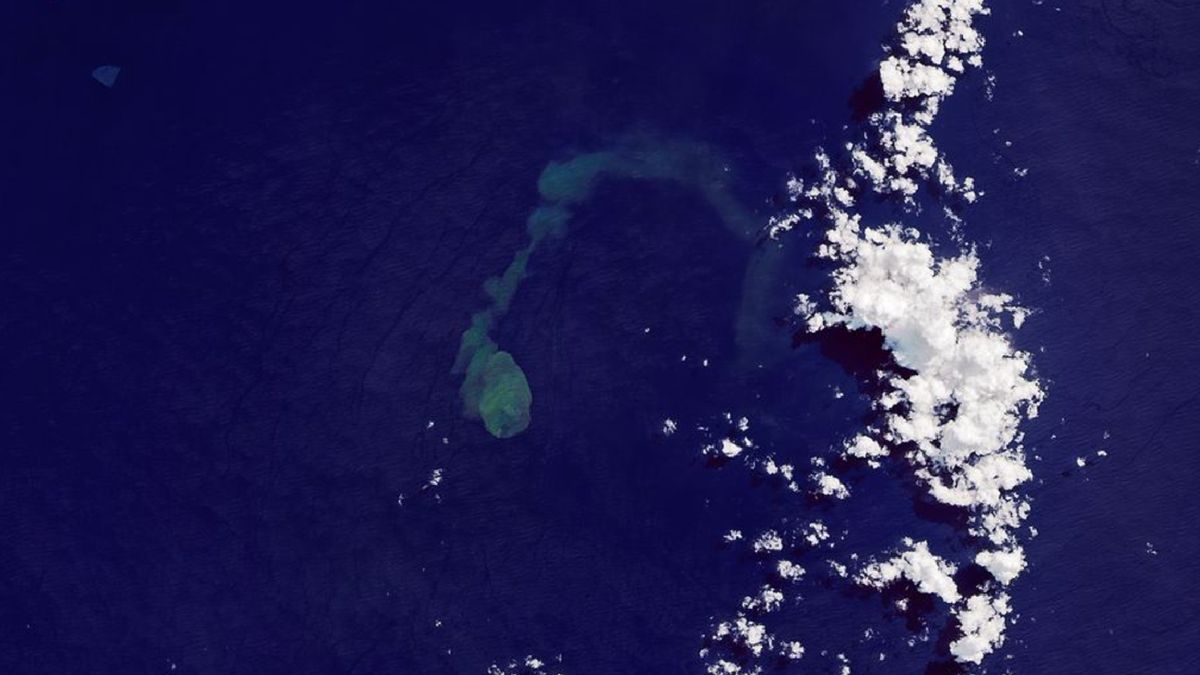
QUICK FACTS

Where is it? Kavachi volcano, Solomon Islands [-8.992492984, 157.96863838]

What’s in the photo? A plume of discolored water rising up from an undersea eruption

Which satellite took the photo? Landsat 9

When was it taken? May 14, 2022

This unusual image shows a large plume of discolored water rising toward the Pacific Ocean’s surface from the Kavachi volcano, also known as “sharkcano,” during an undersea eruption.

Kavachi is a submarine volcano that is part of the Solomon Islands, around 15 miles (24 kilometers) south of Vangunu Island. Its peak stands roughly 3,600 feet (1,100 meters) above the seafloor and lies just 65 feet (20 m) below the waves. The volcano is named after the sea god of the Vangunu people and is also referred to as “Rejo te Kvachi,” or “Kavachi’s Oven,” according to NASA’s Earth Observatory.

In 2015, a research expedition discovered multiple scalloped hammerhead sharks (Sphyrna lewini) and silky sharks (Carcharhinus falciformis) living within the volcano’s central crater. The surprising presence of the oceanic predators at the volcano raised “new questions about the ecology of active submarine volcanoes and the extreme environments in which large marine animals exist,” the researchers wrote.

It is unclear whether any of the sharks at Kavachi were hurt by the outburst that triggered the plume in the image or if they were able to sense the incoming eruption and evacuate the crater.

The image was first released in May 2022 by NASA Goddard on the social media platform X along with the caption: “You’ve heard of sharknado, now get ready for sharkcano.”

Related: See all the best images of Earth from space

A giant plume of black smoke and water erupting from the sea's surface

Kavachi’s most violent recent eruption was in October 2016 when a jet of volcanic debris was ejected above the ocean’s surface. (Image credit: Alex DeCiccio/Wikimedia)

The plume in the photo is part of an eruption that began in October 2021 and lasted for just a few weeks after the aerial image was taken. Similar plumes occurred during subsequent eruptions in August 2023 and April 2024, according to the Global Volcanism Program at the Smithsonian’s National Museum of Natural History.

Get the world’s most fascinating discoveries delivered straight to your inbox.

Before then, the volcano’s most recent major eruptions were in 2016, 2014, 2007 and 2003. In the past, researchers also sighted ephemeral islands up to half a mile (1 km) wide being birthed by the eruptions and then sinking. A similar ghostly landmass recently emerged after an undersea volcano in Japan blew its top in 2023.

Explosive plumes

Kavachi experiences “phreatomagmatic eruptions,” which occur when magma meets water and ejects steam, ash, volcanic rock fragments and chunks of magma known as “incandescent bombs,” according to the Earth Observatory.

A study conducted in the wake of the 2007 eruption found that the volcanic plumes are made of warm, acidic water that also contains particulate matter and sulfur, which “attracts microbial communities that thrive on [the chemicals],” the researchers wrote.

The volcano can also launch jets of heated water without any visible plumes or other signs of erupting.

Residents of neighboring islands have frequently reported that they regularly see steam and ash on the water’s surface between eruptions, further confirming that the so-called sharkcano is percolating beneath the surface.

Source link

Share. Facebook Twitter Pinterest LinkedIn Tumblr Email
Previous ArticleMeet Formula 1’s biggest rookie intake in years. Some already are targeting the podium
Next Article Is ranch dressing a liquid or a solid? It’s actually a 5th state of matter.
Editor
  • Website

Related Posts

Lifestyle

New robotic heart mimics common, mysterious condition to help researchers study it

July 11, 2026
Lifestyle

Canon EOS R6 III review: A wildlife wonder

July 10, 2026
Lifestyle

Medieval babies and adults buried together in Sweden were not related, archaeologists discover — raising big questions about early Christian burial practices

July 10, 2026
Add A Comment

Comments are closed.

Categories
  • Entertainment
  • Lifestyle
  • News
  • Sports
  • Tech
  • Travel
Recent Posts
  • New robotic heart mimics common, mysterious condition to help researchers study it
  • Canon EOS R6 III review: A wildlife wonder
  • Medieval babies and adults buried together in Sweden were not related, archaeologists discover — raising big questions about early Christian burial practices
  • NASA is creating a fifth state of matter on the ISS, thanks to an upgrade to a mini-fridge-sized quantum lab
  • New sodium metal battery design charges in just 4 minutes and retains its capacity for years
calendar
July 2026
M T W T F S S
 12345
6789101112
13141516171819
20212223242526
2728293031  
« Jun    
Recent Posts
  • New robotic heart mimics common, mysterious condition to help researchers study it
  • Canon EOS R6 III review: A wildlife wonder
  • Medieval babies and adults buried together in Sweden were not related, archaeologists discover — raising big questions about early Christian burial practices
About

Welcome to Baynard Media, your trusted source for a diverse range of news and insights. We are committed to delivering timely, reliable, and thought-provoking content that keeps you informed
and inspired

Categories
  • Entertainment
  • Lifestyle
  • News
  • Sports
  • Tech
  • Travel
Facebook X (Twitter) Pinterest WhatsApp
  • Contact Us
  • About Us
  • Privacy Policy
  • Disclaimer
  • UNSUBSCRIBE
© 2026 copyrights reserved

Type above and press Enter to search. Press Esc to cancel.