

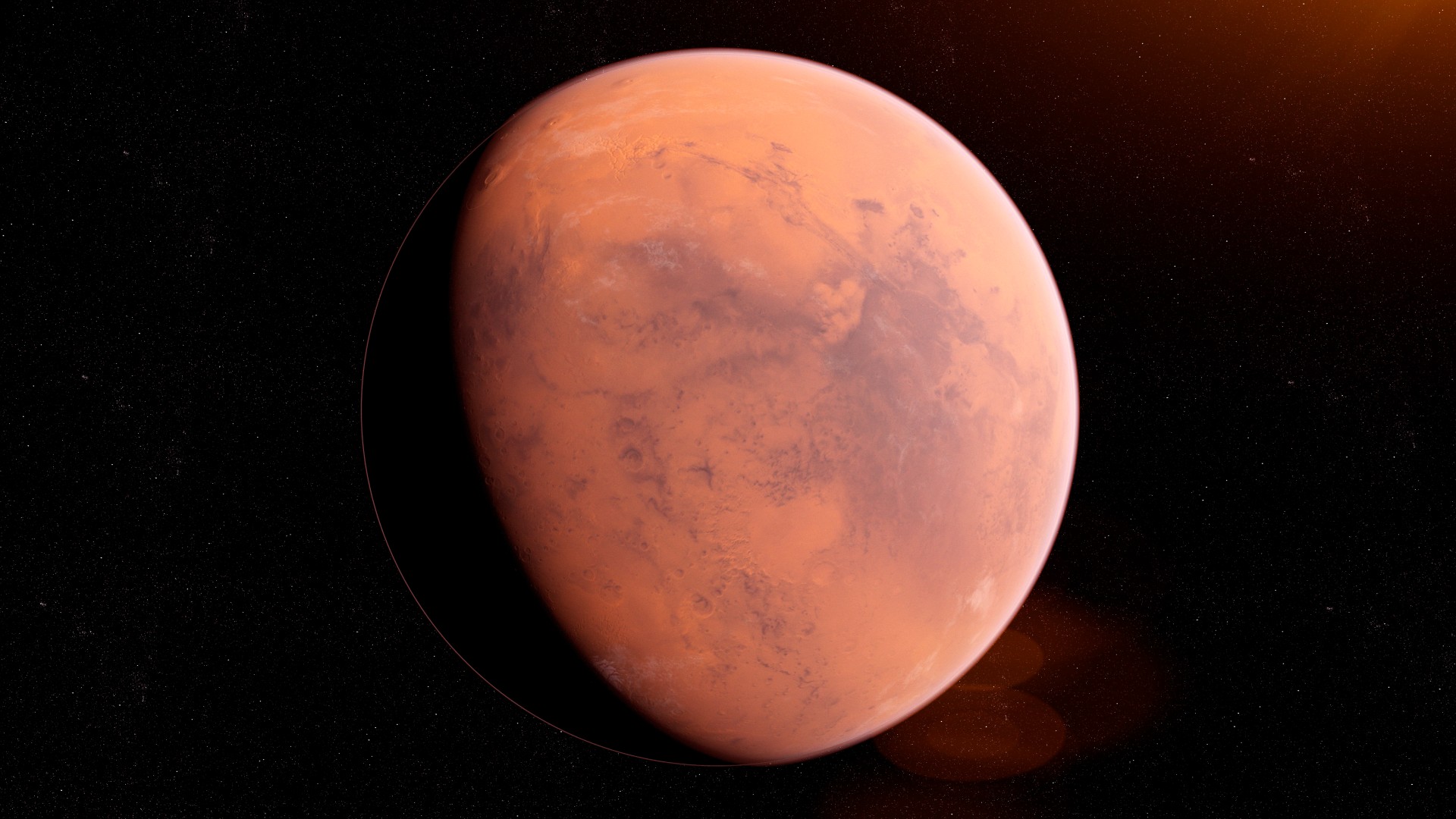
We may have been wrong about how Mars got its characteristic red hue, a new study reveals.
The Red Planet owes its ruddy complexion to rusted iron minerals, dispersed across billions of years by winds, throughout the planet’s dust. Past spacecraft observations of Martian dust led scientists to believe that this rust emerged in dry conditions, after the planet’s water had disappeared.
Now, new research, published Feb. 25 in the journal Nature Communications, contests this view. Instead, Mars’ red color is better matched by ferrihydrite — an iron oxide that contains water — and so the hue must have formed back when the now-arid planet was a cool ocean world, the study authors suggest. In other words, Mars may be red today because it was blue in the past.
“Our findings have opened up new questions about the Martian past,” first author Adomas Valantinas, a planetary scientist at Brown University, told Live Science. “We still don’t know the original source location of the ferrihydrite before it was distributed globally through dust storms, the exact chemical composition of Mars’ atmosphere when the ferrihydrite formed, or the precise timing of Mars’ oxidation.”
Mars’ fiery color has captivated astronomers since antiquity. The Romans named the planet after their god of war because of its blood-stained hue, and the ancient Egyptians gave it the name “her desher,” or “the red one,” according to NASA.
Related: ‘At least 150,000 tons’ of water frost discovered atop Mars’ tallest volcanoes
In modern times, spacecraft sent to the Red Planet found no water within Martian dust. Therefore, scientists have attributed the planet’s redness to an iron oxide called hematite, which forms under dry conditions. But a dearth of detailed laboratory experiments left this conclusion relatively unsupported.
To better investigate the origins of Mars’ color, the researchers behind the new study took data from three spacecraft orbiting Mars — the European Space Agency’s (ESA) Mars Express orbiter and Trace Gas Orbiter (TGO) and NASA’s Mars Reconnaissance Orbiter — and from NASA’s Curiosity, Pathfinder and Opportunity rovers to piece together an unprecedented view of the planet’s mineral composition and dust size.
With this information in hand, the researchers then used an advanced grinder machine to create realistic replica dust with grain sizes roughly one-hundredth the width of a human hair in the lab on Earth. By analyzing this dust via the same methods as the spacecraft, the scientists discovered that Martian dust closely matches signatures for ferrihydrite, which formed when the planet was cool and wet.
Despite answering one important question, the findings also raise others, such as what it could reveal about the planet’s past windows of habitability and the prospect that life once existed on its surface.
“Ferrihydrite requires liquid water and forms rapidly under cold, wet, oxidizing conditions, typically at circumneutral pH. Hematite, in contrast, can form in warm and dry conditions through slow chemical weathering processes,” Valantinas said. “The finding suggests Mars experienced periods of aqueous alteration — cold, wet conditions with active chemistry — before transitioning to its current desert state. This provides new constraints on the timeline of Mars’s habitability and indicates potential environments where microbial life could have thrived.”
“We eagerly await the results from upcoming missions like ESA’s Rosalind Franklin rover and the NASA-ESA Mars sample return, which will allow us to probe deeper into what makes Mars red,” Colin Wilson, project scientist for ESA’s TGO and Mars Express, said in a statement.
“Some of the samples already collected by NASA’s Perseverance rover and awaiting return to Earth include dust,” Wilson added. “Once we get these precious samples into the lab, we’ll be able to measure exactly how much ferrihydrite the dust contains, and what this means for our understanding of the history of water — and the possibility for life — on Mars.”
Mars quiz: Is your knowledge of the Red Planet out of this world?
