

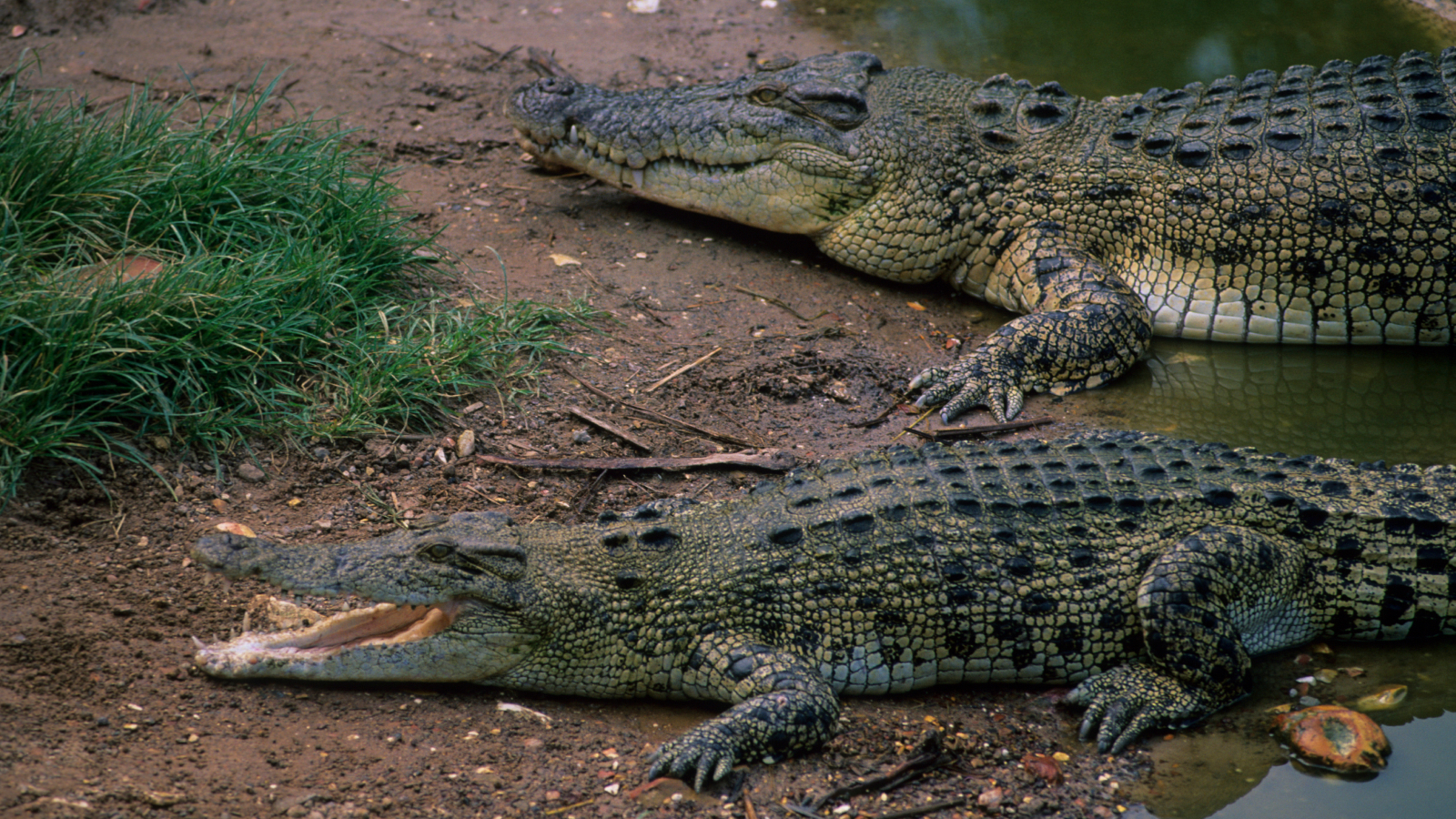
Climate change may be pushing crocodiles to their limit, a new study finds.
In Australia, estuarine crocodiles (Crocodylus porosus) are struggling due to global warming. Like most reptiles, crocodiles are ectothermic (cold-blooded), which means their body temperatures are determined by the external environment rather than by internal processes — in contrast to endothermic (warm-blooded) animals, such as birds and mammals.
When crocodiles need to warm up, they lie in the sun. And when they need to cool down, they may lie in the shade, retreat to cool streams and pools, or bask on the shore at night.
But a warming climate has increased these crocs’ body temperatures, which in turn appears to be changing their behavior. In a paper published Feb. 12 in the journal Current Biology, scientists report that over a 15-year period, the average body temperature of the crocodiles increased by a small but significant amount. Further, they spent more days at their critical thermal limit — 89.6 degrees Fahrenheit (32 degrees Celsius).
Previous research on captive crocodiles has shown that body temperatures of 89.6 F or higher lead to reduced swimming and diving performance. When their bodies get too hot, crocodiles spend more time attempting to cool themselves and reduce their activity.
“A hotter croc has a higher metabolism,” lead author Kaitlin Barham, a doctoral candidate studying crocodile movement and behavior at the University of Queensland, Australia, told Live Science. “Higher metabolism means burning oxygen more rapidly. Lab research found that they just couldn’t hold their breath for as long. It would take them a bit longer to recover at the surface.”
Related: Why can’t you suffocate by holding your breath?
Between 2008 and 2023, the researchers studied 203 estuarine crocodiles (also called saltwater crocodiles) at the Steve Irwin Wildlife Reserve in Queensland. They tracked the reptiles’ body temperatures using acoustic devices implanted under the skin. These devices sent signals to nearby receivers and additional trackers were used to monitor when the crocodiles submerged themselves, and for how long.
If a crocodile was not detected for a period ranging from 30 minutes to 24 hours and then was detected again with a higher or lower body temperature, the scientists assumed that the croc had altered its behavior to regulate its body temperature — either basking in the sun to raise it or finding a cool spot to lower it.
“The croc would disappear for a few hours, and then come back 1 or 2 degrees [C, or 1.8 to 3.6 F] cooler,” Barham said.
During the study period, the researchers recorded nearly 6.5 million temperature readings from the crocodiles. The highest body temperatures increased by 0.99 F (0.55 C). Of the crocodiles that were monitored, 135 showed body temperatures exceeding 89.6 F at least once, and one individual showed body temperatures above 89.6 F for more than a month in 2021.
The highest body temperatures were linked to El Niño periods, during which unusually warm Pacific currents led to hot, dry spells on land. The frequency of these periods is believed to be increasing as a result of climate change.
Cooling behaviors were detected more frequently when ambient temperatures were hotter. The crocodiles also submerged themselves for shorter periods when temperatures were high, according to the tracking data.
It is unclear how these alterations to the crocodiles’ behavior are affecting their survival. They are certainly adapted to high temperatures already, but it is possible that increasing periods of hot weather may reduce their ability to hunt. Crocodiles are stealth predators and usually submerge themselves to ambush prey on the shores of rivers.
“Every minute that they’re up on the bank trying to bring their body temperature down is a minute that they’re not spending traveling, reproducing or looking for food,” Barham said. “That could result in future indirect effects on their health.”
Crocodile quiz: Test your knowledge on the prehistoric predators
