Close Menu
  • Home
  • UNSUBSCRIBE
  • News
  • Lifestyle
  • Tech
  • Entertainment
  • Sports
  • Travel
Facebook X (Twitter) WhatsApp
Trending
  • Lemur used in ‘lemur yoga’ session dies of human herpesvirus, study finds
  • ‘A fine line between reducing stigma and trivialising conditions’: Social media, self-diagnosis and the glamorization of ADHD
  • New 2D memory device stores data on just a single electron
  • Before we ban kids from social media completely, here’s what we should try first | Jonathan Bellack and Mariana Olaizola Rosenblat
  • Scientists uncover a better way to beat ‘the bends’ — using deep-diving pigs
  • Mars may have been losing its water more than 4 billion years ago, oldest-known Martian meteorite suggests
  • ‘The lance head was still inside the pelvis’: Mass grave found in Austria may hold casualties of unknown ancient Roman battle
  • ‘Full-on berserker mode’: Archaeologists solve mystery of medieval soldiers with gruesome square holes in their skull
Facebook X (Twitter) WhatsApp
Baynard Media
  • Home
  • UNSUBSCRIBE
  • News
  • Lifestyle
  • Tech
  • Entertainment
  • Sports
  • Travel
Baynard Media
Home»Lifestyle»‘Bull’s-eye!’ Hubble telescope spots record-shattering 9-ring galaxy — and the cosmic ‘dart’ that smashed through its center
Lifestyle

‘Bull’s-eye!’ Hubble telescope spots record-shattering 9-ring galaxy — and the cosmic ‘dart’ that smashed through its center

EditorBy EditorFebruary 7, 2025No Comments3 Mins Read
Share Facebook Twitter Pinterest LinkedIn Tumblr Reddit Telegram Email
Share
Facebook Twitter LinkedIn Pinterest Email

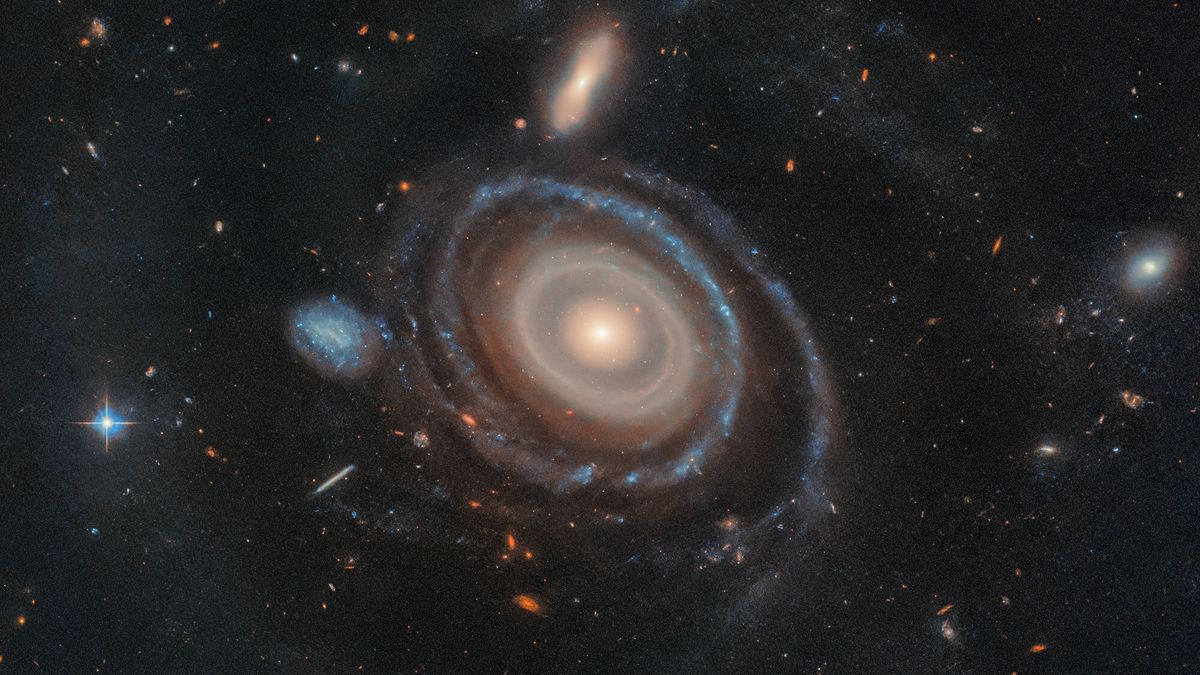
Astronomers have spotted a “bull’s-eye” galaxy with a whopping nine rings, smashing the previous record by six rings. The discovery of the galaxy, known as LEDA 1313424, is helping researchers understand what happens when galaxies collide.

Astronomers using the Hubble Space Telescope spotted LEDA 1313424 “serendipitously” while reviewing a sky survey completed in 2019. The researchers initially counted eight visible rings and later confirmed a faint ninth ring using data from the W. M. Keck Observatory in Hawaii. They published their results Feb. 4 in The Astrophysical Journal Letters.

The scientists believe the rings formed when a dwarf galaxy collided with LEDA 1313424’s center roughly 50 million years ago. The impact sent shock waves rolling through the larger galaxy like ripples in a pond. These waves, in turn, pushed clouds of cosmic gas and dust together into rings, thus creating new star-forming regions. Those areas now shine as bright concentric circles around the galaxy’s “bull’s-eye.”

A diagram of the Bullseye Galaxy's nine concentric rings

A diagram of the Bullseye Galaxy’s nine concentric rings (Image credit: NASA, ESA, Ralf Crawford (STScI))

The blue dwarf galaxy that ran through LEDA 1313424 is still connected to the collision site by a thin tether of gas, and is visible just to the left of the larger galaxy in the new image. The blue dwarf now sits about 130,000 light-years away from its larger companion — a distance greater than the width of the Milky Way.

Related: The 12 strangest objects in the universe

Hubble’s timing was impeccable. “We’re catching the Bullseye at a very special moment in time,” Pieter van Dokkum, an astronomer at Yale University and co-author of the study, said in a statement. “There’s a very narrow window when a galaxy like this would have so many rings.”

In addition to setting records, LEDA 1313424’s rings help to confirm past predictions about how such galactic structures form. “That theory was developed for the day that someone saw so many rings,” van Dokkum said.

Get the world’s most fascinating discoveries delivered straight to your inbox.

Rather than being evenly spaced like a target, the rings are clustered tightly at the galaxy’s center and are more widely spaced farther out. This suggests the first few rings formed rapidly and spread widely, carried by momentum from the initial collision. The remaining rings came together more slowly and traveled less as the disturbance began settling down.

LEDA 1313424’s rings will likely dissipate over time, but its current stunning configuration will help scientists model how galaxies form rings in the first place. Astronomers can look forward to finding more multiringed galaxies in the future. Hubble’s successor, NASA’s Nancy Grace Roman Space Telescope, is scheduled to launch in May 2027. With a field of view 100 times larger than Hubble’s, it promises to capture light from millions — or perhaps billions — of galaxies in its lifetime.

Source link

Share. Facebook Twitter Pinterest LinkedIn Tumblr Email
Previous ArticleCraig Conover & Paige DeSorbo Picked Out Engagement Rings Pre-Breakup 
Next Article USAID to be reduced to about 290 foreign service officers and civil servants
Editor
  • Website

Related Posts

Lifestyle

Lemur used in ‘lemur yoga’ session dies of human herpesvirus, study finds

August 15, 2026
Lifestyle

‘A fine line between reducing stigma and trivialising conditions’: Social media, self-diagnosis and the glamorization of ADHD

August 15, 2026
Lifestyle

New 2D memory device stores data on just a single electron

August 15, 2026
Add A Comment

Comments are closed.

Categories
  • Entertainment
  • Lifestyle
  • News
  • Sports
  • Tech
  • Travel
Recent Posts
  • Lemur used in ‘lemur yoga’ session dies of human herpesvirus, study finds
  • ‘A fine line between reducing stigma and trivialising conditions’: Social media, self-diagnosis and the glamorization of ADHD
  • New 2D memory device stores data on just a single electron
  • Before we ban kids from social media completely, here’s what we should try first | Jonathan Bellack and Mariana Olaizola Rosenblat
  • Scientists uncover a better way to beat ‘the bends’ — using deep-diving pigs
calendar
September 2026
M T W T F S S
 123456
78910111213
14151617181920
21222324252627
282930  
« Aug    
Recent Posts
  • Lemur used in ‘lemur yoga’ session dies of human herpesvirus, study finds
  • ‘A fine line between reducing stigma and trivialising conditions’: Social media, self-diagnosis and the glamorization of ADHD
  • New 2D memory device stores data on just a single electron
About

Welcome to Baynard Media, your trusted source for a diverse range of news and insights. We are committed to delivering timely, reliable, and thought-provoking content that keeps you informed
and inspired

Categories
  • Entertainment
  • Lifestyle
  • News
  • Sports
  • Tech
  • Travel
Facebook X (Twitter) Pinterest WhatsApp
  • Contact Us
  • About Us
  • Privacy Policy
  • Disclaimer
  • UNSUBSCRIBE
© 2026 copyrights reserved

Type above and press Enter to search. Press Esc to cancel.