Close Menu
  • Home
  • UNSUBSCRIBE
  • News
  • Lifestyle
  • Tech
  • Entertainment
  • Sports
  • Travel
Facebook X (Twitter) WhatsApp
Trending
  • New robotic heart mimics common, mysterious condition to help researchers study it
  • Canon EOS R6 III review: A wildlife wonder
  • Medieval babies and adults buried together in Sweden were not related, archaeologists discover — raising big questions about early Christian burial practices
  • NASA is creating a fifth state of matter on the ISS, thanks to an upgrade to a mini-fridge-sized quantum lab
  • New sodium metal battery design charges in just 4 minutes and retains its capacity for years
  • Quantum computing wielded to create extremely rare material critical to nuclear fusion
  • Scientists build tiny ‘diving suit’ for cockroaches, turning them into search-and-rescue cyborgs
  • Physicists develop the first working model of quantum mechanics using only ‘real’ numbers
Facebook X (Twitter) WhatsApp
Baynard Media
  • Home
  • UNSUBSCRIBE
  • News
  • Lifestyle
  • Tech
  • Entertainment
  • Sports
  • Travel
Baynard Media
Home»Lifestyle»‘We’ve just seen earthquake after earthquake after earthquake’: Santorini earthquake swarm intensifies but likely won’t trigger volcano
Lifestyle

‘We’ve just seen earthquake after earthquake after earthquake’: Santorini earthquake swarm intensifies but likely won’t trigger volcano

EditorBy EditorFebruary 3, 2025No Comments3 Mins Read
Share Facebook Twitter Pinterest LinkedIn Tumblr Reddit Telegram Email
Share
Facebook Twitter LinkedIn Pinterest Email

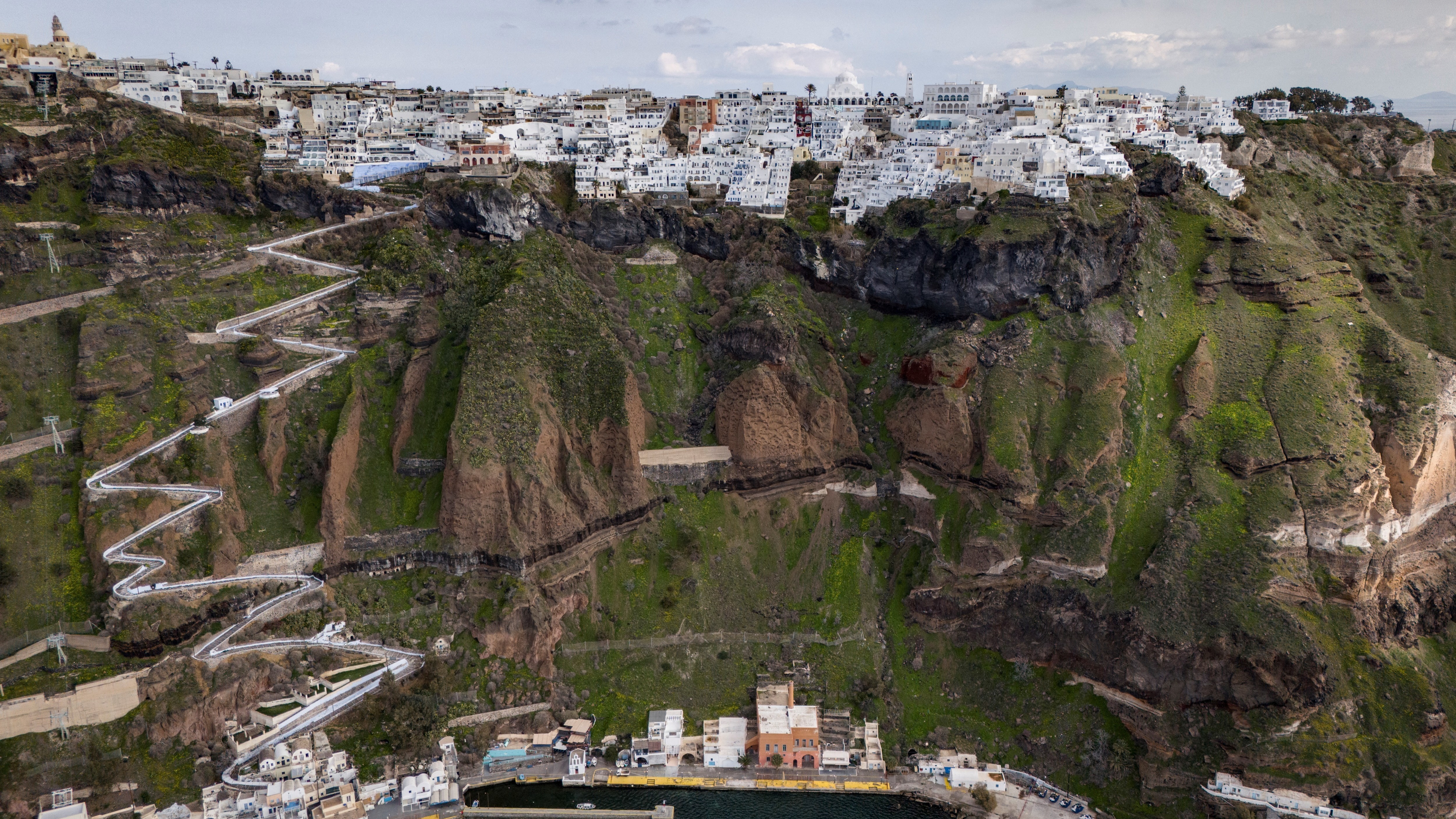
Greek authorities have closed schools and deployed emergency crews as a swarm of earthquakes intensifies near the volcanic island of Santorini. Scientists aren’t expecting Santorini or other volcanoes in the region to erupt, but they warn more powerful earthquakes could be coming.

People on Santorini began feeling tremors last week as a cluster of underwater earthquakes broke out beneath the Mediterranean’s Aegean Sea. These small earthquakes — mostly magnitude 3.5 or less — continued to intensify on Monday (Feb. 3).

The largest earthquake so far was a magnitude 5, which struck 21 miles (34 kilometers) northeast of Santorini at 2:27 p.m. local time (7.27 a.m. EST), according to the University of Athens’ earthquake tracking website.

The Greek authorities have responded to the earthquakes by ordering precautionary measures on Santorini and nearby islands, all of which are popular tourist destinations, the Associated Press reported.

Santorini sits on the exposed part of a largely underwater volcano called the Santorini caldera. However, researchers believe the earthquakes there are driven by the movement of plates, or plate tectonics, rather than volcanic activity.

David Pyle, a professor of Earth sciences at the University of Oxford who has studied volcanos in the Santorini caldera, told Live Science that the earthquakes by Santorini are likely caused by a series of faults — or zones where two blocks of rock move or slip against each other. However, he noted that the earthquakes were “unusual.”

“The problem with this event is that we’ve just seen earthquake after earthquake after earthquake,” Pyle said. “It’s all underwater, and so it’s really hard to anticipate what’s going to happen next.”

Get the world’s most fascinating discoveries delivered straight to your inbox.

Related: Yellowstone National Park earthquake shakes hottest and oldest geothermal area

The Aegean Sea sits on a small plate of crust, which is stretching as the nearby African plate slides beneath the Eurasian plate. Pyle noted that stretching in the Aegean’s crust creates stresses that move the faults driving the earthquakes.

This isn’t the first time Santorini has experienced a series of small, concentrated earthquakes, known as an earthquake swarm. Magma moving beneath Santorini triggered a swarm around the island in 2011 and 2012, but that event was less severe than the ongoing swarm, which is northeast of the island.

“The area that is being affected is a little larger [than in 2011 and 2012,] the rate at which the detected earthquakes are occurring is also larger, and the focus of the events is outside the Santorini caldera,” Pyle said.

Kolumbo volcano

Most of the earthquakes have occurred between another underwater volcano, Kolumbo, which is approximately 4.4 miles (7 kilometers) northeast of Santorini, and the small island of Anydros. While plate tectonics appear to be driving the earthquakes this time, Pyle noted that researchers are unsure whether there’s a direct link between the tectonic activity and any potential volcanic activity at Kolumbo.

“We actually don’t really know much about the deep systems supplying magma to the volcanos,” Pyle said.

Kolumbo volcano last erupted in 1650, triggering a catastrophic tsunami that devastated islands in the region. Santorini was shaped by the earlier Minoan eruption in 1600 B.C., which was one of the largest volcanic eruptions in human history, according to Columbia University’s Lamont-Doherty Earth Observatory in New York.

Source link

Share. Facebook Twitter Pinterest LinkedIn Tumblr Email
Previous ArticleUSAID website offline as Musk carries out federal bloodletting
Next Article Army Helicopter Warned Twice Before Crash
Editor
  • Website

Related Posts

Lifestyle

New robotic heart mimics common, mysterious condition to help researchers study it

July 11, 2026
Lifestyle

Canon EOS R6 III review: A wildlife wonder

July 10, 2026
Lifestyle

Medieval babies and adults buried together in Sweden were not related, archaeologists discover — raising big questions about early Christian burial practices

July 10, 2026
Add A Comment

Comments are closed.

Categories
  • Entertainment
  • Lifestyle
  • News
  • Sports
  • Tech
  • Travel
Recent Posts
  • New robotic heart mimics common, mysterious condition to help researchers study it
  • Canon EOS R6 III review: A wildlife wonder
  • Medieval babies and adults buried together in Sweden were not related, archaeologists discover — raising big questions about early Christian burial practices
  • NASA is creating a fifth state of matter on the ISS, thanks to an upgrade to a mini-fridge-sized quantum lab
  • New sodium metal battery design charges in just 4 minutes and retains its capacity for years
calendar
July 2026
M T W T F S S
 12345
6789101112
13141516171819
20212223242526
2728293031  
« Jun    
Recent Posts
  • New robotic heart mimics common, mysterious condition to help researchers study it
  • Canon EOS R6 III review: A wildlife wonder
  • Medieval babies and adults buried together in Sweden were not related, archaeologists discover — raising big questions about early Christian burial practices
About

Welcome to Baynard Media, your trusted source for a diverse range of news and insights. We are committed to delivering timely, reliable, and thought-provoking content that keeps you informed
and inspired

Categories
  • Entertainment
  • Lifestyle
  • News
  • Sports
  • Tech
  • Travel
Facebook X (Twitter) Pinterest WhatsApp
  • Contact Us
  • About Us
  • Privacy Policy
  • Disclaimer
  • UNSUBSCRIBE
© 2026 copyrights reserved

Type above and press Enter to search. Press Esc to cancel.