Close Menu
  • Home
  • UNSUBSCRIBE
  • News
  • Lifestyle
  • Tech
  • Entertainment
  • Sports
  • Travel
Facebook X (Twitter) WhatsApp
Trending
  • George Kittle’s wife shares live reaction to Achilles injury
  • ‘The scientific cost would be severe’: A Trump Greenland takeover would put climate research at risk
  • Headlines Across OC as Angel Stadium Sale Debate Intensifies
  • Anti-Islam activists clash with pro-Muslim counter-protesters in Dearborn, Michigan
  • Best monitor deal: Get the 45-inch LG Ultragear gaming monitor for its lowest price yet
  • Slovakia U21 0 – 4 England U21
  • 13 Top Sleep Products That Transform Your Bedtime Routine for Better Rest
  • Firefighters rescue puppies from burning house
Facebook X (Twitter) WhatsApp
Baynard Media
  • Home
  • UNSUBSCRIBE
  • News
  • Lifestyle
  • Tech
  • Entertainment
  • Sports
  • Travel
Baynard Media
Home»Lifestyle»James Webb telescope captures 1st ‘mid-infrared’ flare from Milky Way’s supermassive black hole
Lifestyle

James Webb telescope captures 1st ‘mid-infrared’ flare from Milky Way’s supermassive black hole

EditorBy EditorJanuary 17, 2025No Comments3 Mins Read
Share Facebook Twitter Pinterest LinkedIn Tumblr Reddit Telegram Email
Share
Facebook Twitter LinkedIn Pinterest Email

The James Webb Space Telescope (JWST) has detected a flare from the supermassive black hole at the center of the Milky Way — and it could help explain why these strange outbursts occur..

Sagittarius A* is 4 million times the mass of the sun and sits 26,000 light-years away from Earth, according to NASA. The disk of dust and gas orbiting this black hole regularly sends off flares, or high-energy flashes of light, probably caused by magnetic field disturbances. Simulations hint that flares happen when two magnetic field lines connect, releasing a burst of energy, researchers from the Max Planck Institute for Radio Astronomy in Germany said in a statement. Energized electrons zip along these connected lines at near the speed of light, emitting high-energy radiation photons, or light particles.

Until recently, though, astronomers had only observed these flares in short-wave visible light and long-wave radio singles — not in the middle part of the electromagnetic spectrum.

“For over 20 years, we’ve known what happens in the radio and what happens in the near infrared, but the connection between them was never 100% clear or certain,” study co-lead author Joseph Michail, a researcher at the Harvard Center for Astrophysics, said in a statement. “This new observation in [mid-infrared] fills in that gap and connects the two.”

But now, the JWST can detect this mid-infrared region — the part of the spectrum humans experience as heat. The space telescope orbits the sun nearly a million miles (1.5 million kilometers) from Earth and has been making observations from that vantage point since 2022. On April 6, 2024, the JWST detected a 40-minute flare from the black hole.

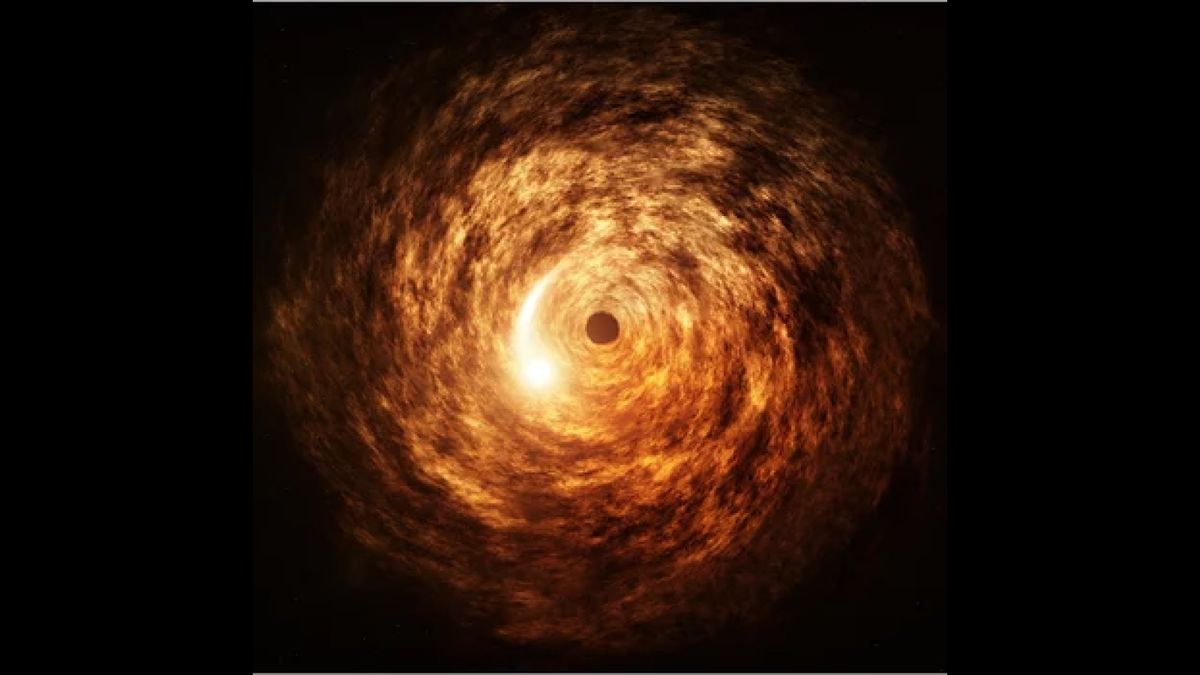
Artist’s conception of the mid-IR flare in Sgr A* (left: beginning; center: middle; right: end), capturing the variability, or changing intensity, of the flare.

Artist’s conception of the mid-IR flare in Sgr A* (left: beginning; center: middle; right: end), capturing the variability, or changing intensity, of the flare. The flare, which might be caused by magnetic reconnection, travels around the black hole while the electrons cool to lower energies causing the emission to become brighter at longer wavelengths relative to shorter wavelengths. If humans could see in the Mid-infrared, the flare would appear redder at the end of the flare than at the beginning. (Image credit: © CfA/Mel Weiss)

The telescope’s observations backed up the simulations that suggest criss-crossing magnetic field lines drive the flares. The researchers saw links between variations in the short-wavelength measurements and the mid-infrared measurements, which indicate that speeding electrons are indeed ejecting photons, or packets of light, as they zip along magnetic field lines — a process called synchrotron emission.

“While our observations suggest that Sgr A*’s mid-IR emission does indeed result from synchrotron emission from cooling electrons, there’s more to understand about magnetic reconnection and the turbulence in Sgr A*’s accretion disk,” study co-lead author Sebastiano von Fellenberg, a researcher at the Max Planck Institute for Radio Astronomy, said in the statement. “This first-ever mid-IR detection, and the variability seen with the SMA [Submillimeter Array], has not only filled a gap in our understanding of what has caused the flare in Sgr A* but has also opened a new line of important inquiry.”

Get the world’s most fascinating discoveries delivered straight to your inbox.

The findings, posted to the physics preprint database arXiv.org, have been accepted for publication in The Astrophysical Journal Letters.

Source link

Share. Facebook Twitter Pinterest LinkedIn Tumblr Email
Previous ArticleBest AirTag deal: Save $30 on this 4-pack Apple AirTag
Next Article Liverpool pick up first home win of the season against Brighton
Editor
  • Website

Related Posts

Lifestyle

‘The scientific cost would be severe’: A Trump Greenland takeover would put climate research at risk

January 17, 2026
Lifestyle

New ‘Transformer’ humanoid robot can launch a shapeshifting drone off its back — watch it in action

November 19, 2025
Lifestyle

Medieval spear pulled from Polish lake may have belonged to prince or nobleman

November 19, 2025
Add A Comment

Comments are closed.

Categories
  • Entertainment
  • Lifestyle
  • News
  • Sports
  • Tech
  • Travel
Recent Posts
  • George Kittle’s wife shares live reaction to Achilles injury
  • ‘The scientific cost would be severe’: A Trump Greenland takeover would put climate research at risk
  • Headlines Across OC as Angel Stadium Sale Debate Intensifies
  • Anti-Islam activists clash with pro-Muslim counter-protesters in Dearborn, Michigan
  • Best monitor deal: Get the 45-inch LG Ultragear gaming monitor for its lowest price yet
calendar
February 2026
M T W T F S S
 1
2345678
9101112131415
16171819202122
232425262728  
« Jan    
Recent Posts
  • George Kittle’s wife shares live reaction to Achilles injury
  • ‘The scientific cost would be severe’: A Trump Greenland takeover would put climate research at risk
  • Headlines Across OC as Angel Stadium Sale Debate Intensifies
About

Welcome to Baynard Media, your trusted source for a diverse range of news and insights. We are committed to delivering timely, reliable, and thought-provoking content that keeps you informed
and inspired

Categories
  • Entertainment
  • Lifestyle
  • News
  • Sports
  • Tech
  • Travel
Facebook X (Twitter) Pinterest WhatsApp
  • Contact Us
  • About Us
  • Privacy Policy
  • Disclaimer
  • UNSUBSCRIBE
© 2026 copyrights reserved

Type above and press Enter to search. Press Esc to cancel.