
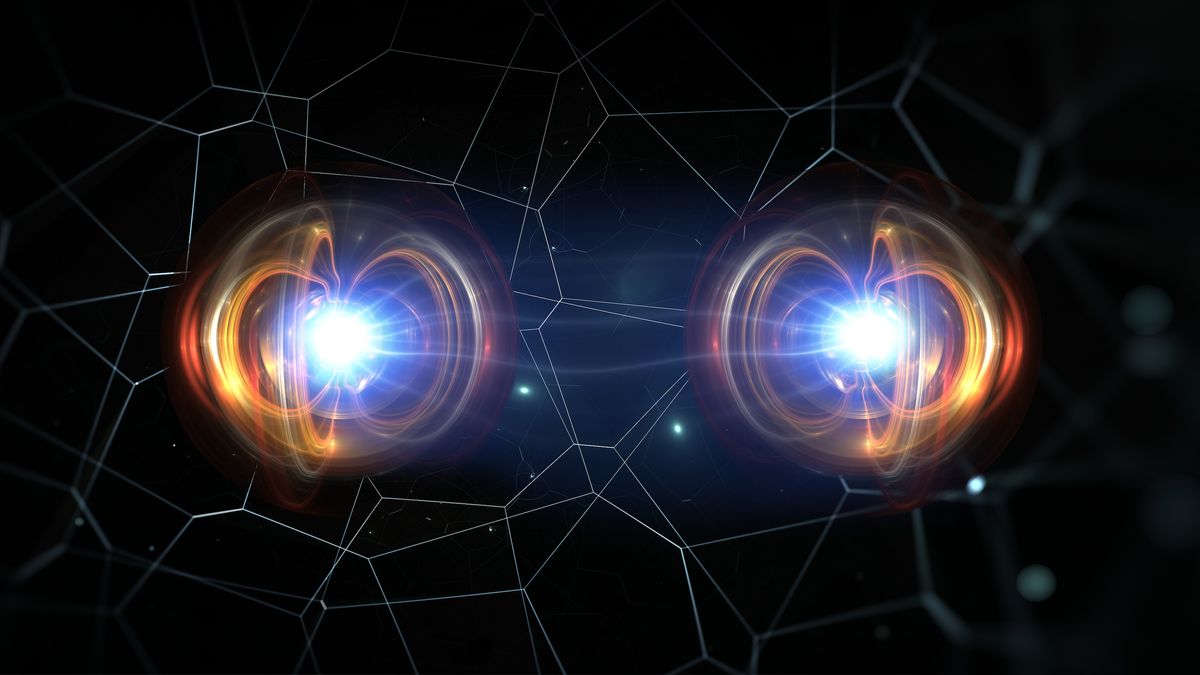
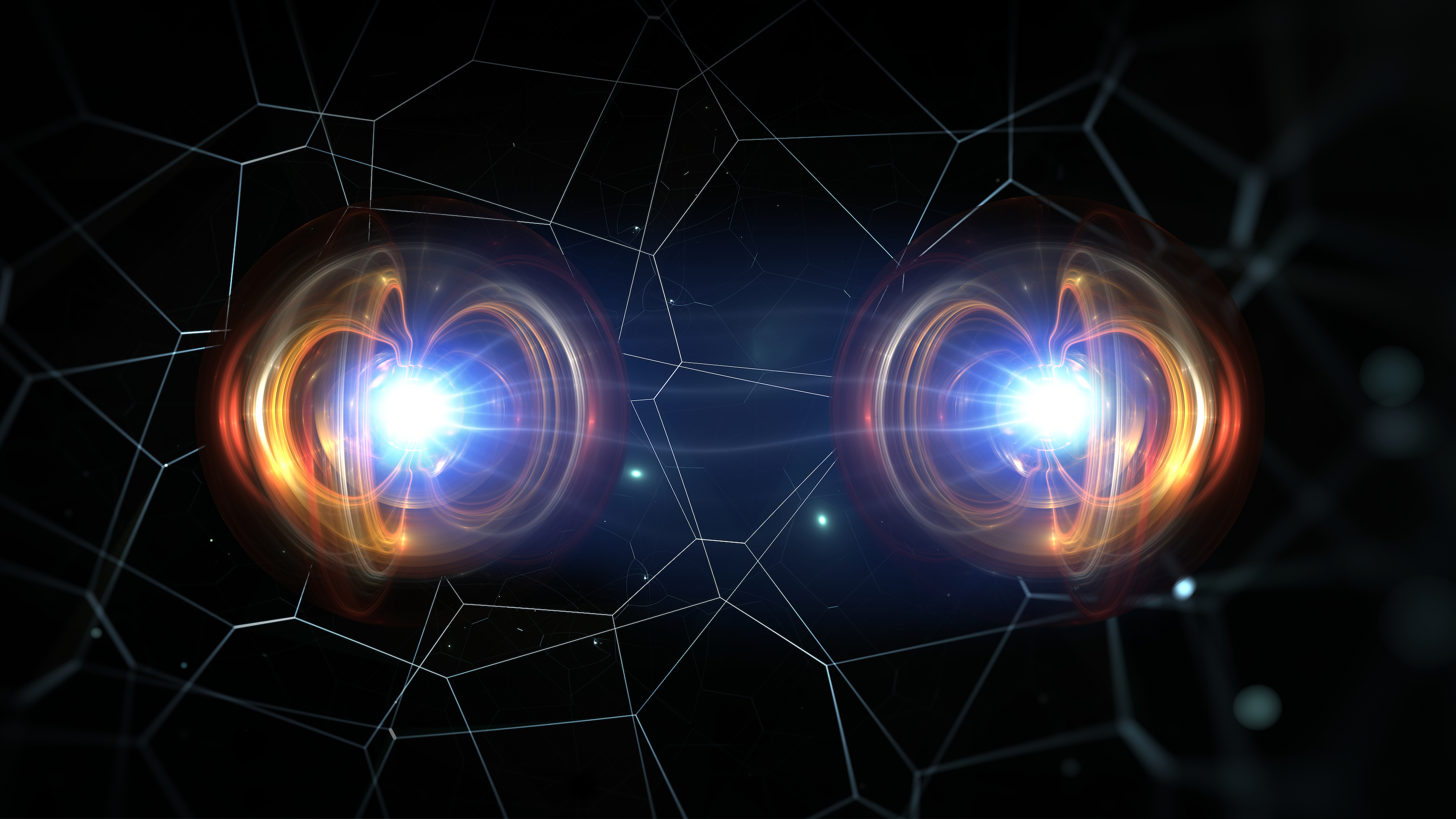
Scientists have peered inside protons and discovered that quarks and gluons, their fundamental building blocks, experience quantum entanglement.
Entangled particles are connected to each other, so that a change to one instantaneously causes a change to the other, even if they are separated by vast distances. Albert Einstein famously dismissed the idea as “spooky action at a distance,” but later experiments proved that the bizarre, locality-breaking effect is real.
Physicists have observed entanglement between quarks before but had never found evidence that they exist in a quantumly connected state inside protons.
Now, a team of researchers has discovered entanglement between quarks and gluons inside protons over a distance of one quadrillionth of a meter — allowing the particles to share information across the proton. The researchers published their findings Dec. 2, 2024 in the journal Reports on Progress in Physics.
“For decades, we’ve had a traditional view of the proton as a collection of quarks and gluons, and we’ve been focused on understanding so-called single-particle properties, including how quarks and gluons are distributed inside the proton,” study co-author Zhoudunming Tu, a physicist at Brookhaven National Laboratory in Upton, New York, said in a statement. “Now, with evidence that quarks and gluons are entangled, this picture has changed. We have a much more complicated, dynamic system.”
‘Spooky action’ at the smallest scale
Experimental proof of quantum entanglement first emerged in the 1970s, but many aspects of the phenomenon remain relatively unexplored — including the entangled interactions between quarks. This is mainly because the subatomic particles don’t exist on their own and instead fuse into various particle combinations known as hadrons. For example, baryons, such as protons and neutrons, are combinations of three quarks bound tightly together by strong force-carrying gluons.
Related: Heaviest antimatter particle ever discovered could hold secrets to our universe’s origins
When individual quarks are ripped from hadrons, the energy used to extract them makes them unstable, transforming them into branching jets of particles in a process called hadronization. This makes the task of sifting through the trillions of particle decay products to reconstruct their original state incredibly difficult.
But that’s exactly what the researchers did. To probe the inner workings of protons, the scientists mined data collected by the Large Hadron Collider (LHC) and Hadron-Electron Ring Accelerator (HERA) particle collider experiments.
Then they applied a principle from quantum information science that says a system’s entropy (a measure of how many energy states a system can be arranged in, often incorrectly referred to as “disorder”) increases with its entanglement — causing the distribution of the particle sprays to appear messier.
By comparing the particle sprays to calculations of their entropy, the physicists discovered that the quarks and gluons inside the colliding protons existed in a maximally entangled state, each sharing the most information possible.
“Entropy is usually associated with uncertainty on some information, while entanglement leads to information ‘sharing’ between the two entangled parties. So these two can be related to each other in quantum mechanics,” Tu told Live Science in an email. “We use the predicted entropy (with entanglement assumed) to check with what the data says, and we found great agreement.”
The scientists say their discovery could help to glean more insights into fundamental particles — such as how quarks and gluons remain confined within protons. The research has also prompted further questions about how entanglement changes when protons are locked inside atomic nuclei.
“Because nuclei are made of protons and neutrons, it is natural to ask what would the entanglement do to nuclei structure,” Tu said. “We plan to use the electron-ion collider (EIC) to study this. This will come in 10 years. Before that, some collision types, so-called ultra-peripheral collisions in heavy-ion collisions, may work too.”
