Close Menu
  • Home
  • UNSUBSCRIBE
  • News
  • Lifestyle
  • Tech
  • Entertainment
  • Sports
  • Travel
Facebook X (Twitter) WhatsApp
Trending
  • ‘A weird result from an already weird hominin’: Archaeologists discover all Homo naledi skeletons found in South African cave are female
  • China’s Einstein Probe detected a mysterious cosmic explosion — and scientists have no idea what caused it
  • Satellites reveal Earth has a surprising symmetry in the way it reflects light — and it might be tied to the El Niño cycle
  • Water might secretly be a mix of 2 different liquids, scientists say
  • ‘Weirdos of the sperm whale world’ appear to be evolving 2 different dialects, audio recordings suggest
  • 60 million stars: Euclid space telescope snaps the largest-ever close-up photo of the Milky Way’s crowded heart
  • ‘If there’s any country that will do it, it’s China’: Why is China diverting some of the world’s mightiest rivers thousands of miles?
  • Drug-induced ‘brain freeze’ may help protect the brain after a stroke, early study suggests
Facebook X (Twitter) WhatsApp
Baynard Media
  • Home
  • UNSUBSCRIBE
  • News
  • Lifestyle
  • Tech
  • Entertainment
  • Sports
  • Travel
Baynard Media
Home»Lifestyle»Earth from space: Svalbard’s radioactive ‘Bear Island’ surrounded by rare cloud swirls and a giant algal bloom
Lifestyle

Earth from space: Svalbard’s radioactive ‘Bear Island’ surrounded by rare cloud swirls and a giant algal bloom

EditorBy EditorJanuary 14, 2025No Comments3 Mins Read
Share Facebook Twitter Pinterest LinkedIn Tumblr Reddit Telegram Email
Share
Facebook Twitter LinkedIn Pinterest Email

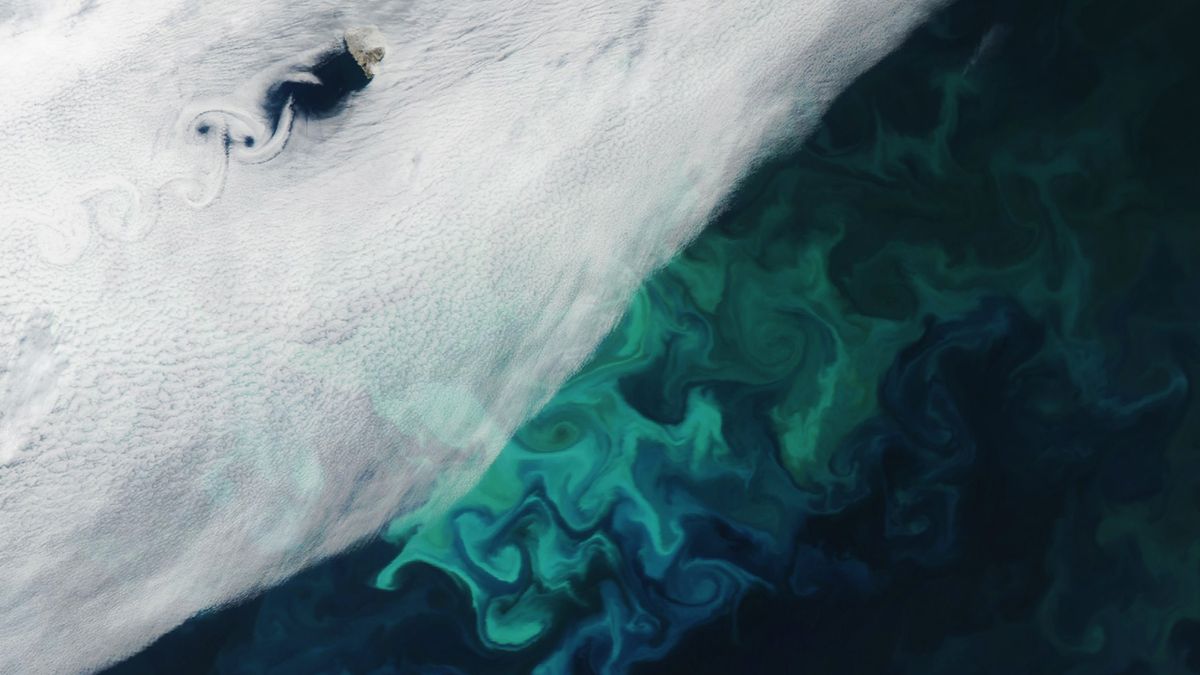
QUICK FACTS

Where is it? Bear Island, Svalbard [74.43137835, 19.058443166]

What’s in the photo? Atmospheric vortices in the clouds and a swirling algal bloom in the ocean

Which satellite took the photo? NASA Aqua

When was it taken? July 13, 2023

This striking satellite shot shows a pair of simultaneous phenomena painting parallel swirls in the sea and sky surrounding Bear Island. The isolated land mass, also known as Bjørnøya, is located in Norway’s Svalbard archipelago and is surrounded by highly radioactive waters that may endanger local wildlife — which, ironically, does not include many bears.

In the upper left corner of the image, a gap in the clouds is trailed by a series of interlinked cloud swirls that appear to have been platted together like a pretzel. These swirls, known as von Kármán vortices, are formed when clouds get caught up in an airflow that has been disrupted by a tall landmass, most often above an ocean, according to NASA’s Earth Observatory.

In this case, the vortices are created by clouds passing over Miseryfjellet, the largest mountain on Bear Island. Miseryfjellet, which translates to “misery mountain,” has three peaks: Urd, Verdande and Skuld, named after a trio of deities from Norse mythology, known as the Norns. The tallest peak, Skuld, stands around 1,759 feet (536 meters) above sea level.

In the center of the image, a gigantic bloom of photosynthetic algae, or phytoplankton, can be seen swirling near the surface of the Barents Sea. The light green hues of the algal artwork are the result of chlorophyll — the pigment in algae and plants that allows them to convert sunlight into energy, via photosynthesis. The spiraling shapes of the bloom, which spans up to 250 miles (400 kilometers) across, are the result of ocean currents.

Related: See all the best images of Earth from space

A photo of a polar bear looking at the camera while standing on a shore line

Bear Island was named after polar bears but the white bears are actually rarely seen on the island. (Image credit: Paul Souders via Getty Images)

The simultaneous appearance of von Kármán vortices and the algal bloom is a complete coincidence and the two phenomena are in no way connected, according to Earth Observatory.

Bear Island

Dutch explorers first discovered Bear Island in the late 16th century and named it after a polar bear (Ursus maritimus) that was seen swimming nearby. However, polar bears are rarely seen on the island, which is one of the most southern points in Svalbard and is rarely accessible to the white bears via Arctic sea ice.

Get the world’s most fascinating discoveries delivered straight to your inbox.

For example, in 2019, researchers stationed at the Bjørnøya weather station spotted a polar bear for the first time in more than 8 years, according to PolarBearScience.com.

Instead, the island’s most abundant residents include foxes, seals and seabirds. In total, around 1 million seabirds gather along the island’s cliffs every year during the breeding season, according to Earth Observatory.

However, in recent years, fears have been raised about how these birds and the rest of the island’s ecosystem could be impacted by an unusual spike in radioactivity leaking from a Cold War-era nuclear submarine, K-278 Komsomolets, which sunk to the seafloor in 1989 roughly 115 miles (185 km) southwest of Bear Island.

In 2019, the BBC reported that the levels of radiation in the water surrounding the submarine were 800,000 times higher than normal, thanks to continued leakage from the vessel’s reactor. However, it is still unclear whether this could be impacting the wider marine environment.

Source link

Share. Facebook Twitter Pinterest LinkedIn Tumblr Email
Previous ArticleChina is considering selling TikTok to Elon Musk, report claims
Next Article Best Meta Quest 3S deal: Save over $50
Editor
  • Website

Related Posts

Lifestyle

‘A weird result from an already weird hominin’: Archaeologists discover all Homo naledi skeletons found in South African cave are female

June 25, 2026
Lifestyle

China’s Einstein Probe detected a mysterious cosmic explosion — and scientists have no idea what caused it

June 25, 2026
Lifestyle

Satellites reveal Earth has a surprising symmetry in the way it reflects light — and it might be tied to the El Niño cycle

June 24, 2026
Add A Comment

Comments are closed.

Categories
  • Entertainment
  • Lifestyle
  • News
  • Sports
  • Tech
  • Travel
Recent Posts
  • ‘A weird result from an already weird hominin’: Archaeologists discover all Homo naledi skeletons found in South African cave are female
  • China’s Einstein Probe detected a mysterious cosmic explosion — and scientists have no idea what caused it
  • Satellites reveal Earth has a surprising symmetry in the way it reflects light — and it might be tied to the El Niño cycle
  • Water might secretly be a mix of 2 different liquids, scientists say
  • ‘Weirdos of the sperm whale world’ appear to be evolving 2 different dialects, audio recordings suggest
calendar
June 2026
M T W T F S S
1234567
891011121314
15161718192021
22232425262728
2930  
« May    
Recent Posts
  • ‘A weird result from an already weird hominin’: Archaeologists discover all Homo naledi skeletons found in South African cave are female
  • China’s Einstein Probe detected a mysterious cosmic explosion — and scientists have no idea what caused it
  • Satellites reveal Earth has a surprising symmetry in the way it reflects light — and it might be tied to the El Niño cycle
About

Welcome to Baynard Media, your trusted source for a diverse range of news and insights. We are committed to delivering timely, reliable, and thought-provoking content that keeps you informed
and inspired

Categories
  • Entertainment
  • Lifestyle
  • News
  • Sports
  • Tech
  • Travel
Facebook X (Twitter) Pinterest WhatsApp
  • Contact Us
  • About Us
  • Privacy Policy
  • Disclaimer
  • UNSUBSCRIBE
© 2026 copyrights reserved

Type above and press Enter to search. Press Esc to cancel.