
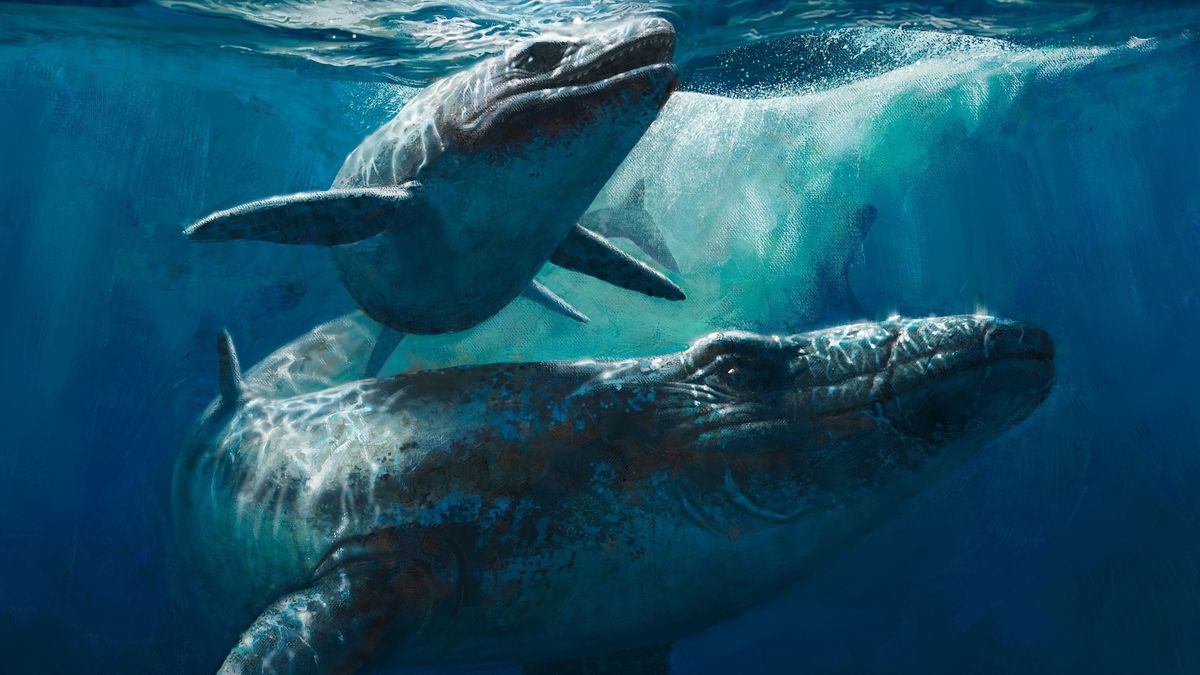
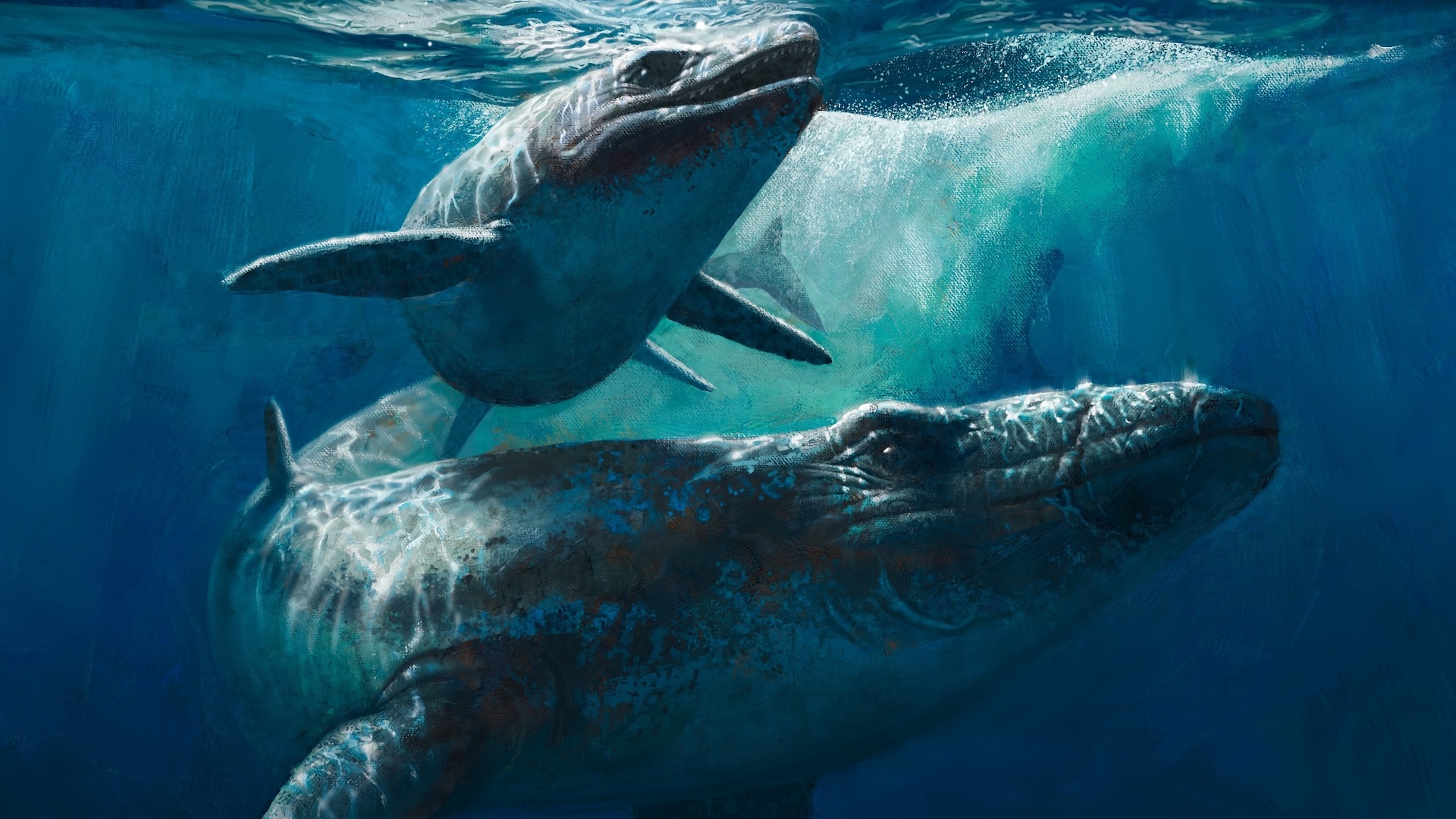
A never-before-seen mosasaur species first described in 2021 may be based on forged fossils, a new study suggests.
Researchers are now calling for computed tomography (CT) scans of the remains to verify whether the 72.1 to 66 million-year-old jaw is real after finding a number of discrepancies that indicate it is a fake.
If this fossil is indeed a forgery, it “should be established in the published literature that this is a fake,” study lead author Henry Sharpe, a researcher at the University of Alberta, told Live science.
The scientists behind the original study described the species, named Xenodens calminechari, from a partial jaw bone and four sharp teeth unearthed in a phosphate mine in Morocco’s Khouribga province. Those teeth prompted the team in 2021 to make claims about its uniqueness, and these are key to the doubts raised in the new study, which was published Dec. 16, 2024, in the journal The Anatomical Record.
Mosasaurs were predatory marine reptiles that dominated the oceans during the Cretaceous period (145 million to 66 million years ago). They were hugely diverse, reaching lengths of between 10 and 50 feet (3 to 15 meters) feet. They also had varying tooth shapes befitting their different diets. The 2021 team claimed that X. calminechari had “small, short, bladelike teeth packed together to form a saw-like cutting edge.” This, the team said, was not only “unique among squamata” — the order to which mosasaurs belong — but also among tetrapods, or four-limbed vertebrates.
Related: 80 million-year-old sea monster jaws filled with giant globular teeth for crushing prey discovered in Texas
This caught Sharpe’s attention. What began as an exercise in critical review revealed troubling contradictions in mosasaur biology, coupled with concerns about the fossil’s provenance.
Two of the mosasaur’s closely-packed teeth sit in one tooth socket. This conflicts with all other known mosasaur species, in which each tooth has its own socket, according to the new study. Rather than being constructed out of bone from the jaw, tooth sockets are “made by bone that develops from the tooth itself. Each tooth crown makes its own house,” said study co-author Michael Caldwell, a professor of biological sciences at the University of Alberta. In other words, there should be only one tooth per socket.
Mosasaurs “replaced their teeth continuously throughout their lives,” he told Live Science. “Every time one of these teeth is resorbed and falls out, there’s a huge pit left over. And that’s because the next tooth is coming into that hole to build all that tissue back up again so that it’s firmly anchored in the jaw.”
Additionally, rather than sitting flush within the jaw, two of the teeth also appear to have a little material, or “medial overlap,” extending over them on one side. That overlap shouldn’t be there in normal mosasaur tooth development. “The fact that there’s that medial overlap is a huge indicator” of a possible forgery, study co-author Mark Powers, PhD candidate at the University of Alberta, told Live Science.
The fossil wasn’t excavated by paleontologists, and the phosphate mine it was found in is from an area known for fossils with forged features, according to the study.
Sharpe and his colleagues hoped to CT scan the fossil to determine whether it was a forgery, but reaching out to Nick Longrich, a paleontologist from the University of Bath and lead author of the 2021 paper, about the fossil proved problematic.
According to Sharpe, Longrich asked if they were writing a paper and “if so, what’s the angle of that paper?” That raised “immediate red flags,” Sharpe said. “That’s the holotype” — the official specimen that represents a new species. He added that scientists cannot withhold information about a holotype or the holotype itself because other researchers don’t support your hypothesis. “That’s totally unethical that he would even request that,” he added.
Longrich did not respond to a request for comment about the claims in the new study.
Paulina Jiménez-Huidobro, a paleontologist at the University of Bonn who was not involved in either study, agrees with the conclusions of this latest paper, noting that the “dentition looks unusual in both morphology and implantation.” Having multiple teeth in one socket suggests “that those teeth do not belong to that jaw,” she told Live Science.
“It is unfortunate that Xenodens could not be scanned,” she added. “CT scans allow us to see internal structures and to distinguish different materials based on their densities.”
Wahiba Bel Haouz, a researcher at Morocco’s University of Hassan II Casablanca, who was also not involved in the research, said the country doesn’t yet have “legislation to protect and preserve our fossil heritage.” She said foreign scientists should always collaborate with Moroccans to avoid working on forgeries.
