Close Menu
  • Home
  • UNSUBSCRIBE
  • News
  • Lifestyle
  • Tech
  • Entertainment
  • Sports
  • Travel
Facebook X (Twitter) WhatsApp
Trending
  • Do you really have to wash rice before you cook it?
  • Neuroscientists are searching for the ‘cellular substrate of loneliness’
  • Bow-Wow, Ding-Dong, Pooh-Pooh: Expert explains early theories of how human language evolved — and their silly names
  • Famous child mummies in Andes may belong to kids who were sacrificed to ‘ritually anchor’ the Inca’s presence as their empire expanded
  • Artemis II crew captures rare double auroras on the dark side of Earth as they zoom toward the moon — Space photo of the week
  • Has all the water on Earth been peed before?
  • ‘This might be the point of no return’: Experts on the current measles outbreak and where we go from here
  • NASA’s experimental X-59 jet breaks sound barrier for 1st time in step toward ‘quiet supersonic’ technology
Facebook X (Twitter) WhatsApp
Baynard Media
  • Home
  • UNSUBSCRIBE
  • News
  • Lifestyle
  • Tech
  • Entertainment
  • Sports
  • Travel
Baynard Media
Home»Lifestyle»Dancing dwarf: A 2,300-year-old ancient Egyptian statue of a godlike man with a muscular 6-pack
Lifestyle

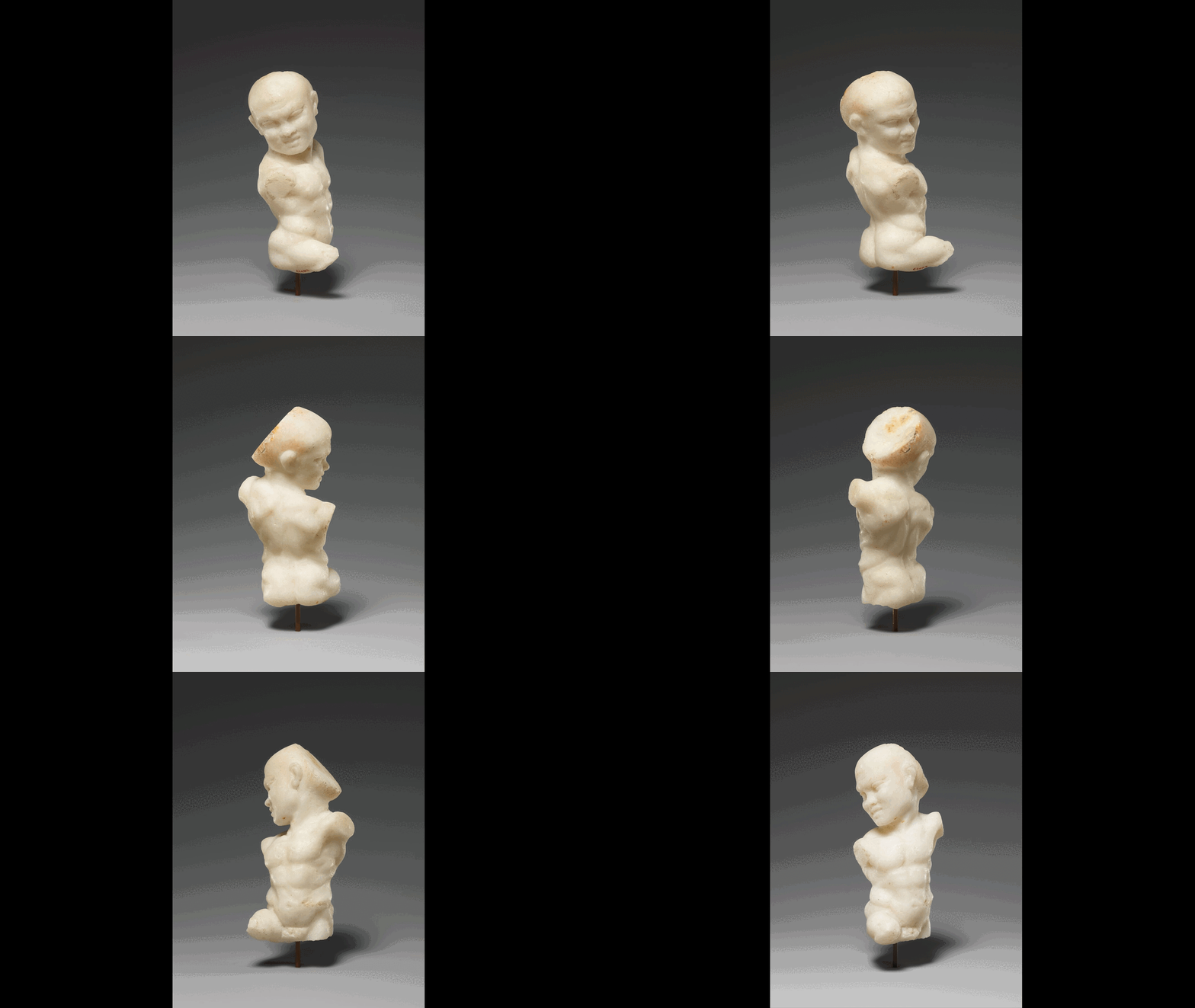
Dancing dwarf: A 2,300-year-old ancient Egyptian statue of a godlike man with a muscular 6-pack

EditorBy EditorJanuary 6, 2025No Comments2 Mins Read
Share Facebook Twitter Pinterest LinkedIn Tumblr Reddit Telegram Email
Share
Facebook Twitter LinkedIn Pinterest Email

What it is: A marble statuette

Where it is from: Alexandria, Egypt

When it was made: Sometime between 332 and 150 B.C., during the Ptolemaic period

Related: 2,000-year-old RSVP: A birthday invitation from the Roman frontier that has the earliest known Latin written by a woman

What it tells us about the past:

This marble statuette depicts a dwarf-dancer, which was a common motif in ancient Mediterranean art. But while examples from Greece were usually exaggerated or grotesque, suggesting dwarves were stigmatized, this one from Egypt shows that dwarves were honored members of the culture, rather than caricatured.

The sculpture — just 4 inches (10 centimeters) tall — depicts a nude man whose torso is twisted in a way that implies movement. His arms and legs are missing, as well as the back of his head. The statuette is on display at the Metropolitan Museum of Art in New York City.

Get the world’s most fascinating discoveries delivered straight to your inbox.

The Met notes that the statuette combines the classical Greek tradition of nudity with a highly skilled rendering of the man’s musculature in the later Hellenistic style which, combined with its discovery in Egypt, suggests that there was strong interest in depicting different human body types in the Ptolemaic period. During this dynasty, Egypt was ruled by Ptolemy I Soter I, a general of Alexander the Great who took over part of the empire following the Macedonian king’s death.

MORE ASTONISHING ARTIFACTS

But dwarves in Egyptian culture far predate the Ptolemies. Early written records in Egypt from four millennia ago mention dwarfs and pygmies associated with the households of nobles and pharaohs, where they were usually held in high esteem. Part of this esteem may be related to the Egyptian god Bes who, according to the Ashmolean Museum, is usually depicted as being very short with strong muscles and an expressive face. Bes was a warrior and protector who watched over women in childbirth. He was also a dancer who frequently played the tambourine.

According to The Met, this marble dwarf-dancer, who may have held an ancient percussion instrument, is thus part of “the long Egyptian tradition in which dwarves were integrated in society and had, in general, positive associations.”

Source link

Share. Facebook Twitter Pinterest LinkedIn Tumblr Email
Previous ArticleDivine Iheme: British sprinter dubbed ‘the new Noah Lyles’ breaks 60m age 15 world record twice | Athletics News
Next Article FoCais Rec: Meet One combines AI recording, transcription, and summarization in 120+ languages
Editor
  • Website

Related Posts

Lifestyle

Do you really have to wash rice before you cook it?

June 15, 2026
Lifestyle

Neuroscientists are searching for the ‘cellular substrate of loneliness’

June 14, 2026
Lifestyle

Bow-Wow, Ding-Dong, Pooh-Pooh: Expert explains early theories of how human language evolved — and their silly names

June 14, 2026
Add A Comment

Comments are closed.

Categories
  • Entertainment
  • Lifestyle
  • News
  • Sports
  • Tech
  • Travel
Recent Posts
  • Do you really have to wash rice before you cook it?
  • Neuroscientists are searching for the ‘cellular substrate of loneliness’
  • Bow-Wow, Ding-Dong, Pooh-Pooh: Expert explains early theories of how human language evolved — and their silly names
  • Famous child mummies in Andes may belong to kids who were sacrificed to ‘ritually anchor’ the Inca’s presence as their empire expanded
  • Artemis II crew captures rare double auroras on the dark side of Earth as they zoom toward the moon — Space photo of the week
calendar
June 2026
M T W T F S S
1234567
891011121314
15161718192021
22232425262728
2930  
« May    
Recent Posts
  • Do you really have to wash rice before you cook it?
  • Neuroscientists are searching for the ‘cellular substrate of loneliness’
  • Bow-Wow, Ding-Dong, Pooh-Pooh: Expert explains early theories of how human language evolved — and their silly names
About

Welcome to Baynard Media, your trusted source for a diverse range of news and insights. We are committed to delivering timely, reliable, and thought-provoking content that keeps you informed
and inspired

Categories
  • Entertainment
  • Lifestyle
  • News
  • Sports
  • Tech
  • Travel
Facebook X (Twitter) Pinterest WhatsApp
  • Contact Us
  • About Us
  • Privacy Policy
  • Disclaimer
  • UNSUBSCRIBE
© 2026 copyrights reserved

Type above and press Enter to search. Press Esc to cancel.