Close Menu
  • Home
  • UNSUBSCRIBE
  • News
  • Lifestyle
  • Tech
  • Entertainment
  • Sports
  • Travel
Facebook X (Twitter) WhatsApp
Trending
  • The US government wants to mine more lithium, but there may not be enough water to do it, study finds
  • NASA’s Perseverance rover finds record-breaking trove of carbon molecules at Bright Angel rock formation on Mars
  • Some of the last surviving Neanderthals were remarkably diverse ‪—‬ suggesting inbreeding didn’t doom them
  • 'This is the next jump in technology': World's first sub-1nm chip keeps Moore's Law alive a little longer
  • Scientists find thousands of earthquakes in a perfectly straight line in Alaska, revealing a hidden ‘microplate’
  • ‘You can’t patch your way out of it’: Cheap AI worm can spread between devices without human guidance — but how did scientists create it?
  • Diagnostic dilemma: After taking a medicine for years, a man suddenly had weird changes in his taste that made food disgusting
  • ‘A weird result from an already weird hominin’: Archaeologists discover all Homo naledi skeletons found in South African cave are female
Facebook X (Twitter) WhatsApp
Baynard Media
  • Home
  • UNSUBSCRIBE
  • News
  • Lifestyle
  • Tech
  • Entertainment
  • Sports
  • Travel
Baynard Media
Home»News»NASA’s solar probe flies closer to the sun than any human-made object ever
News

NASA’s solar probe flies closer to the sun than any human-made object ever

EditorBy EditorDecember 24, 2024No Comments3 Mins Read
Share Facebook Twitter Pinterest LinkedIn Tumblr Reddit Telegram Email
Share
Facebook Twitter LinkedIn Pinterest Email

The Summary

  • NASA’s Parker Solar Probe dove extremely close to the solar surface on Dec. 24.
  • The spacecraft should get nearer to the sun than any other human-made object in history — within 3.86 million miles.
  • The mission was designed to study the sun’s outer atmosphere and help researchers learn about how solar storms erupt into space.

NASA “tasted” the sun on Christmas Eve.

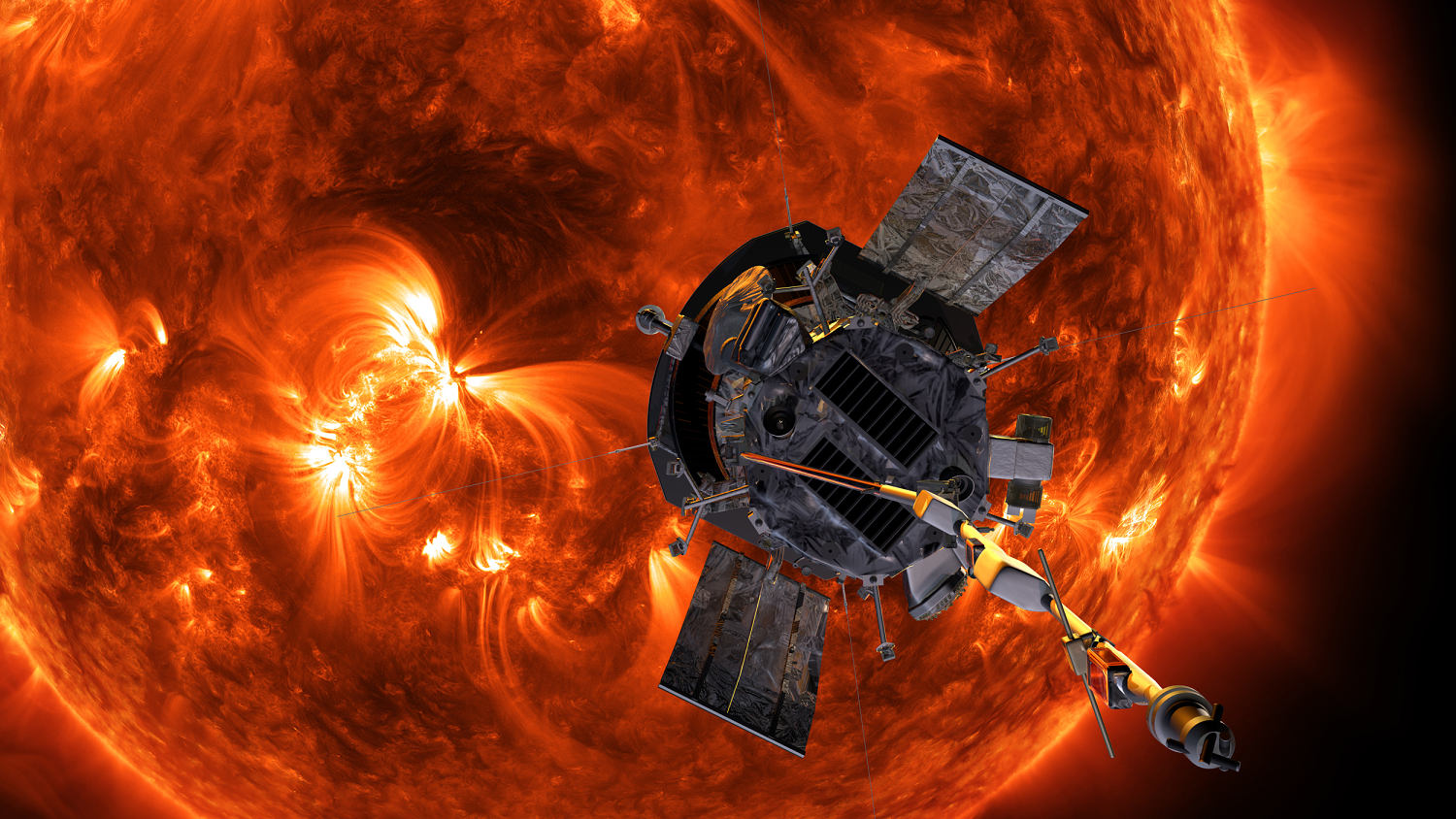
The agency’s Parker Solar Probe made its closest-ever approach to the sun on Tuesday, swooping nearer to our star than any other human-made object in history.

The spacecraft, which is about the size of a small car, dove within 3.86 million miles of the solar surface at around 6:53 a.m. ET on Tuesday, flying by at about 430,000 mph, according to NASA.

“If you can imagine, it’s like going 96% of the way there to the sun’s surface,” said Kelly Korreck, a program scientist in NASA’s heliophysics division.

Mission controllers weren’t able to communicate with the probe during the maneuver, and will have to wait about three days to pick up a signal that the spacecraft survived its rendezvous with the sun.

If all went well, the first images from the close encounter will likely be beamed back to Earth sometime in January, the agency said.

As the Parker Solar Probe swoops close to the sun, it will likely fly through plumes of solar plasma and could even dive into active regions of the star, Korreck said.

The mission was designed to study the outermost part of the sun’s atmosphere, an ultrahot region known as the corona. Scientists are keen to observe the corona up close because researchers have long puzzled over why the outer layer of the sun’s atmosphere is hundreds of times hotter than the star’s surface.

Observing the corona will also help researchers study how storms that brew on the sun’s surface erupt into space. The probe will, for instance, be able to observe streams of the highest-energy solar particles as they are hurled from the sun, exploding into the cosmos at supersonic speeds.

“This is the birthplace of space weather,” Korreck said. “We’ve observed space weather from afar, but now Parker is living through it. Now we’ll be able to understand better how space weather forms, and when we see storms on the sun in our telescopes, we’ll be able to say what that means for us here on Earth.”

During periods of intense space weather, the sun can unleash giant solar flares and streams of charged particles, known as solar wind, directly at Earth. When these outbursts interact with our planet’s magnetic field, they can damage satellites and knock out power grids — along with supercharging the northern lights.

Korreck said the Parker Solar Probe mission will help researchers better forecast space weather and its potential consequences, similar to the work that meteorologists and atmospheric scientists do for weather on Earth.

The Parker probe launched into space in 2018 and has circled the sun more than 20 times since then. The Christmas Eve flyby will be the first of three final close swings planned for the mission. The spacecraft was named for Eugene Parker, a pioneering astrophysicist at the University of Chicago who first theorized the existence of solar wind. Parker died in 2022 at the age of 94.

Last month, the spacecraft flew by Venus in a maneuver that was designed to help slingshot the probe close to the sun. The close approach was timed to coincide with the most active period of the sun’s 11-year cycle of activity. This busy phase, which is typically characterized by a flurry of solar storms and high magnetic activity, is known as the solar maximum.

Source link

Share. Facebook Twitter Pinterest LinkedIn Tumblr Email
Previous Article$8 Tees, $34 Leggings & More
Next Article Michael van Gerwen: Three-time darts world champion not retiring for at least another 10 years | Darts News
Editor
  • Website

Related Posts

News

Omar files new financial form in response to Trump, GOP critics

April 21, 2026
News

Ex-CENTCOM commanderwarns against ‘risky’ US ground op to seize Iran uranium

April 21, 2026
News

Santa Ana’s Upcoming Report on Police Firing on ICE Protesters Lacks Details

April 21, 2026
Add A Comment

Comments are closed.

Categories
  • Entertainment
  • Lifestyle
  • News
  • Sports
  • Tech
  • Travel
Recent Posts
  • The US government wants to mine more lithium, but there may not be enough water to do it, study finds
  • NASA’s Perseverance rover finds record-breaking trove of carbon molecules at Bright Angel rock formation on Mars
  • Some of the last surviving Neanderthals were remarkably diverse ‪—‬ suggesting inbreeding didn’t doom them
  • 'This is the next jump in technology': World's first sub-1nm chip keeps Moore's Law alive a little longer
  • Scientists find thousands of earthquakes in a perfectly straight line in Alaska, revealing a hidden ‘microplate’
calendar
June 2026
M T W T F S S
1234567
891011121314
15161718192021
22232425262728
2930  
« May    
Recent Posts
  • The US government wants to mine more lithium, but there may not be enough water to do it, study finds
  • NASA’s Perseverance rover finds record-breaking trove of carbon molecules at Bright Angel rock formation on Mars
  • Some of the last surviving Neanderthals were remarkably diverse ‪—‬ suggesting inbreeding didn’t doom them
About

Welcome to Baynard Media, your trusted source for a diverse range of news and insights. We are committed to delivering timely, reliable, and thought-provoking content that keeps you informed
and inspired

Categories
  • Entertainment
  • Lifestyle
  • News
  • Sports
  • Tech
  • Travel
Facebook X (Twitter) Pinterest WhatsApp
  • Contact Us
  • About Us
  • Privacy Policy
  • Disclaimer
  • UNSUBSCRIBE
© 2026 copyrights reserved

Type above and press Enter to search. Press Esc to cancel.