Close Menu
  • Home
  • UNSUBSCRIBE
  • News
  • Lifestyle
  • Tech
  • Entertainment
  • Sports
  • Travel
Facebook X (Twitter) WhatsApp
Trending
  • George Kittle’s wife shares live reaction to Achilles injury
  • ‘The scientific cost would be severe’: A Trump Greenland takeover would put climate research at risk
  • Headlines Across OC as Angel Stadium Sale Debate Intensifies
  • Anti-Islam activists clash with pro-Muslim counter-protesters in Dearborn, Michigan
  • Best monitor deal: Get the 45-inch LG Ultragear gaming monitor for its lowest price yet
  • Slovakia U21 0 – 4 England U21
  • 13 Top Sleep Products That Transform Your Bedtime Routine for Better Rest
  • Firefighters rescue puppies from burning house
Facebook X (Twitter) WhatsApp
Baynard Media
  • Home
  • UNSUBSCRIBE
  • News
  • Lifestyle
  • Tech
  • Entertainment
  • Sports
  • Travel
Baynard Media
Home»Lifestyle»9 best things to see in the night sky with binoculars
Lifestyle

9 best things to see in the night sky with binoculars

EditorBy EditorMarch 4, 2025No Comments5 Mins Read
Share Facebook Twitter Pinterest LinkedIn Tumblr Reddit Telegram Email
Share
Facebook Twitter LinkedIn Pinterest Email

Looking up at the night sky is awe-inspiring, but add a pair of binoculars, and suddenly, the heavens come alive in spectacular detail. Star clusters sparkle, distant galaxies reveal themselves and nebulas glow. There are even a couple of eclipses coming up that will demand a close-up, like the total lunar eclipse on March 13-14.

Choose a pair of the best stargazing binoculars — with specs like 8×42, 7×50 or 10×50, or thereabouts — and another layer of the night sky will be unlocked. Here’s what to look at in a pair of binoculars from February to April.

If you want to get even closer to the night sky, the best telescopes will give you that extra bit of power.

9 best things to see with binoculars between February to April 2025

The moon and total lunar eclipse

phases of a total lunar eclipse above the countryside

The total lunar eclipse on March 13-14 is an excellent target to observe with binoculars. (Image credit: Getty Images)

The lunar surface itself is an excellent target for binoculars, with dark areas and ancient lava fields called maria easily visible. You can look at the moon at any time — most conveniently soon after sunset between the new moon and the full moon — but don’t miss the total lunar eclipse on March 13-14, 2025, if you’re in North or South America. During that event, the lunar surface will turn a reddish-pink for 65 minutes (hence the name ‘blood moon’).

The Pleiades (M45)
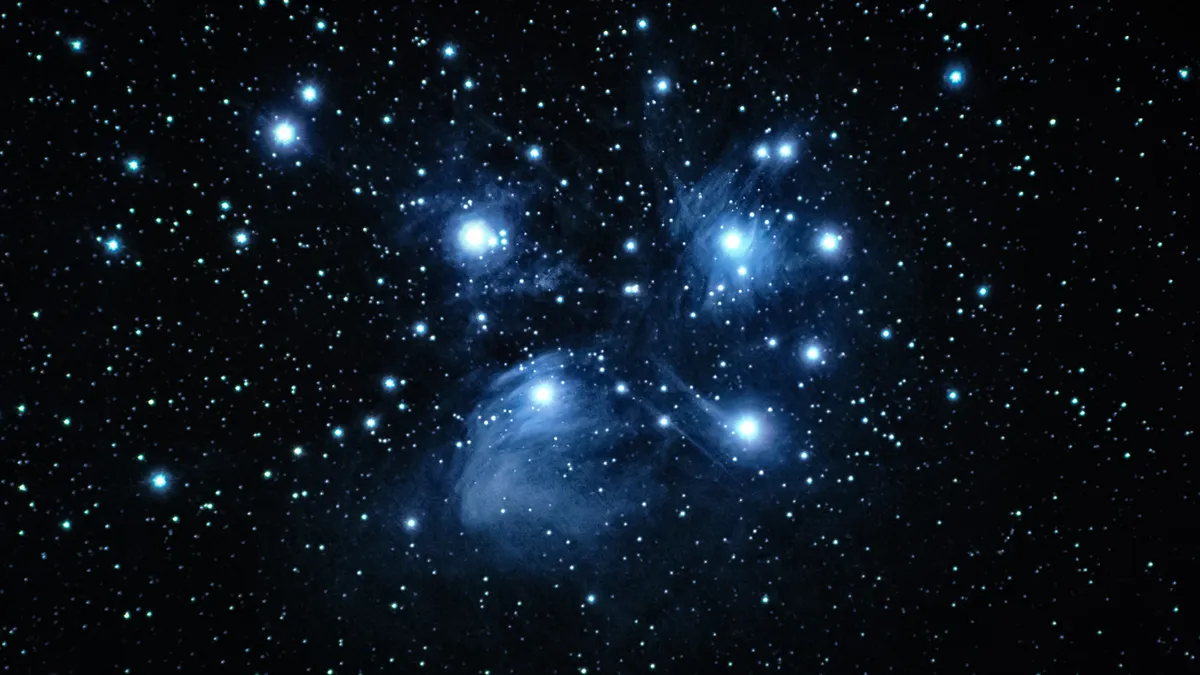
A picture of Messier 45, known as the pleiades star cluster or the Seven Sisters.

The Pleiades shine bright through a pair of the best binoculars. (Image credit: LazyPixel/Brunner Sébastien via Getty Images)

Pronounced ‘Plee-er-Deez’, this sparkling open cluster of stars totals six or seven visible to the naked eye (hence the nickname ‘The Seven Sisters’) and about 100 stars in a pair of the best binoculars. A bright object in the constellation Taurus, the Pleiades will be closely visited by the moon on March 5, April 1 and April 29, 2025.

Orion’s Sword

Orion Nebula

You’ll spot the Orion nebula within Orion’s sword. (Image credit: Getty Images)

The closest star-forming region to the solar system, the Orion Nebula (M42) is easy to find with the naked eye but looks its best through any pair of binoculars. Just find the fuzzy but bright patch known as Orion’s Sword below the three stars in Orion’s Belt, and you’re there. It’s best seen from January to April.

The ’S’ in Orion’s Belt

Orion's belt

Orion’s belt is a popular stargazing target with the naked eye, and it looks even better through binoculars. (Image credit: Getty Images)

All stars look like points of light in a pair of binoculars, so they don’t generally make for great targets. One exception is Orion’s Belt, which is an instantly recognizable line of three equally spaced stars — Alnitak, Alnilam and Mintaka. Winding between the latter two stars is a lovely S-shape of stars. It’s a staple of the binocular night sky from January to April.

Hyades Cluster

Hyades star cluster, Pleiades star cluster, Mars and Aldebaran

The Hyades star cluster surrounding the red giant, Aldebaran (left), with Mars (center) and the Pleiades (right). (Image credit: Getty Images)

The V-shape of stars in the Hyades, in the constellation Taurus, is a classic binocular site that in close-up reveals hundreds of stars. At just 151 light-years distant, the Hyades is the closest open cluster of stars to the solar system. Its main bright star may appear to be the red giant Aldebaran, the ‘eye of the bull’, but it’s unrelated to the Hyades and lies just 65 light-years away. It’s best seen from January to April.

The sun and solar eclipses
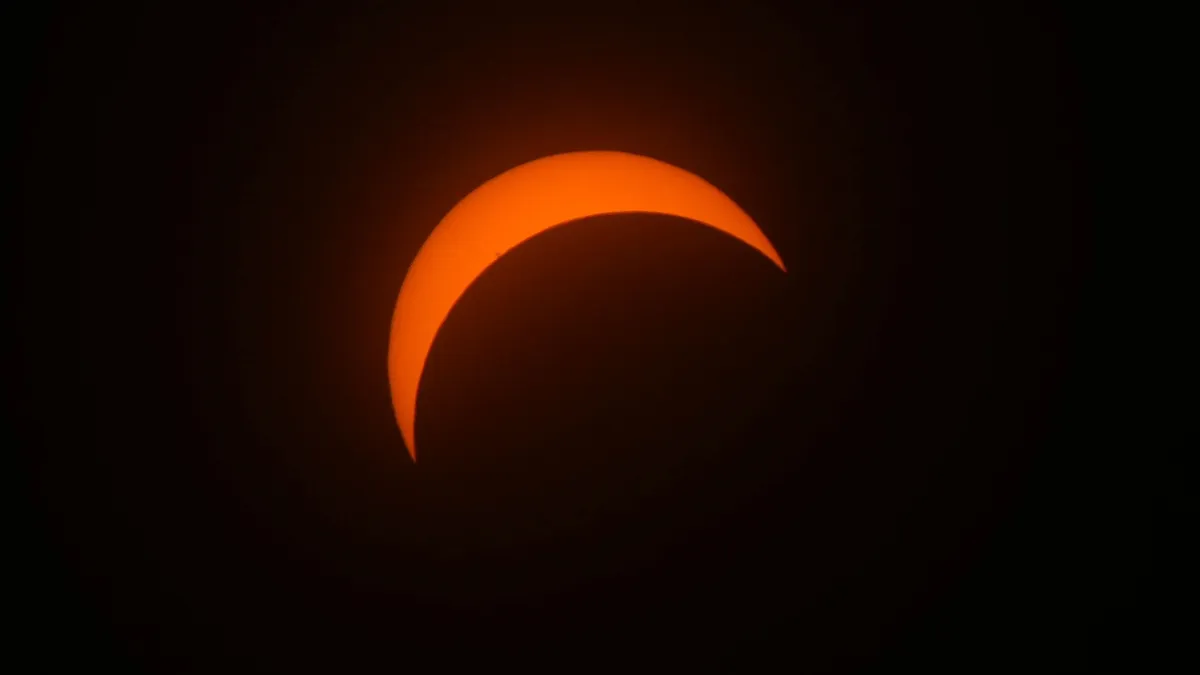
A partial solar eclipse showing the sun as a narrow red crescent

There will be a partial solar eclipse on March 29, 2025. (Image credit: Kirby Lee / Contributor via Getty Images)

If you can find some solar filters for your binoculars — or buy some special solar binoculars — then 2025 is the perfect year to get eyes on the sun. When it’s close to solar maximum, its once-every-11-years peak in activity, sunspots are typically visible every day. As a bonus, there is a partial solar eclipse on March 29, 2025, which will be visible at sunrise from eastern Canada and the northeastern U.S. as well as Europe and northwest Africa.

Beehive Cluster (M44)
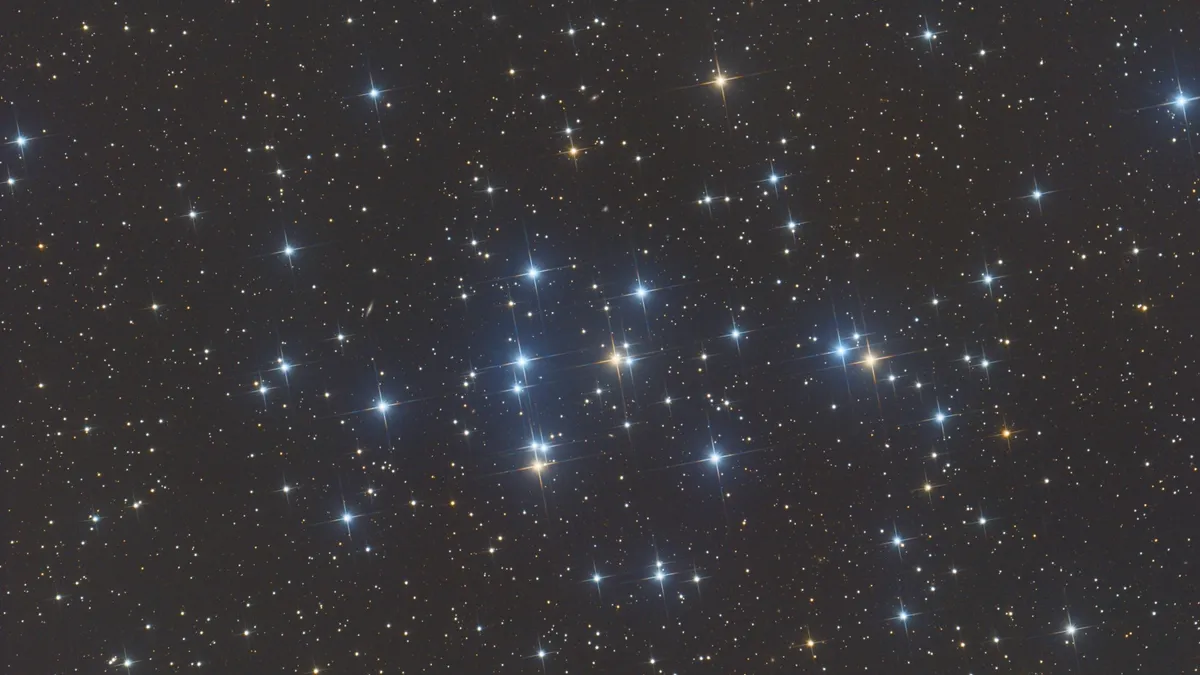
Several bright stars of the Beehive Cluster, a group of roughly 1,000 tight-knit stars

The Beehive Cluster is one of the most beautiful sights to see with binoculars. (Image credit: Fried Lauterbach/ CC BY-SA 4.0)

Perhaps the most beautiful star cluster to see through a pair of binoculars is the Beehive Cluster in the constellation Cancer. Best seen from February to April between the constellations Leo and Gemini (the latter of which has Mars in attendance), M44 displays hundreds of stars in binoculars.

Andromeda Galaxy (M31)
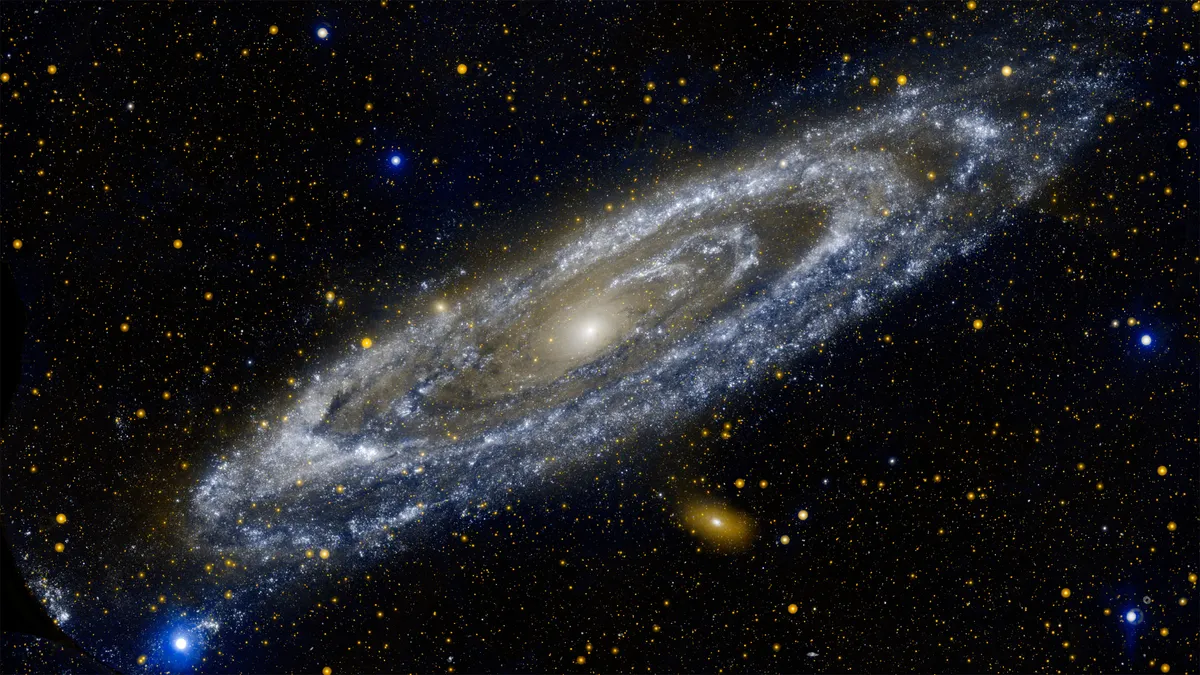
Our largest galactic neighbor, the Andromeda galaxy (or M31) sits about 2.5 million light-years away and spans some 260,000 light-years across.

Our closest neighbor, Andromeda, is seen as a fuzzy patch of light through binoculars. (Image credit: NASA/JPL-Caltech)

The farthest object it’s possible to see in the night sky with the naked eye, Andromeda nevertheless only truly impresses in a pair of binoculars. At ‘just’ 2.5 million light-years distant, this close galaxy to our Milky Way is visible halfway between the W-shaped constellation of Cassiopeia and the star Alpheratz in the ‘Great Square’ of Pegasus, in the western sky just after dark during spring. It looks like a fuzzy patch of light, so use the averted vision technique to see it: look slightly to the side of M31, and your peripheral vision — which is more sensitive to brightness — will better appreciate what a spectacular object this is.

The ‘Horse and Rider’

Ursa Major constellation

The double star known as the ‘horse and rider’, Mizar and Alcor, pictured second from the left. (Image credit: Getty Images)

Binoculars can reveal intriguing double stars. Those with keen eyesight can look at the star Mizar in the constellation Ursa Major — better known as the Big Dipper or Plough asterism — and see two stars. However, this is far easier to do using a pair of binoculars. Mizar has a dimmer companion called Alcor, which is easy to split with a pair of binoculars. Known as the ‘horse and rider’, the two stars — about 82 light-years distant — don’t orbit each other. They’re visible to those in the northern hemisphere for most of the year, apart from fall.

Source link

Share. Facebook Twitter Pinterest LinkedIn Tumblr Email
Previous ArticleSnakes: Facts about one of the most iconic creatures is animal hiss-tory
Next Article The fight to replace Ron DeSantis in Florida is on, marked by jockeying with Trump
Editor
  • Website

Related Posts

Lifestyle

‘The scientific cost would be severe’: A Trump Greenland takeover would put climate research at risk

January 17, 2026
Lifestyle

New ‘Transformer’ humanoid robot can launch a shapeshifting drone off its back — watch it in action

November 19, 2025
Lifestyle

Medieval spear pulled from Polish lake may have belonged to prince or nobleman

November 19, 2025
Add A Comment

Comments are closed.

Categories
  • Entertainment
  • Lifestyle
  • News
  • Sports
  • Tech
  • Travel
Recent Posts
  • George Kittle’s wife shares live reaction to Achilles injury
  • ‘The scientific cost would be severe’: A Trump Greenland takeover would put climate research at risk
  • Headlines Across OC as Angel Stadium Sale Debate Intensifies
  • Anti-Islam activists clash with pro-Muslim counter-protesters in Dearborn, Michigan
  • Best monitor deal: Get the 45-inch LG Ultragear gaming monitor for its lowest price yet
calendar
February 2026
M T W T F S S
 1
2345678
9101112131415
16171819202122
232425262728  
« Jan    
Recent Posts
  • George Kittle’s wife shares live reaction to Achilles injury
  • ‘The scientific cost would be severe’: A Trump Greenland takeover would put climate research at risk
  • Headlines Across OC as Angel Stadium Sale Debate Intensifies
About

Welcome to Baynard Media, your trusted source for a diverse range of news and insights. We are committed to delivering timely, reliable, and thought-provoking content that keeps you informed
and inspired

Categories
  • Entertainment
  • Lifestyle
  • News
  • Sports
  • Tech
  • Travel
Facebook X (Twitter) Pinterest WhatsApp
  • Contact Us
  • About Us
  • Privacy Policy
  • Disclaimer
  • UNSUBSCRIBE
© 2026 copyrights reserved

Type above and press Enter to search. Press Esc to cancel.