
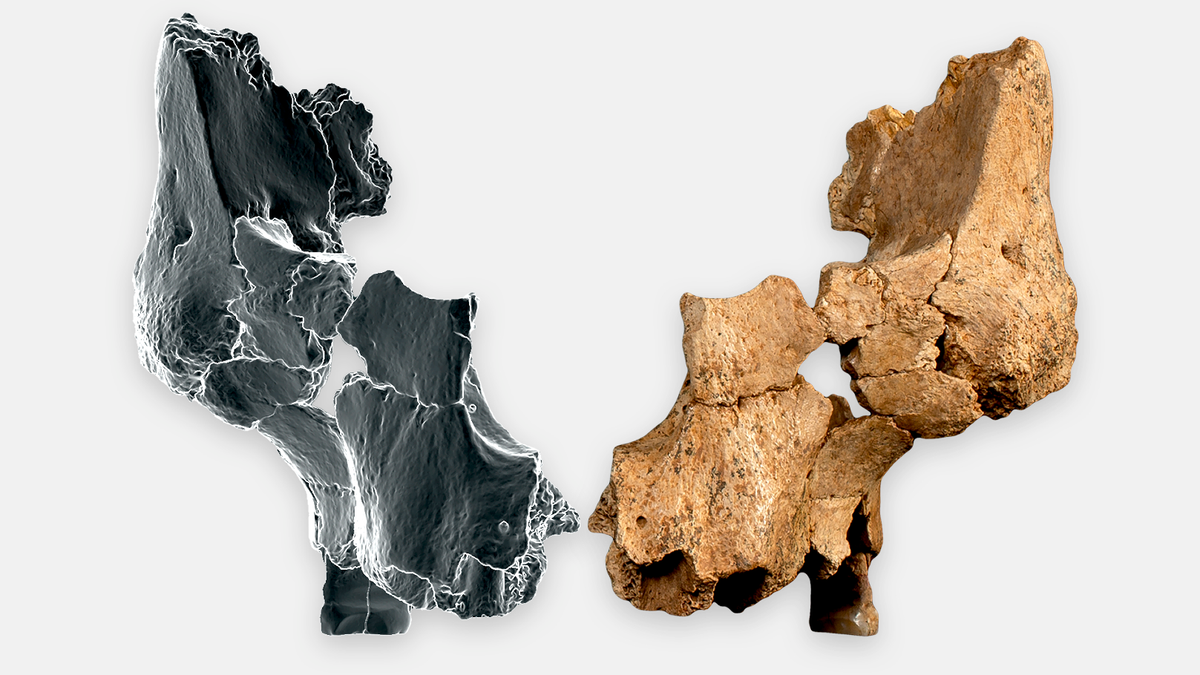
Fragments of a skull found in Spain reveal that human ancestors arrived in Western Europe far earlier than previously thought, a new study finds.
The bones were discovered in a cave in the Atapuerca Mountains that was already known as a spot used by Homo antecessor, the species that Neanderthals likely evolved from. But the new bones are hundreds of thousands of years older and shaped differently, suggesting that Homo erectus — an ancestor of modern humans — also lived in Europe during the Early Pleistocene (2.6 million to 800,000 years ago).
“This paper introduces a new actor into the study of human evolution in Europe,” Rosa Huguet, a paleoanthropologist at the Catalan Institute of Human Paleoecology and Social Evolution and lead author of a study published Wednesday (March 12) in the journal Nature, said at a news conference ahead of publication.
Huguet and colleagues found the facial bone fragments while excavating the cave site of Sima del Elefante (“Pit of the Elephant”) in 2022. When a student told Huguet they had found bones, “we were very excited,” Huguet said, “and in this moment, we thought — 95% sure — that we had a human remain.”
All of the fragments came from the left side of the face — specifically, the maxilla, or upper jaw and part of the cheek bone.
“We didn’t know at the beginning what specifically it was,” study co-author José María Bermúdez de Castro, a paleoanthropologist at the National Center for Research on Human Evolution in Spain, said at the news conference. But from the shape of the teeth, it was clear that the bones belonged to a human relative.
After more than two years of research, the team has published their analysis of the fragmentary skeleton, which they nicknamed “Pink” after Pink Floyd’s Dark Side of the Moon, calling it the “earliest human face of Western Europe.”
Related: 1.5 million-year-old footprints reveal our Homo erectus ancestors lived with a 2nd proto-human species

Homo erectus in Spain
This face is surprisingly different from that of H. antecessor, another early species found in Spain. H. antecessor remains have been found at several cave sites in the Atapuerca Mountains since 1994, and they date from 1.2 million years to 800,000 years ago. Similar to modern humans’ faces, the face of H. antecessor is flat and vertical.
But the new, fully reconstructed facial skeleton of “Pink” from Sima del Elefante is strikingly different from the previously discovered H. antecessor remains, suggesting it does not actually belong to that species as originally thought. It has a more robust face that projects outward, making it look more like our much-older H. erectus ancestors.
Experts think the first expansion of hominins out of Africa began around 1.8 million years ago, when H. erectus moved out through the Levantine corridor, a narrow strip of land that connects Africa to Eurasia. Although sites with H. erectus remains are found throughout East Africa and Asia, finds of this age in Western Europe are few and far between.
This means the first hominin to make it to Western Europe was not H. antecessor as previously assumed, but probably H. erectus, at least 1.4 million years ago. Because “Pink” has some anatomical features that do not fit exactly with H. erectus, the team described it in their study as “H. aff. erectus,” where “aff.” means “affinis” or “similar to” in Latin.
Based on the worn molars, the team concluded that “Pink” was an adult. But because so little of the skeleton remains, they were unable to figure out if the individual was male or female. Future paleoproteomic analysis of the tooth enamel, which has proteins that can indicate an individual’s sex, may eventually reveal this information.
This is the third time that members of this research team have discovered hominin fossils in unexpectedly deep layers in this collection of caves, said study co-author María Martinón-Torres, a paleoanthropologist at the National Center for Research on Human Evolution.

In 1997, H. antecessor was first assigned to bones found in the Atapuerca Mountains dating to about 850,000 years ago, and in 2008, a couple layers above “Pink,” members of the team reported a fossil dated to 1.1 million to 1.2 million years ago as the “first hominin of Europe.” Although they are separated by hundreds of thousands of years, “Pink” may be the same species as the 2008 bones, according to Bermúdez de Castro.
In addition to bones, the team discovered stone tools at Sima del Elefante. The simple tools were made out of local quartz, chert and limestone, said study co-author Xosé Pedro Rodríguez-Álvarez, a prehistoric archaeologist at the Catalan Institute of Human Paleoecology and Social Evolution, and animal bones found at the site show evidence of human-created cut marks.
“Pink” provides further evidence that the Atapuerca Mountains formed an important corridor rich in natural resources that humans and animals passed through 1.4 million years ago, likely after arriving in the area from Eastern Europe.
But there are still questions about what happened around 1.1 million years ago. Harsh and cold climatic conditions may have led to the disappearance of H. aff. erectus, Bermúdez de Castro suggested, followed by the arrival of H. antecessor.
However, if the assumption of dramatic climate change in the Atapuerca Mountains is incorrect, it is possible that a residual population of H. aff. erectus coincided with H. antecessor for a short time, meaning two hominin species overlapped in Western Europe.
“The most important take-home message is that this fossil represents the earliest human fossil found so far in Western Europe,” Martinón-Torres said, “documenting a previously unknown human population in Europe.”
Work at Sima del Elefante and on “Pink” continues, Martinón-Torres said, including a search for more fossils to fully understand who these hominins were, where they came from, and what interactions they had with other hominins in the area.
Neanderthal quiz: How much do you know about our closest relatives?
